
Bit Brix
6.4k Posts

Bit Brix
 Square Verified+
Report
Block User
Early. Patient. Convicted. Built on-chain...
487 Following
30.1K+ Followers
10.0K+ Liked
Posts
All
Live
·
--
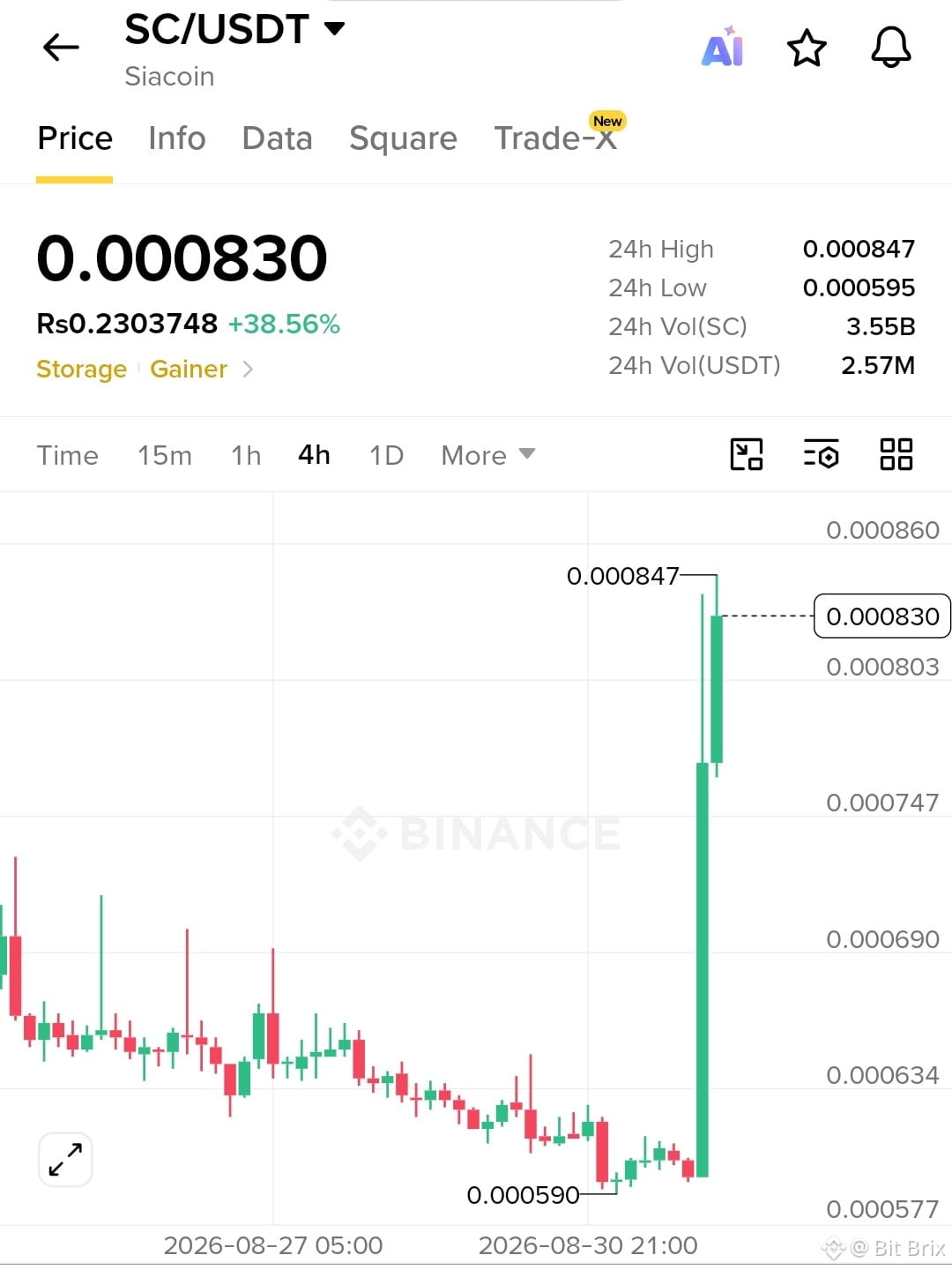
$SC is showing strong momentum after a sharp breakout from the 0.00059 area.
Entry: 0.00078–0.00080
TP: 0.000847 → 0.00090
SL: 0.000745
Don’t chase the candle. Let the retest confirm strength, then execute.
$SC is showing strong momentum after a sharp breakout from the 0.00059 area.
Entry: 0.00078–0.00080
TP: 0.000847 → 0.00090
SL: 0.000745
Don’t chase the candle. Let the retest confirm strength, then execute.
Entry: 0.00078–0.00080
TP: 0.000847 → 0.00090
SL: 0.000745
Don’t chase the candle. Let the retest confirm strength, then execute.
1
149
·
--
🎙️ Let's talk about the BNB spot market trend and DCA into BNB!
End
03 h 36 m 24 s
17.3k
36
39
·
--
🎙️ Bosses keep placing orders today dusk—more or less (bullish or bearish)?
End
02 h 45 m 19 s
11k
21
20
·
--
$KII
{alpha}(560xeec6574eabba52bac3f0277f2cd5ac7e67197886)
— EP 0.050229 | TP 0.0527 / 0.0552 | SL 0.0477
$DOS
{future}(DOSUSDT)
— EP 0.22376 | TP 0.2350 / 0.2460 | SL 0.2125
$QUID
{alpha}(84530x1a44233fae8d50f1aeb3a5d58dd426ff4814cb53)
— EP 0.064961 | TP 0.0682 / 0.0715 | SL 0.0617
Red market, but these levels are getting interesting.
Let's go $
$KII
— EP 0.050229 | TP 0.0527 / 0.0552 | SL 0.0477
$DOS
— EP 0.22376 | TP 0.2350 / 0.2460 | SL 0.2125
$QUID
— EP 0.064961 | TP 0.0682 / 0.0715 | SL 0.0617
Red market, but these levels are getting interesting.
Let's go $
— EP 0.050229 | TP 0.0527 / 0.0552 | SL 0.0477
$DOS
— EP 0.22376 | TP 0.2350 / 0.2460 | SL 0.2125
$QUID
— EP 0.064961 | TP 0.0682 / 0.0715 | SL 0.0617
Red market, but these levels are getting interesting.
Let's go $
$KII
55%
$DOS
35%
$QUID
10%
62 votes • Voting closed
1
4.7k
·
--
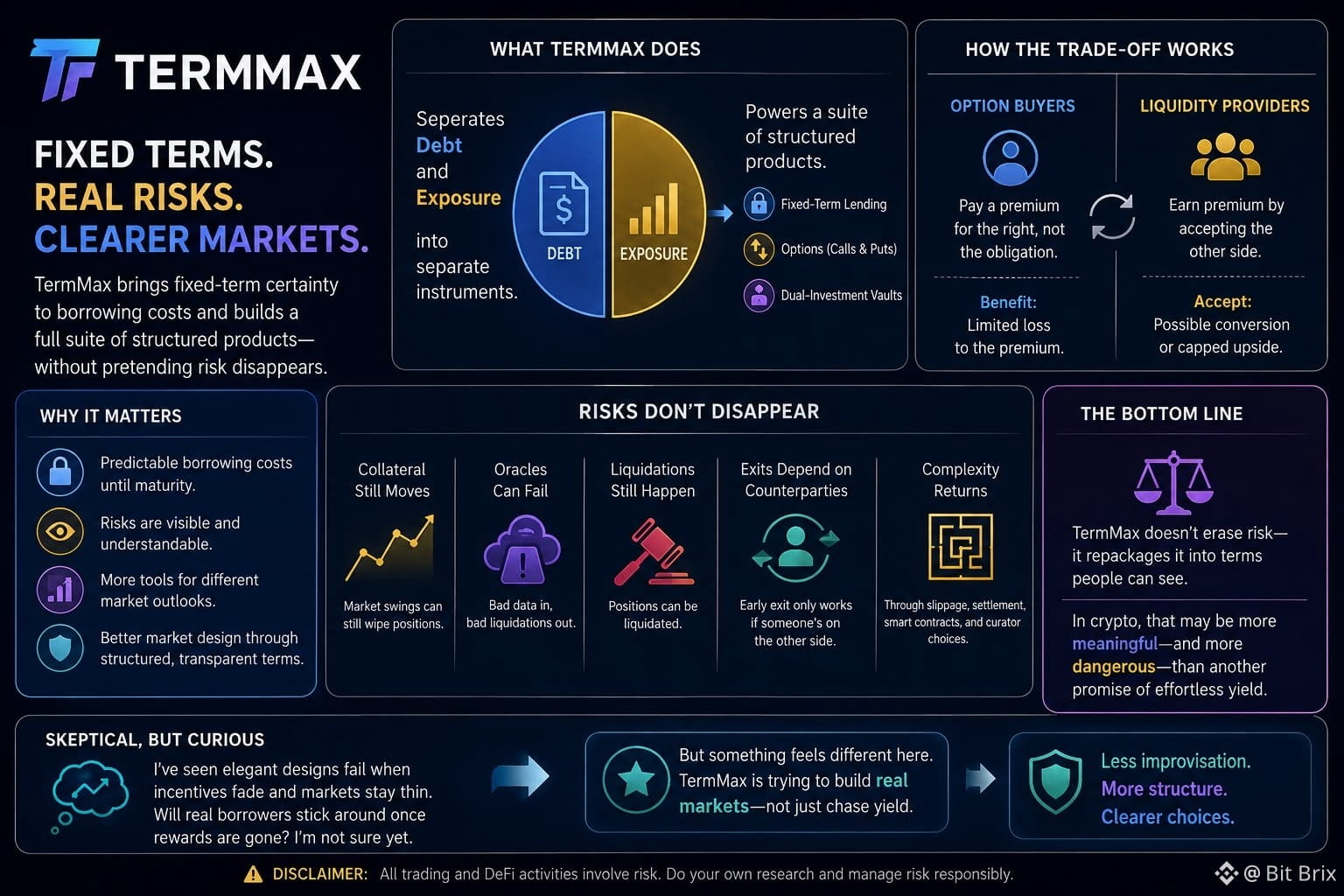
I'm noticing TermMax for a reason I didn't expect: it is trying to make crypto feel less improvised. I've watched lending protocols sell "certainty" before, only for rates, incentives, or liquidity to break the moment the market became inconvenient. A fixed borrowing cost until maturity is genuinely useful, but it doesn't make the rest of the position fixed. Collateral still moves. Oracles still fail. Liquidations still happen. And if you want out early, the exit is only as real as the counterparty waiting on the other side.
What keeps pulling my attention back is the way TermMax turns debt and exposure into separate instruments, then pushes the same machinery toward calls, puts, and dual-investment vaults. Option buyers can limit their loss to the premium; liquidity providers earn that premium by accepting the uglier side of the bargain—being converted into a falling token or selling away upside when price runs. That trade-off feels honest, at least on paper.
I've seen this before: elegant token design, thin markets, rewards masking weak organic demand. Fixed-term liquidity fragments easily, and complexity has a habit of returning through slippage, settlement, smart contracts, and curator choices. I don't fully trust it, and I’m not sure yet that enough real borrowers will stay once incentives fade. But something about this feels different. TermMax isn't pretending risk disappears; it is repackaging it into terms people can actually see. In crypto, that may be more meaningful—and more dangerous—than another promise of effortless yield.
#TermMax @termmax
I'm noticing TermMax for a reason I didn't expect: it is trying to make crypto feel less improvised. I've watched lending protocols sell "certainty" before, only for rates, incentives, or liquidity to break the moment the market became inconvenient. A fixed borrowing cost until maturity is genuinely useful, but it doesn't make the rest of the position fixed. Collateral still moves. Oracles still fail. Liquidations still happen. And if you want out early, the exit is only as real as the counterparty waiting on the other side.
What keeps pulling my attention back is the way TermMax turns debt and exposure into separate instruments, then pushes the same machinery toward calls, puts, and dual-investment vaults. Option buyers can limit their loss to the premium; liquidity providers earn that premium by accepting the uglier side of the bargain—being converted into a falling token or selling away upside when price runs. That trade-off feels honest, at least on paper.
I've seen this before: elegant token design, thin markets, rewards masking weak organic demand. Fixed-term liquidity fragments easily, and complexity has a habit of returning through slippage, settlement, smart contracts, and curator choices. I don't fully trust it, and I’m not sure yet that enough real borrowers will stay once incentives fade. But something about this feels different. TermMax isn't pretending risk disappears; it is repackaging it into terms people can actually see. In crypto, that may be more meaningful—and more dangerous—than another promise of effortless yield.
#TermMax @TermMax
What keeps pulling my attention back is the way TermMax turns debt and exposure into separate instruments, then pushes the same machinery toward calls, puts, and dual-investment vaults. Option buyers can limit their loss to the premium; liquidity providers earn that premium by accepting the uglier side of the bargain—being converted into a falling token or selling away upside when price runs. That trade-off feels honest, at least on paper.
I've seen this before: elegant token design, thin markets, rewards masking weak organic demand. Fixed-term liquidity fragments easily, and complexity has a habit of returning through slippage, settlement, smart contracts, and curator choices. I don't fully trust it, and I’m not sure yet that enough real borrowers will stay once incentives fade. But something about this feels different. TermMax isn't pretending risk disappears; it is repackaging it into terms people can actually see. In crypto, that may be more meaningful—and more dangerous—than another promise of effortless yield.
#TermMax @TermMax
167
·
--
Bullish
TermMax caught my attention for a pretty simple reason.
I’ve seen too many crypto trades go wrong because the asset wasn’t the problem — the financing was.
You enter a position when borrowing is cheap.
Then the market gets crowded. Rates move.
Suddenly the trade needs to be right just to pay for itself.
That’s the headache TermMax is trying to remove.
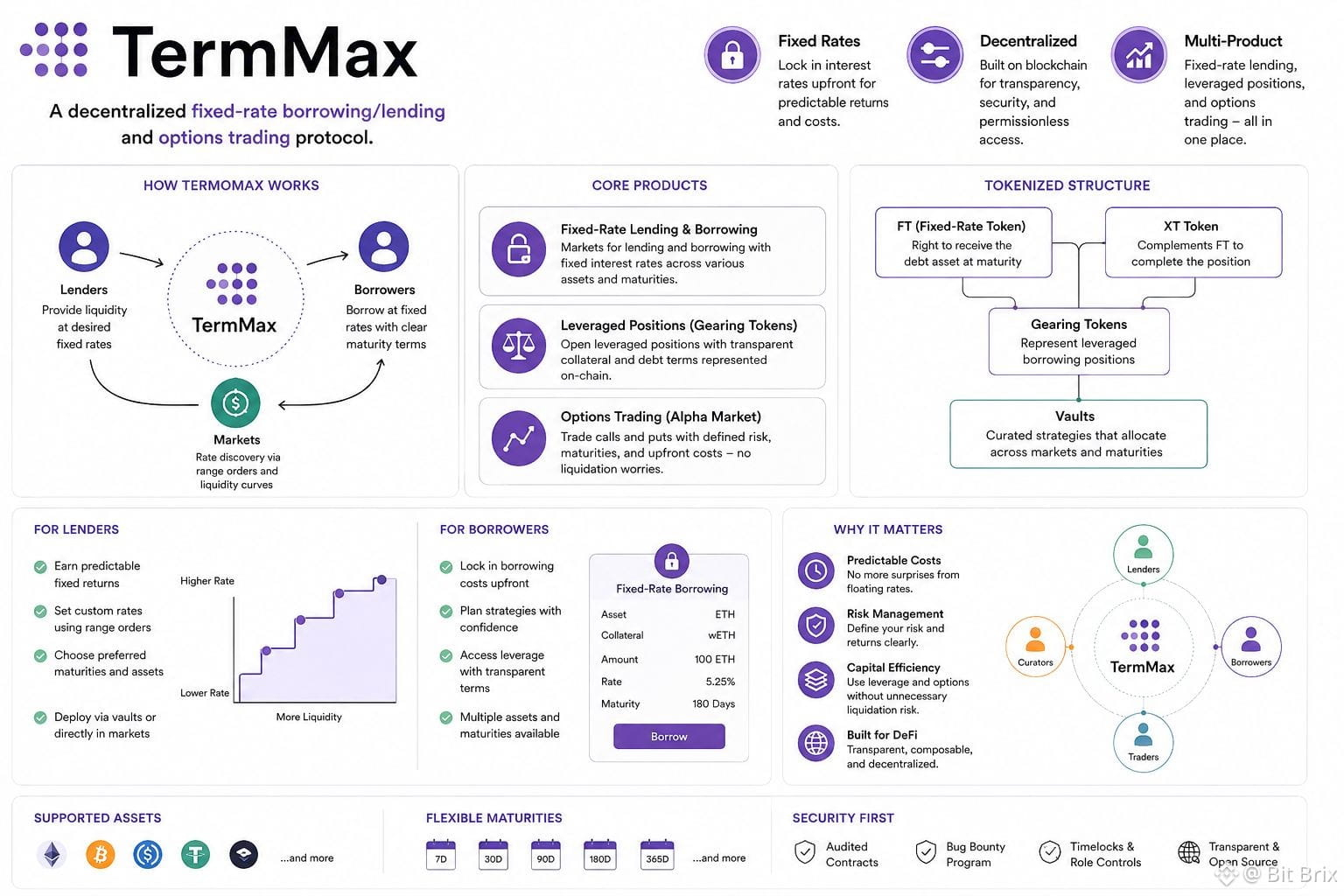
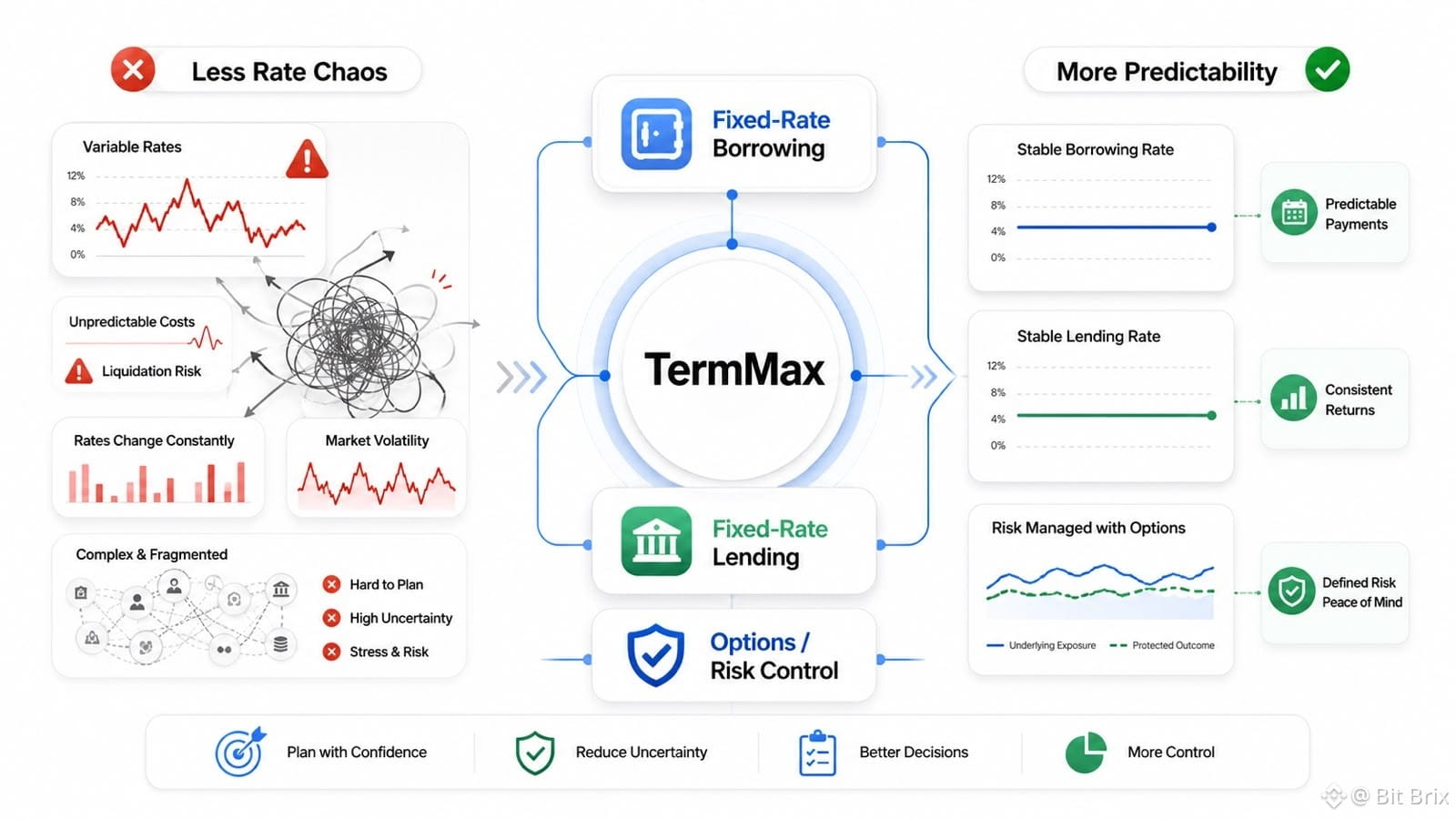
Instead of leaving borrowing costs floating, TermMax builds fixed-rate markets around specific assets and maturities. You know what the financing is supposed to cost before you commit.
It sounds boring.
Honestly, that’s exactly why I like it.
Under the hood, it gets much more interesting: tokenized future debt, range-based pricing, managed vaults, leveraged positions, and an options layer built around defined risk.
It’s not perfect. The hard part is liquidity, execution, risk management, and proving that users stay when incentives disappear.
But that’s the part I’m watching.
Because in DeFi, flashy products are easy.
Building infrastructure that still works when the market gets ugly?
That’s much harder.
TermMax is betting that knowing the price of money tomorrow is worth more than pretending tomorrow will look like today.
#TermMax @termmax
TermMax caught my attention for a pretty simple reason.
I’ve seen too many crypto trades go wrong because the asset wasn’t the problem — the financing was.
You enter a position when borrowing is cheap.
Then the market gets crowded. Rates move.
Suddenly the trade needs to be right just to pay for itself.
That’s the headache TermMax is trying to remove.
Instead of leaving borrowing costs floating, TermMax builds fixed-rate markets around specific assets and maturities. You know what the financing is supposed to cost before you commit.
It sounds boring.
Honestly, that’s exactly why I like it.
Under the hood, it gets much more interesting: tokenized future debt, range-based pricing, managed vaults, leveraged positions, and an options layer built around defined risk.
It’s not perfect. The hard part is liquidity, execution, risk management, and proving that users stay when incentives disappear.
But that’s the part I’m watching.
Because in DeFi, flashy products are easy.
Building infrastructure that still works when the market gets ugly?
That’s much harder.
TermMax is betting that knowing the price of money tomorrow is worth more than pretending tomorrow will look like today.
#TermMax @TermMax
I’ve seen too many crypto trades go wrong because the asset wasn’t the problem — the financing was.
You enter a position when borrowing is cheap.
Then the market gets crowded. Rates move.
Suddenly the trade needs to be right just to pay for itself.
That’s the headache TermMax is trying to remove.
Instead of leaving borrowing costs floating, TermMax builds fixed-rate markets around specific assets and maturities. You know what the financing is supposed to cost before you commit.
It sounds boring.
Honestly, that’s exactly why I like it.
Under the hood, it gets much more interesting: tokenized future debt, range-based pricing, managed vaults, leveraged positions, and an options layer built around defined risk.
It’s not perfect. The hard part is liquidity, execution, risk management, and proving that users stay when incentives disappear.
But that’s the part I’m watching.
Because in DeFi, flashy products are easy.
Building infrastructure that still works when the market gets ugly?
That’s much harder.
TermMax is betting that knowing the price of money tomorrow is worth more than pretending tomorrow will look like today.
#TermMax @TermMax
135
·
--
Bullish
Crypto has made people tired of big promises.
Too many tokens.
Too many narratives.
Too many projects that look alive until the rewards stop.
That is why TermMax feels different to look at.
Not perfect. Not guaranteed. Just different.
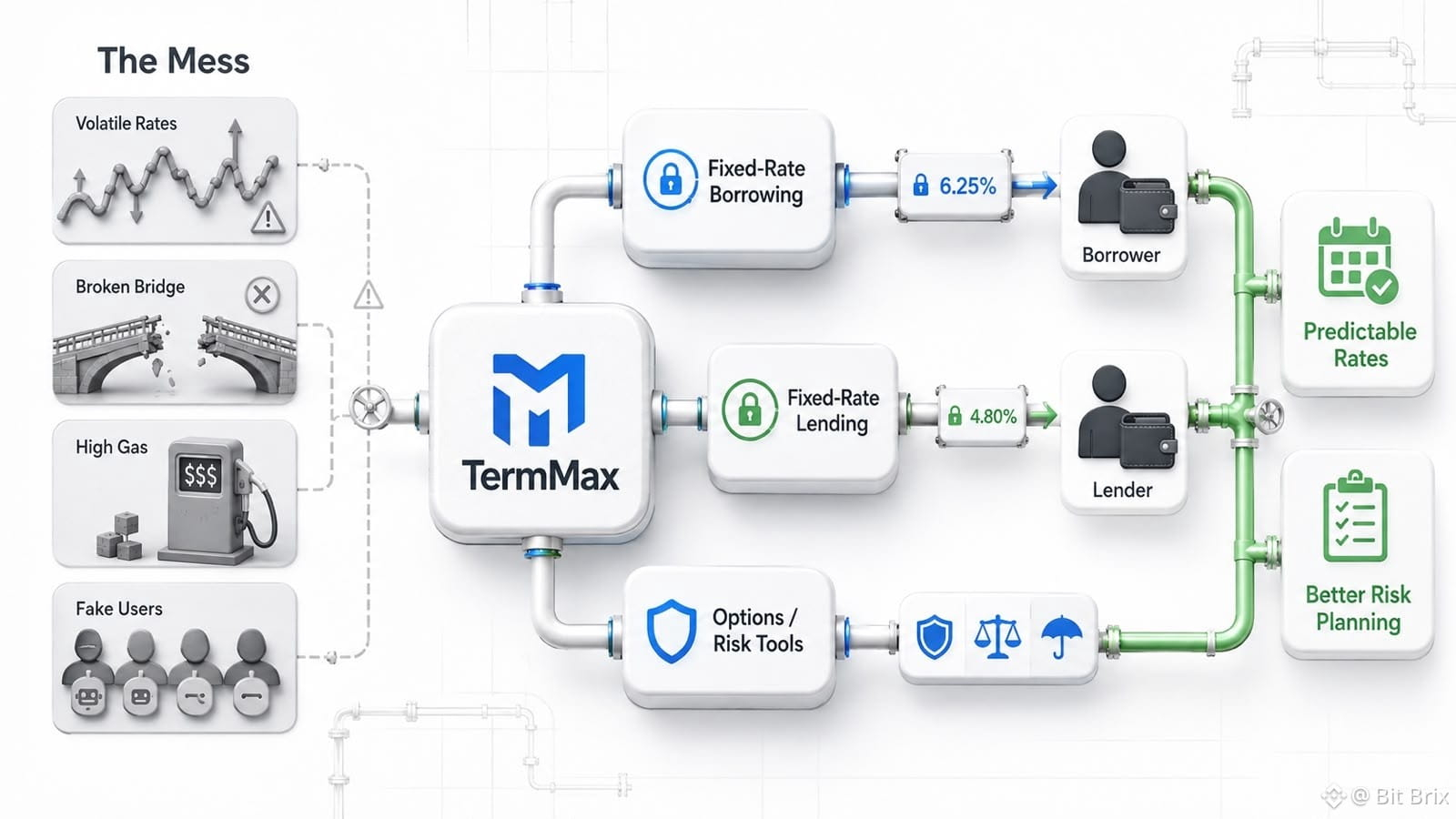
It is not trying to be loud. It is working around fixed-rate borrowing, lending, and options trading, the boring DeFi plumbing most people ignore until the market gets messy.
And honestly, boring might be the point.
When borrowing rates move too fast, users feel it.
When liquidity disappears, users feel it.
When risk is hidden under clean dashboards, users feel it.
TermMax is trying to touch that problem.
Maybe it works.
Maybe it takes time.
Maybe the market does not care yet.
But at least it is focused on something real: making DeFi less chaotic under the hood.
No hype from me.
Just cautious curiosity.
#termmax @termmax
Crypto has made people tired of big promises.
Too many tokens.
Too many narratives.
Too many projects that look alive until the rewards stop.
That is why TermMax feels different to look at.
Not perfect. Not guaranteed. Just different.
It is not trying to be loud. It is working around fixed-rate borrowing, lending, and options trading, the boring DeFi plumbing most people ignore until the market gets messy.
And honestly, boring might be the point.
When borrowing rates move too fast, users feel it.
When liquidity disappears, users feel it.
When risk is hidden under clean dashboards, users feel it.
TermMax is trying to touch that problem.
Maybe it works.
Maybe it takes time.
Maybe the market does not care yet.
But at least it is focused on something real: making DeFi less chaotic under the hood.
No hype from me.
Just cautious curiosity.
#termmax @TermMax
Too many tokens.
Too many narratives.
Too many projects that look alive until the rewards stop.
That is why TermMax feels different to look at.
Not perfect. Not guaranteed. Just different.
It is not trying to be loud. It is working around fixed-rate borrowing, lending, and options trading, the boring DeFi plumbing most people ignore until the market gets messy.
And honestly, boring might be the point.
When borrowing rates move too fast, users feel it.
When liquidity disappears, users feel it.
When risk is hidden under clean dashboards, users feel it.
TermMax is trying to touch that problem.
Maybe it works.
Maybe it takes time.
Maybe the market does not care yet.
But at least it is focused on something real: making DeFi less chaotic under the hood.
No hype from me.
Just cautious curiosity.
#termmax @TermMax
2
110
·
--
Bullish
TermMax feels different because it is not trying to sell a dream.
It is dealing with the boring mess under the hood of DeFi: borrowing rates, lending risk, options, liquidity, and all the uncertainty users usually ignore until the market turns ugly.
Honestly, that is what makes it worth watching.
Anyone who has borrowed in DeFi knows the stress. Rates move. Positions get uncomfortable. Gas spikes at the worst time. Risk suddenly feels very real.
TermMax is trying to make some of that more predictable with fixed-rate borrowing and lending.
That sounds simple, but it is not easy.
It needs real users, real liquidity, and enough trust for people to actually use it when there is no hype campaign pushing them.
Maybe it works. Maybe it takes time. Maybe the market ignores it until people feel the same pain again.
But at least TermMax is pointing at a real problem.
And in crypto, that already makes me pay attention.
#TermMax @termmax
TermMax feels different because it is not trying to sell a dream.
It is dealing with the boring mess under the hood of DeFi: borrowing rates, lending risk, options, liquidity, and all the uncertainty users usually ignore until the market turns ugly.
Honestly, that is what makes it worth watching.
Anyone who has borrowed in DeFi knows the stress. Rates move. Positions get uncomfortable. Gas spikes at the worst time. Risk suddenly feels very real.
TermMax is trying to make some of that more predictable with fixed-rate borrowing and lending.
That sounds simple, but it is not easy.
It needs real users, real liquidity, and enough trust for people to actually use it when there is no hype campaign pushing them.
Maybe it works. Maybe it takes time. Maybe the market ignores it until people feel the same pain again.
But at least TermMax is pointing at a real problem.
And in crypto, that already makes me pay attention.
#TermMax @TermMax
It is dealing with the boring mess under the hood of DeFi: borrowing rates, lending risk, options, liquidity, and all the uncertainty users usually ignore until the market turns ugly.
Honestly, that is what makes it worth watching.
Anyone who has borrowed in DeFi knows the stress. Rates move. Positions get uncomfortable. Gas spikes at the worst time. Risk suddenly feels very real.
TermMax is trying to make some of that more predictable with fixed-rate borrowing and lending.
That sounds simple, but it is not easy.
It needs real users, real liquidity, and enough trust for people to actually use it when there is no hype campaign pushing them.
Maybe it works. Maybe it takes time. Maybe the market ignores it until people feel the same pain again.
But at least TermMax is pointing at a real problem.
And in crypto, that already makes me pay attention.
#TermMax @TermMax
16
15
168
·
--
$KII
{alpha}(560xeec6574eabba52bac3f0277f2cd5ac7e67197886)
jumps 6.60% to $0.068412
$DOS
{future}(DOSUSDT)
drops 10.67% to $0.22817
$QUID
{alpha}(84530x1a44233fae8d50f1aeb3a5d58dd426ff4814cb53)
gains 1.82% to $0.074666
Mixed action across the market—momentum is strong, but volatility remains high. Trade carefully and always DYOR.
$KII
jumps 6.60% to $0.068412
$DOS
drops 10.67% to $0.22817
$QUID
gains 1.82% to $0.074666
Mixed action across the market—momentum is strong, but volatility remains high. Trade carefully and always DYOR.
jumps 6.60% to $0.068412
$DOS
drops 10.67% to $0.22817
$QUID
gains 1.82% to $0.074666
Mixed action across the market—momentum is strong, but volatility remains high. Trade carefully and always DYOR.
$KII
16%
$DOS
74%
$QUID
10%
73 votes • Voting closed
1
5.2k
·
--
Mixed moves in the market!
$KII
{alpha}(560xeec6574eabba52bac3f0277f2cd5ac7e67197886)
climbs 4.78% to $0.06744
$QUID
{alpha}(84530x1a44233fae8d50f1aeb3a5d58dd426ff4814cb53)
gains 2.08% to $0.07446
$DOS
{future}(DOSUSDT)
drops 9.91% to $0.22837
Momentum is building, but volatility remains high. Trade carefully and always DYOR!
Mixed moves in the market!
$KII
climbs 4.78% to $0.06744
$QUID
gains 2.08% to $0.07446
$DOS
drops 9.91% to $0.22837
Momentum is building, but volatility remains high. Trade carefully and always DYOR!
$KII
climbs 4.78% to $0.06744
$QUID
gains 2.08% to $0.07446
$DOS
drops 9.91% to $0.22837
Momentum is building, but volatility remains high. Trade carefully and always DYOR!
2
534
·
--
Honestly, I’m tired of every crypto project claiming it will change everything.
Too many tokens. Too many recycled narratives. Too many projects chasing attention instead of solving something real.
That’s why Babylon caught my eye—not because I’m expecting a 100x, but because the problem actually seems worth thinking about.
Babylon is trying to let people stake their BTC without giving up custody, while using that Bitcoin to help secure proof-of-stake networks.
It’s not flashy. It’s infrastructure. The kind of plumbing nobody notices until it breaks.
Still, I have questions.
Will Bitcoin holders accept extra risk for the rewards? Do smaller networks genuinely need Bitcoin-backed security? And if Bitcoin provides the economic weight, how necessary is the BABY token?
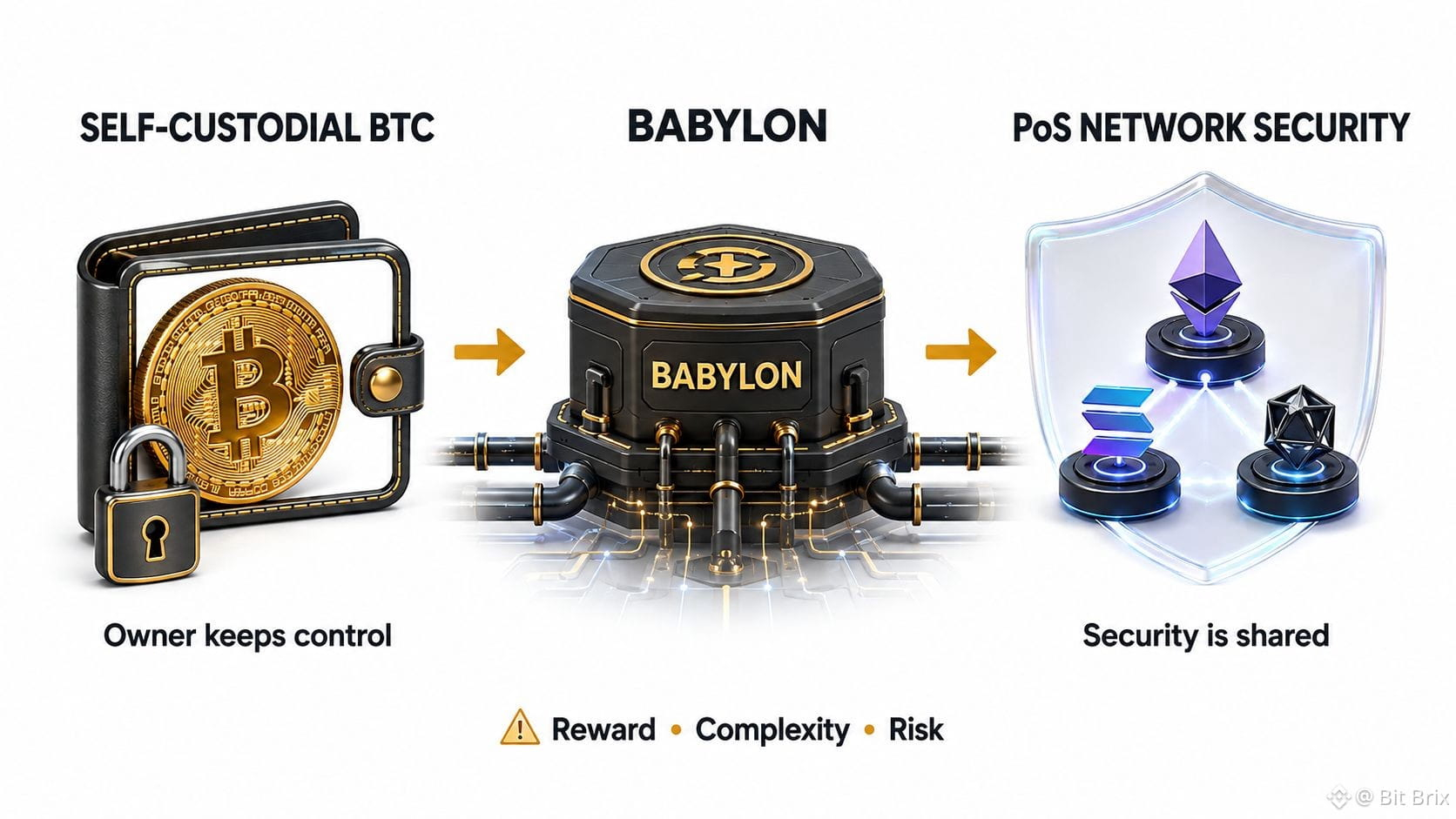
Self-custody sounds better than trusting another platform, but it doesn’t remove every risk. More connections can also mean more places where something goes wrong.
That’s the part people usually ignore when the rewards look attractive.
Maybe Babylon becomes useful infrastructure. Maybe users decide the complexity isn’t worth it. I honestly don’t know.
But at least it’s trying to solve a real problem instead of creating another token with a story attached.
The idea might matter.
The execution will be difficult.
And the market might not care.
For now, cautious curiosity feels more honest than hype.
#baby @babylonlabs_io $BABY
Honestly, I’m tired of every crypto project claiming it will change everything.
Too many tokens. Too many recycled narratives. Too many projects chasing attention instead of solving something real.
That’s why Babylon caught my eye—not because I’m expecting a 100x, but because the problem actually seems worth thinking about.
Babylon is trying to let people stake their BTC without giving up custody, while using that Bitcoin to help secure proof-of-stake networks.
It’s not flashy. It’s infrastructure. The kind of plumbing nobody notices until it breaks.
Still, I have questions.
Will Bitcoin holders accept extra risk for the rewards? Do smaller networks genuinely need Bitcoin-backed security? And if Bitcoin provides the economic weight, how necessary is the BABY token?
Self-custody sounds better than trusting another platform, but it doesn’t remove every risk. More connections can also mean more places where something goes wrong.
That’s the part people usually ignore when the rewards look attractive.
Maybe Babylon becomes useful infrastructure. Maybe users decide the complexity isn’t worth it. I honestly don’t know.
But at least it’s trying to solve a real problem instead of creating another token with a story attached.
The idea might matter.
The execution will be difficult.
And the market might not care.
For now, cautious curiosity feels more honest than hype.
#baby @BabylonLabs_io $BABY
Too many tokens. Too many recycled narratives. Too many projects chasing attention instead of solving something real.
That’s why Babylon caught my eye—not because I’m expecting a 100x, but because the problem actually seems worth thinking about.
Babylon is trying to let people stake their BTC without giving up custody, while using that Bitcoin to help secure proof-of-stake networks.
It’s not flashy. It’s infrastructure. The kind of plumbing nobody notices until it breaks.
Still, I have questions.
Will Bitcoin holders accept extra risk for the rewards? Do smaller networks genuinely need Bitcoin-backed security? And if Bitcoin provides the economic weight, how necessary is the BABY token?
Self-custody sounds better than trusting another platform, but it doesn’t remove every risk. More connections can also mean more places where something goes wrong.
That’s the part people usually ignore when the rewards look attractive.
Maybe Babylon becomes useful infrastructure. Maybe users decide the complexity isn’t worth it. I honestly don’t know.
But at least it’s trying to solve a real problem instead of creating another token with a story attached.
The idea might matter.
The execution will be difficult.
And the market might not care.
For now, cautious curiosity feels more honest than hype.
#baby @BabylonLabs_io $BABY
8
1
116
·
--
I spent some time reading about Babylon, and honestly, it caught my attention.
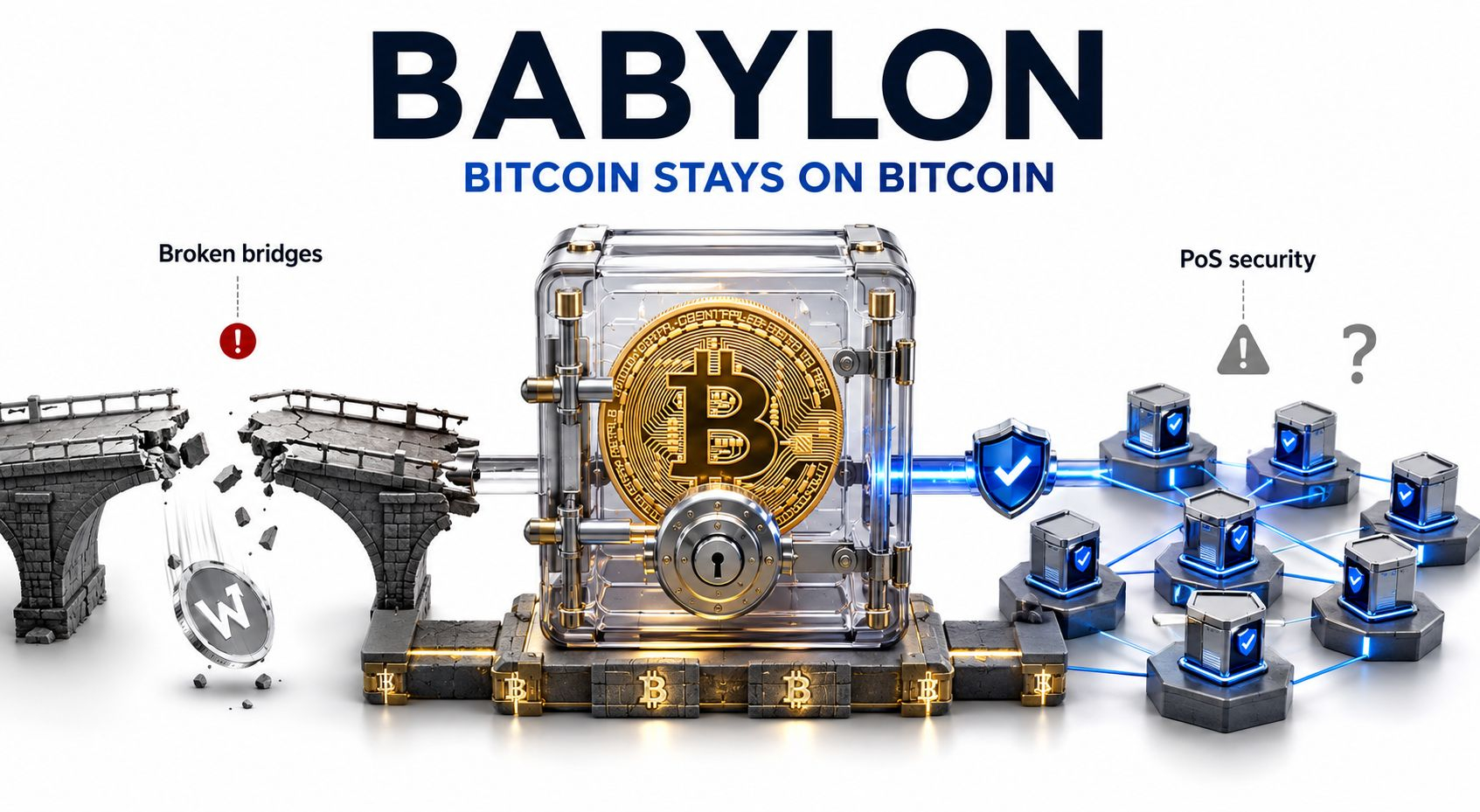
Crypto has given us too many broken bridges, wrapped assets, fake users, and reward systems that disappear when the incentives stop.
Babylon is trying something different: allowing BTC to help secure proof-of-stake networks without moving it away from Bitcoin.
That matters.
Not because every Bitcoin needs to earn yield. Sometimes keeping BTC untouched in a wallet is the whole point. But using Bitcoin without wrapping or bridging it could remove one of crypto’s oldest risks.
The real question is demand.
Do proof-of-stake chains genuinely need Bitcoin-backed security, and will they pay for it sustainably? Or will everything depend on temporary rewards and token issuance?
Then there’s BABY. Maybe the token is necessary for running the network. Maybe it becomes another token constantly searching for more utility.
I don’t know.
Babylon isn’t flashy. It’s plumbing—the kind nobody notices until it breaks.
The problem is real, but the execution will be hard.
Maybe it works, maybe it doesn’t.
For now, cautious curiosity feels more honest than hype.
#baby @babylonlabs_io $BABY
I spent some time reading about Babylon, and honestly, it caught my attention.
Crypto has given us too many broken bridges, wrapped assets, fake users, and reward systems that disappear when the incentives stop.
Babylon is trying something different: allowing BTC to help secure proof-of-stake networks without moving it away from Bitcoin.
That matters.
Not because every Bitcoin needs to earn yield. Sometimes keeping BTC untouched in a wallet is the whole point. But using Bitcoin without wrapping or bridging it could remove one of crypto’s oldest risks.
The real question is demand.
Do proof-of-stake chains genuinely need Bitcoin-backed security, and will they pay for it sustainably? Or will everything depend on temporary rewards and token issuance?
Then there’s BABY. Maybe the token is necessary for running the network. Maybe it becomes another token constantly searching for more utility.
I don’t know.
Babylon isn’t flashy. It’s plumbing—the kind nobody notices until it breaks.
The problem is real, but the execution will be hard.
Maybe it works, maybe it doesn’t.
For now, cautious curiosity feels more honest than hype.
#baby @BabylonLabs_io $BABY
Crypto has given us too many broken bridges, wrapped assets, fake users, and reward systems that disappear when the incentives stop.
Babylon is trying something different: allowing BTC to help secure proof-of-stake networks without moving it away from Bitcoin.
That matters.
Not because every Bitcoin needs to earn yield. Sometimes keeping BTC untouched in a wallet is the whole point. But using Bitcoin without wrapping or bridging it could remove one of crypto’s oldest risks.
The real question is demand.
Do proof-of-stake chains genuinely need Bitcoin-backed security, and will they pay for it sustainably? Or will everything depend on temporary rewards and token issuance?
Then there’s BABY. Maybe the token is necessary for running the network. Maybe it becomes another token constantly searching for more utility.
I don’t know.
Babylon isn’t flashy. It’s plumbing—the kind nobody notices until it breaks.
The problem is real, but the execution will be hard.
Maybe it works, maybe it doesn’t.
For now, cautious curiosity feels more honest than hype.
#baby @BabylonLabs_io $BABY
3
143
·
--
Bullish
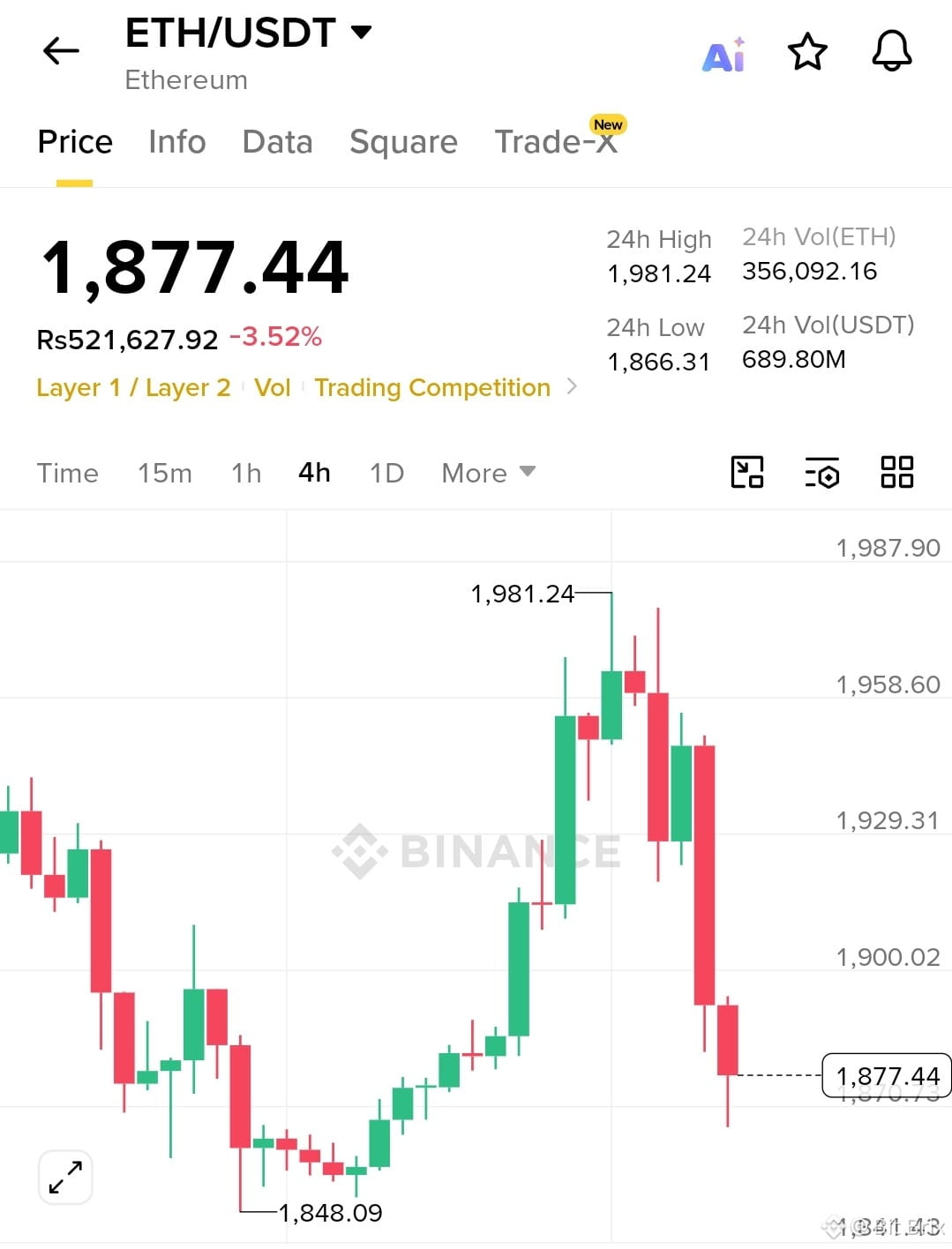
$ETH bears are taking control after a sharp rejection.
EP: $1,875–$1,885
TP1: $1,860
TP2: $1,848
TP3: $1,825
SL: $1,902
Breakdown pressure is building. The next move could be brutal.
Let’s go $ETH
$ETH bears are taking control after a sharp rejection.
EP: $1,875–$1,885
TP1: $1,860
TP2: $1,848
TP3: $1,825
SL: $1,902
Breakdown pressure is building. The next move could be brutal.
Let’s go $ETH
EP: $1,875–$1,885
TP1: $1,860
TP2: $1,848
TP3: $1,825
SL: $1,902
Breakdown pressure is building. The next move could be brutal.
Let’s go $ETH
81
·
--
Bullish
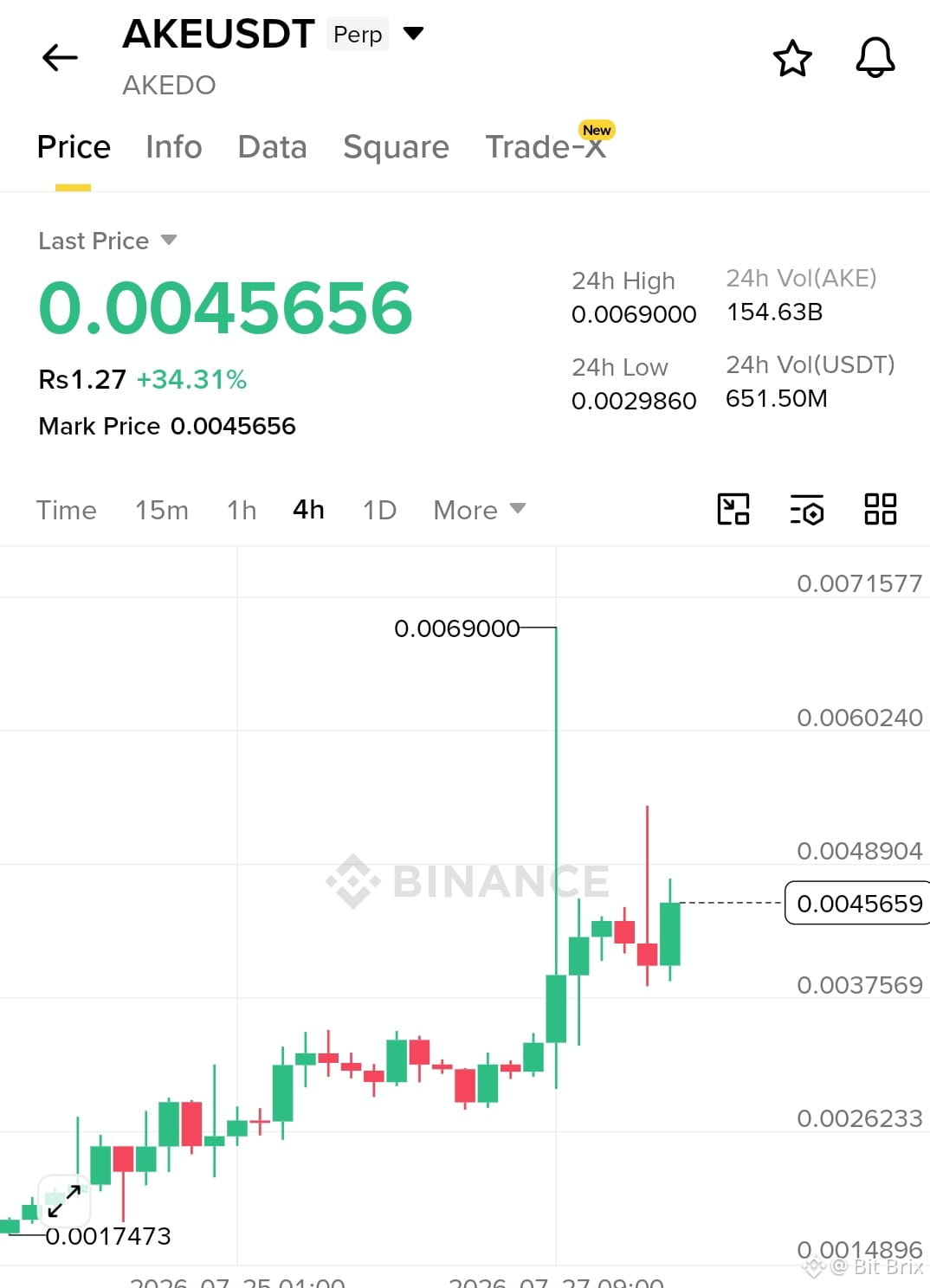
$AKE is gaining serious momentum after a powerful breakout.
EP: $0.00435–$0.00455
TP1: $0.00490
TP2: $0.00550
TP3: $0.00620
SL: $0.00375
Bulls are pressing hard. Hold the breakout and the next leg could move fast.
Let’s go $AKE
$AKE is gaining serious momentum after a powerful breakout.
EP: $0.00435–$0.00455
TP1: $0.00490
TP2: $0.00550
TP3: $0.00620
SL: $0.00375
Bulls are pressing hard. Hold the breakout and the next leg could move fast.
Let’s go $AKE
EP: $0.00435–$0.00455
TP1: $0.00490
TP2: $0.00550
TP3: $0.00620
SL: $0.00375
Bulls are pressing hard. Hold the breakout and the next leg could move fast.
Let’s go $AKE
284
·
--
Bullish
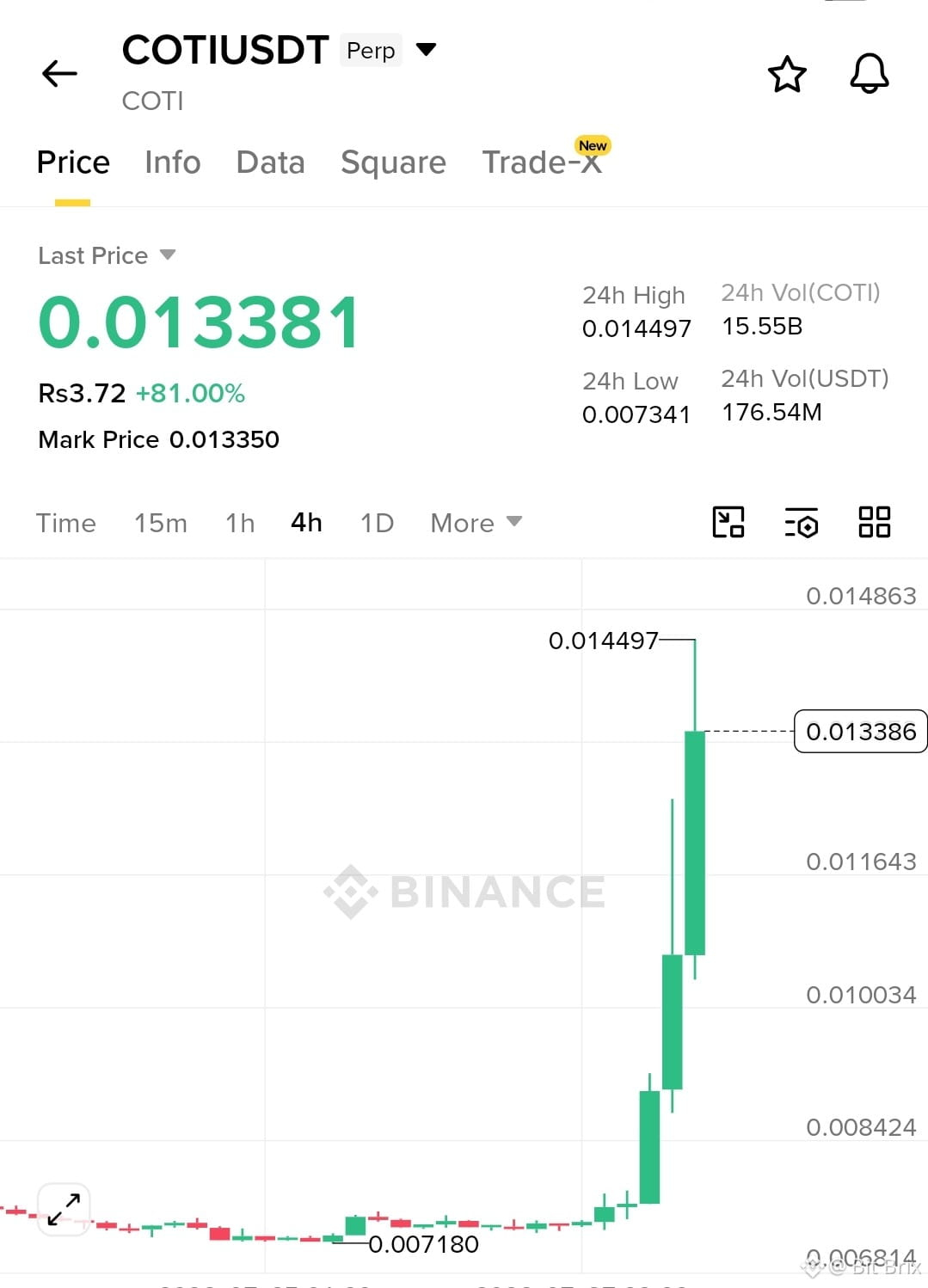
$COTI is exploding after an 81% surge, with strong volume and bullish momentum building on the 4H chart.
EP: $0.0128–$0.0133
TP1: $0.0145
TP2: $0.0160
TP3: $0.0180
SL: $0.0116
High volatility—manage risk carefully.
Let’s go $COTI
$COTI is exploding after an 81% surge, with strong volume and bullish momentum building on the 4H chart.
EP: $0.0128–$0.0133
TP1: $0.0145
TP2: $0.0160
TP3: $0.0180
SL: $0.0116
High volatility—manage risk carefully.
Let’s go $COTI
EP: $0.0128–$0.0133
TP1: $0.0145
TP2: $0.0160
TP3: $0.0180
SL: $0.0116
High volatility—manage risk carefully.
Let’s go $COTI
186
·
--
I’ve been in crypto long enough that the words “economic security” barely register anymore. Every PoS chain says some version of it. Then the token drops, people lose interest, and the security everyone talked about suddenly looks a lot less solid.
Babylon did make me slow down a little.
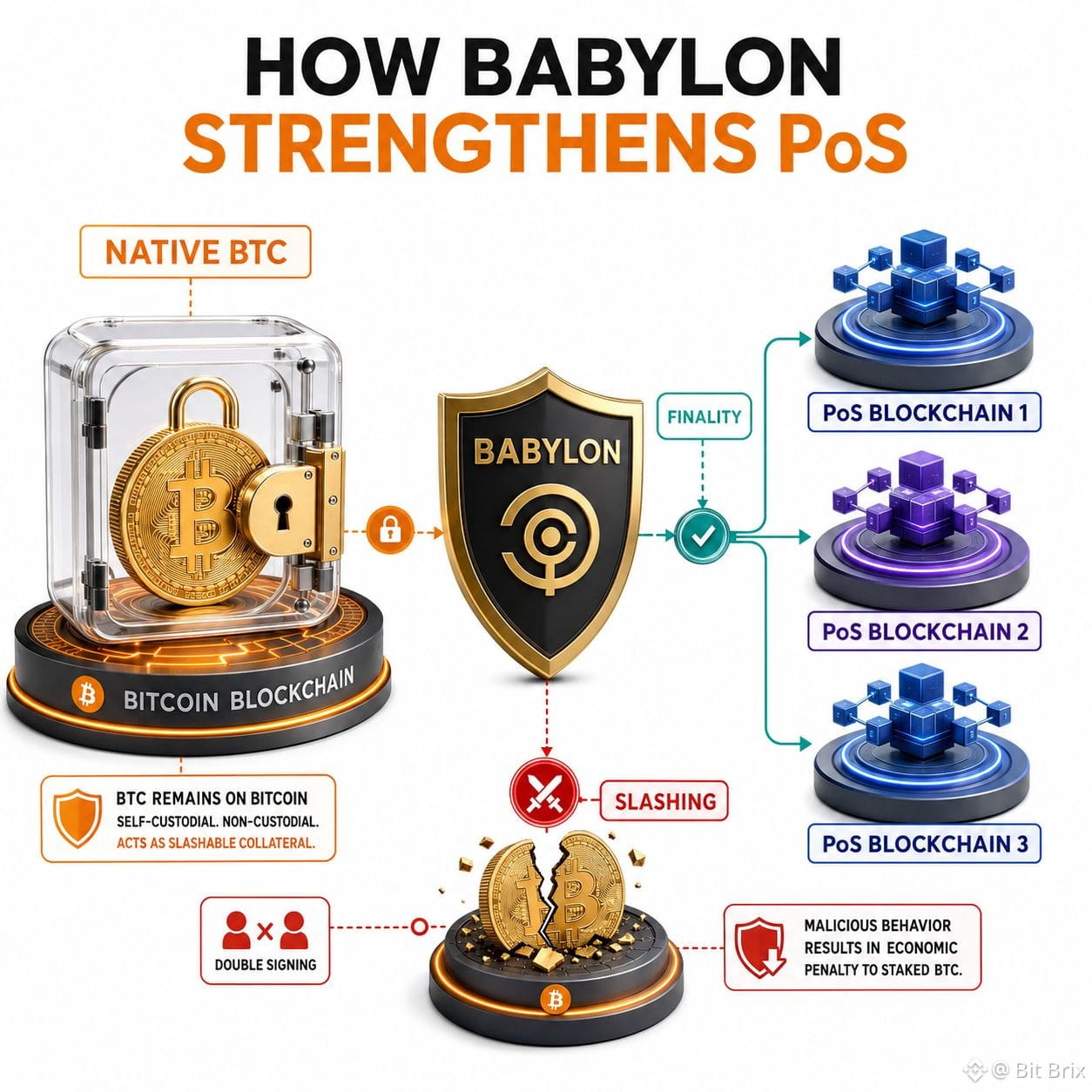
The idea is not especially flashy. Bitcoin stays where it is, rather than becoming another wrapped promise. The BTC backs finality providers and can be slashed if they sign conflicting blocks. Bitcoin checkpoints also make old PoS histories harder to quietly rewrite.
But I’ve watched this pattern before. The simple version fits in one paragraph. The real version needs covenant signers, watchers, key management, reward rules, and several moving parts staying in step across two networks. That is usually where clean ideas start collecting very human problems.
I’m careful with the phrase “secured by Bitcoin.” Miners are not watching over these PoS chains. BTC is collateral inside another system. That difference will probably get lost once the marketing starts.
I don’t fully trust it yet. Enough bitcoin has to show up. Finality providers cannot become another small club. Slashing has to work during the ugly moment when everyone needs it, not only in a test.
Maybe Babylon makes attacks more expensive. That matters. It still cannot fix bad governance, weak demand, or a chain nobody needs. I suppose that is why I’m interested, but not convinced.
#baby @babylonlabs_io $BABY
I’ve been in crypto long enough that the words “economic security” barely register anymore. Every PoS chain says some version of it. Then the token drops, people lose interest, and the security everyone talked about suddenly looks a lot less solid.
Babylon did make me slow down a little.
The idea is not especially flashy. Bitcoin stays where it is, rather than becoming another wrapped promise. The BTC backs finality providers and can be slashed if they sign conflicting blocks. Bitcoin checkpoints also make old PoS histories harder to quietly rewrite.
But I’ve watched this pattern before. The simple version fits in one paragraph. The real version needs covenant signers, watchers, key management, reward rules, and several moving parts staying in step across two networks. That is usually where clean ideas start collecting very human problems.
I’m careful with the phrase “secured by Bitcoin.” Miners are not watching over these PoS chains. BTC is collateral inside another system. That difference will probably get lost once the marketing starts.
I don’t fully trust it yet. Enough bitcoin has to show up. Finality providers cannot become another small club. Slashing has to work during the ugly moment when everyone needs it, not only in a test.
Maybe Babylon makes attacks more expensive. That matters. It still cannot fix bad governance, weak demand, or a chain nobody needs. I suppose that is why I’m interested, but not convinced.
#baby @BabylonLabs_io $BABY
Babylon did make me slow down a little.
The idea is not especially flashy. Bitcoin stays where it is, rather than becoming another wrapped promise. The BTC backs finality providers and can be slashed if they sign conflicting blocks. Bitcoin checkpoints also make old PoS histories harder to quietly rewrite.
But I’ve watched this pattern before. The simple version fits in one paragraph. The real version needs covenant signers, watchers, key management, reward rules, and several moving parts staying in step across two networks. That is usually where clean ideas start collecting very human problems.
I’m careful with the phrase “secured by Bitcoin.” Miners are not watching over these PoS chains. BTC is collateral inside another system. That difference will probably get lost once the marketing starts.
I don’t fully trust it yet. Enough bitcoin has to show up. Finality providers cannot become another small club. Slashing has to work during the ugly moment when everyone needs it, not only in a test.
Maybe Babylon makes attacks more expensive. That matters. It still cannot fix bad governance, weak demand, or a chain nobody needs. I suppose that is why I’m interested, but not convinced.
#baby @BabylonLabs_io $BABY
2
1
126
·
--
Bullish
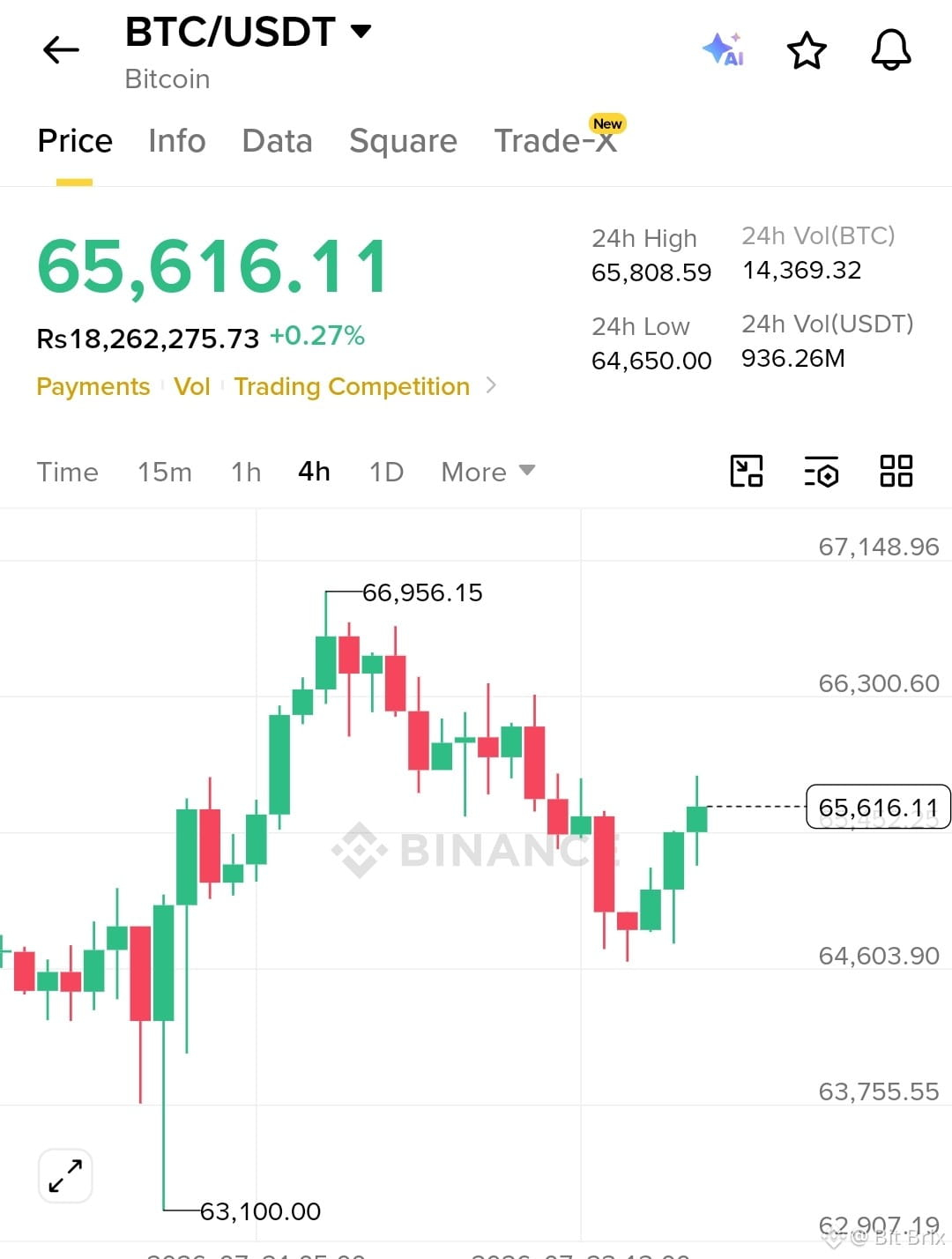
$BTC is bouncing hard and bulls are taking control.
EP: $65,400–$65,650
TP: $66,300 / $66,950 / $67,500
SL: $64,600
The next breakout could be explosive. Let’s go $BTC
$BTC is bouncing hard and bulls are taking control.
EP: $65,400–$65,650
TP: $66,300 / $66,950 / $67,500
SL: $64,600
The next breakout could be explosive. Let’s go $BTC
EP: $65,400–$65,650
TP: $66,300 / $66,950 / $67,500
SL: $64,600
The next breakout could be explosive. Let’s go $BTC
69
·
--
Bullish
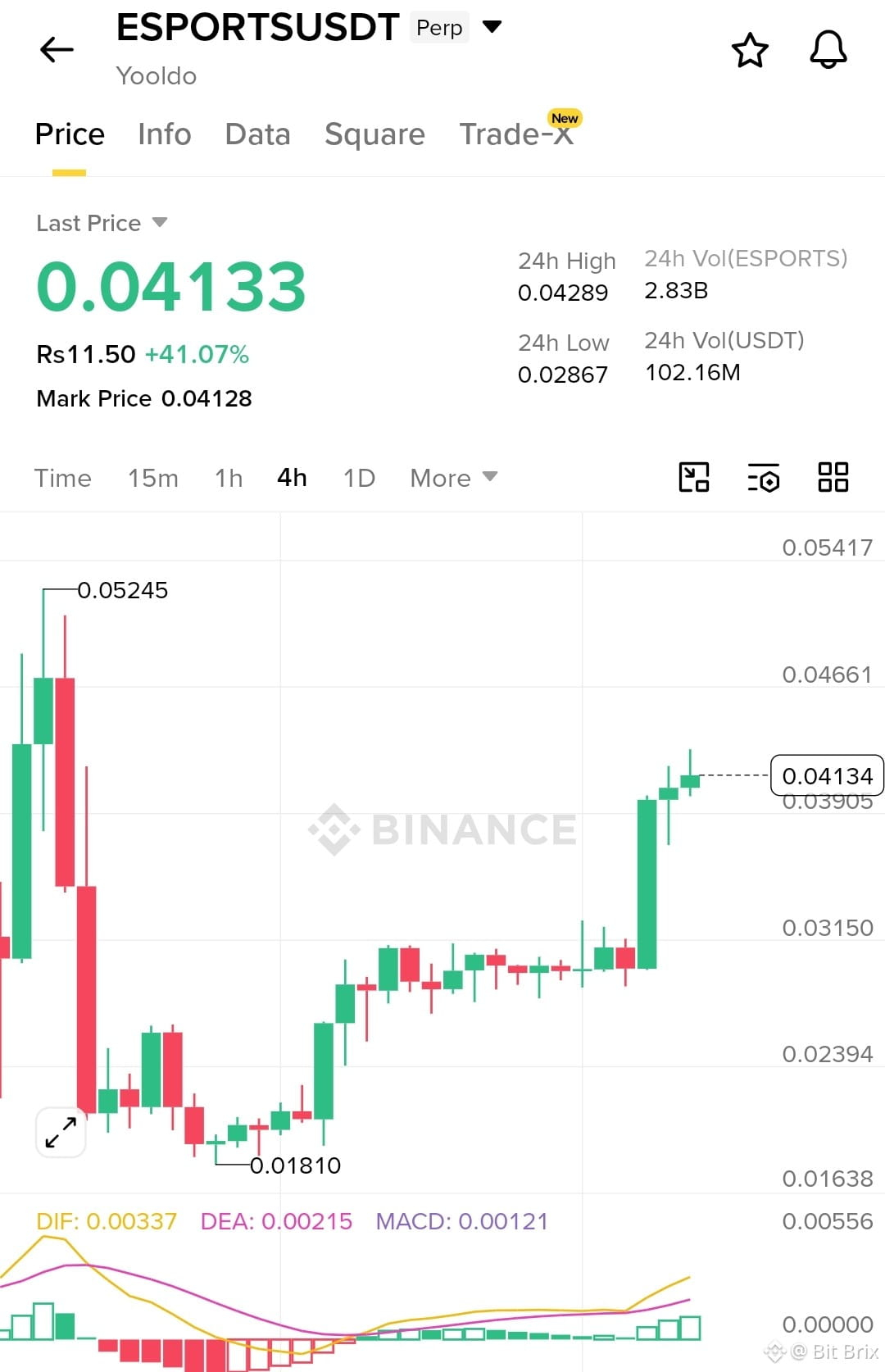
$ESPORTS is surging with a powerful 4H breakout.
EP: $0.0395–$0.0413
TP: $0.0466 / $0.0524 / $0.0580
SL: $0.0368
Momentum is heating up. Let’s go $ESPORTS
$ESPORTS is surging with a powerful 4H breakout.
EP: $0.0395–$0.0413
TP: $0.0466 / $0.0524 / $0.0580
SL: $0.0368
Momentum is heating up. Let’s go $ESPORTS
EP: $0.0395–$0.0413
TP: $0.0466 / $0.0524 / $0.0580
SL: $0.0368
Momentum is heating up. Let’s go $ESPORTS
1
103
·
--
Bullish
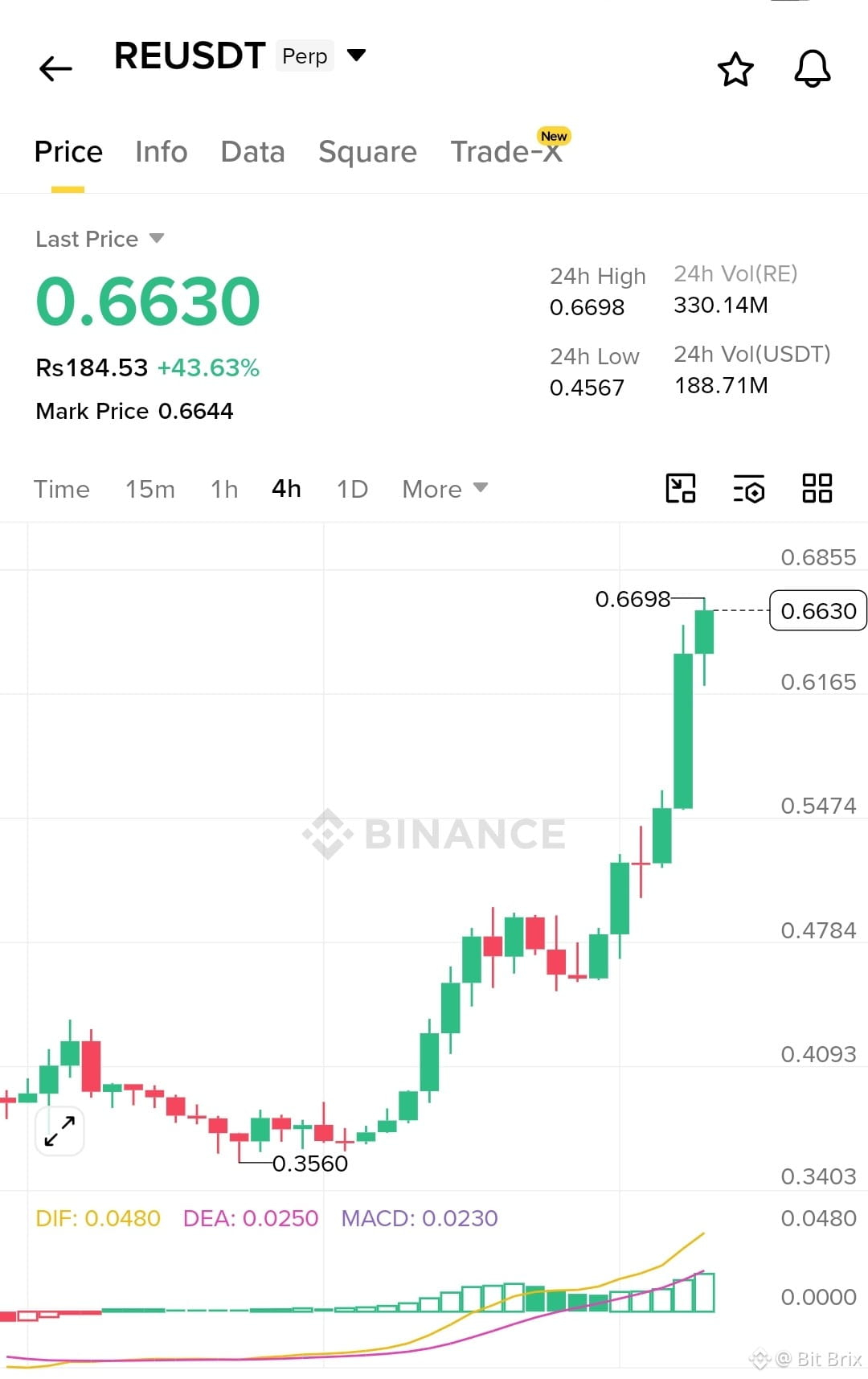
$RE is breaking out hard on the 4H chart.
EP: $0.6500–$0.6630
TP: $0.7000 / $0.7400 / $0.7800
SL: $0.6150
Momentum is explosive—let’s go $RE
$RE is breaking out hard on the 4H chart.
EP: $0.6500–$0.6630
TP: $0.7000 / $0.7400 / $0.7800
SL: $0.6150
Momentum is explosive—let’s go $RE
EP: $0.6500–$0.6630
TP: $0.7000 / $0.7400 / $0.7800
SL: $0.6150
Momentum is explosive—let’s go $RE
157
·
--
Bullish
EP: 0.00071326
TP: 0.00095000
SL: 0.00062000
AKE is leading with explosive momentum. Bulls are in full control and the next breakout could come fast.
Let's go $AKE
{future}(AKEUSDT)
$ESIM
{alpha}(560x7765a659c5b0cfbfd9fbc2ef2298b75a598f2d2d)
$RAVE
{future}(RAVEUSDT)
EP: 0.00071326
TP: 0.00095000
SL: 0.00062000
AKE is leading with explosive momentum. Bulls are in full control and the next breakout could come fast.
Let's go $AKE
$ESIM
$RAVE
TP: 0.00095000
SL: 0.00062000
AKE is leading with explosive momentum. Bulls are in full control and the next breakout could come fast.
Let's go $AKE
$ESIM
$RAVE
AkE♥️
63%
ESIM💪
14%
RAVE💖
23%
30 votes • Voting closed
2.3k
Log in to explore more content
Join global crypto users on Binance Square
⚡️ Get latest and useful information about crypto.
💬 Trusted by the world’s largest crypto exchange.
👍 Discover real insights from verified creators.
Email / Phone number
Trending Topics
SECApprovesNasdaqTexasCommodityTrustRule
11 views
24 Discussing
#SECApprovesNasdaqTexasCommodityTrustRule
🚨 $BTC TRADERS — WATCH THIS!
The SEC has approved Nasdaq’s rule change involving the Texas Commodity Trust. 👀
Why should crypto traders care?
🏦 Institutional access could get stronger
📊 Regulated market infrastructure is expanding
💰 Traditional finance keeps moving closer to crypto
This isn’t just another regulatory headline — it could be another piece of the institutional adoption puzzle.
🔥 Watch $BTC . Watch liquidity. Watch the institutions.
#Bitcoin #BTC #SEC #Nasdaq #Crypto #CryptoNews #Trading #InstitutionalAdoption #BinanceSquare
$BTC
A_K Crypto
·0 Likes
·38 views
ECBRaisesRatesSecondTimeTo2.5%
26 views
12 Discussing
USContinuingJoblessClaims1.774M
1,449 views
112 Discussing