
Ever since the first DeFi protocols started gaining traction in 2020, they have been a driving force in attracting investors to the crypto space. We started to use innovative and decentralized financial applications such as lending with DeFi platforms, lending by staking and earning interest income, trading derivative assets.
To attract new capital, DeFi protocols are starting to adopt RWAs as a source of collateral or new investment opportunities, providing consistent returns for investors.
In short, RWA (Real World Assets) means tokenization of physical world assets. In this context, what we describe as “assets” refers to capital assets, that is, important investment instruments such as houses, cars, real estate, loan portfolios, stocks and bonds. Even works of art with collectible value can be capital assets.
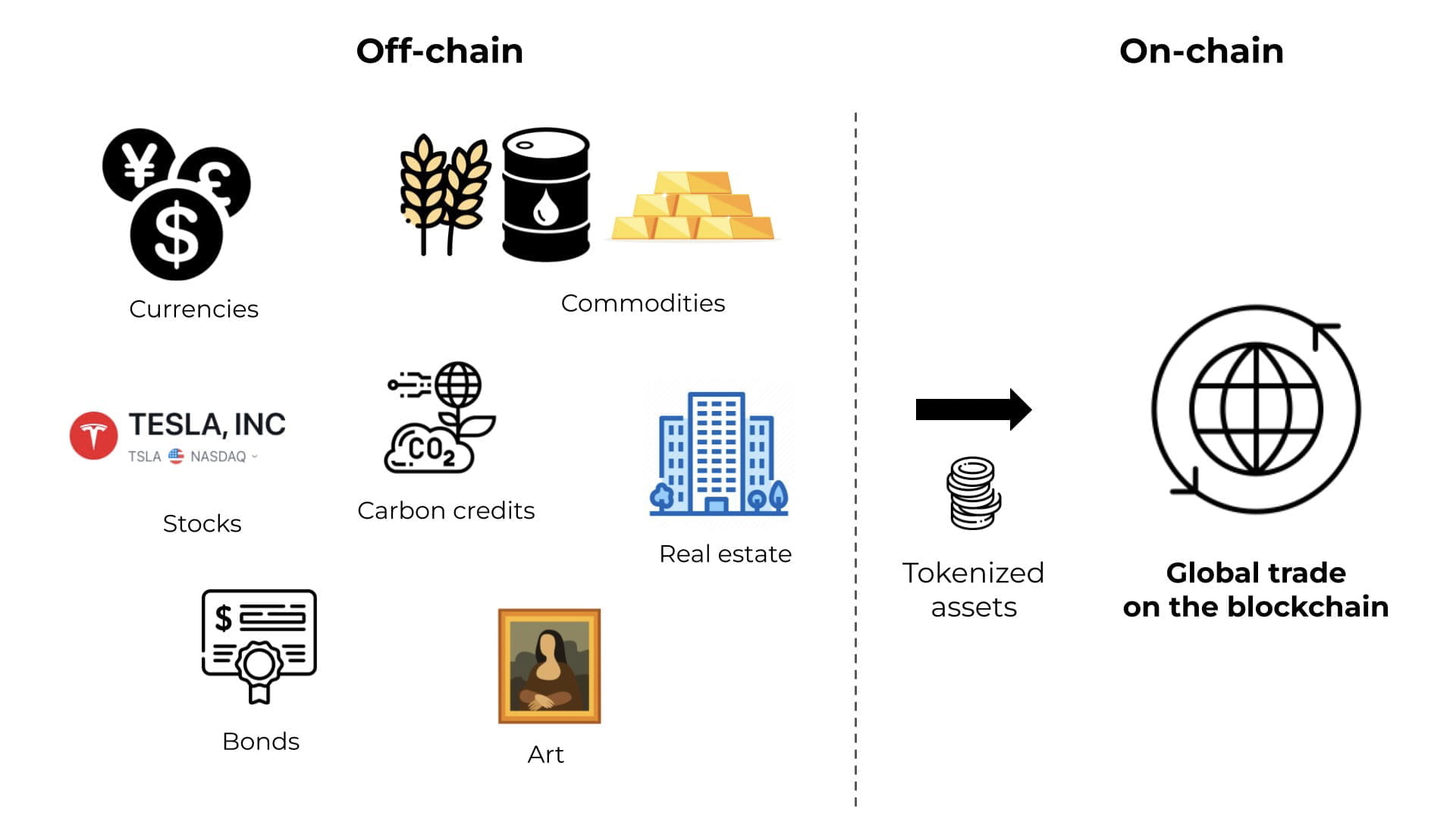
RWAs are an important building block by tokenizing these assets on-chain, bridging the gap between decentralized finance ($45 billion TVL) and traditional finance ($24 trillion market cap for Nasdaq shares alone).
In fact, the concept of RWA is not new in the blockchain industry. The oldest RWA project is the Bytom platform, which allows real-world assets such as stocks to be traded as tokens. Currently, the most successful RWAs are USDT and USDC, which are tokenized real dollars.
Let's look at the RWA projects with the highest volume, according to CoinGecko data:
Let's look at some of these projects and try to understand what they are aiming for:
Ondo Finance: It is a decentralized investment bank that predominantly invests off-chain in US-listed crypto funds and operates an on-chain lending business with Flux Finance, including USDC, FRAX, DAI and USDT, with a lending rate of approximately 5%.
Maple Finance: Maple Finance has been under development for 3 years and its core business is lending/corporate lending. Goldfinch: It is a decentralized lending protocol for off-chain bonds and fintech assets, similar to Maple Finance.
Centrifuge: It is a blockchain for tokenization of real-world fixed income assets such as bills, royalties and mortgages.
Realio Tech: It creates a scalable, accessible DeFi for Real World Assets like capital, real estate, bonds. Realio tokenizes real-world assets on their own blockchain and ensures compliance with the SEC by eliminating middlemen.
RealioVerse: It is a real-world assets themed metaverse platform where users can buy, sell and build projects on the platform. All proceeds are stored in the RealioVerse bank as a "locked liquidity" in RIO for the landowners.
Below you can see the volumes of tokens such as wCFG, MPL, GFI, FACTR, ONDO, RIO, TRADE, TRU, BST.
Institutional Players that are using blockchain for RWA
A very promising signal for RWAs has been rapidly growing interest from traditional institutional players. Some examples of recent RWA developments from the world of traditional finance:
Feb 14 - Siemens issues its first digital bond, worth $60m, on the Polygon blockchain
Feb 16 - Hong Kong issues it’s first tokenized green bond of $101m
Apr 3 - Credit Agricole CIB and Sweden’s SEB begin to develop a blockchain-based platform for digital bonds
Apr 14 - Bank of America details tokenization of RWAs like commodities, currencies, and equities as a key driver of digital asset adoption
Apr 20 - Societe Generale introduces a Euro stablecoin, CoinVertable on Ethereum - the first institutional stablecoin deployed on a public blockchain
Apr 26 - Mitsubishi UFG Trust and Banking Corporation develops a digital securities platform using IBC (cosmos) as the communication protocol and the Corda blockchain infrastructure
However, these projects still pose some risks; their liquidity is low, price stability has not yet been achieved and most of them are in the early stages. Investors should look at the past performance of existing DeFi applications that leverage real-world assets. Whether or not RWA will become the next superstar will depend on how projects develop their infrastructure in the coming years.