

The Internet has come a long way since its inception and we are now in a new era with Web 3.0. Web 3.0 promises to be a more decentralized, secure and user-centric version of the internet, with new technologies such as blockchain and smart contracts at its core.
With Web 3.0, users can better control and own their data, while businesses can benefit from new economic opportunities and increased transparency. However, there are also significant challenges facing Web 3.0, such as technical scalability issues and regulatory barriers.
What is Web 3.0?
Web 3.0, also known as the decentralized web, is the next generation of the internet that aims to provide a more decentralized, open and secure environment for users through blockchain technology.
Web 3.0 is a significant departure from Web 2.0, which is the current version of the internet we use today. Web 2.0 is characterized by centralized platforms and services, such as social media and search engines, that collect and control user data. Web 3.0 aims to give users more control and ownership over their data, using decentralized technologies that enable peer-to-peer interaction without the need for intermediaries.
History of development of the Web

Web 1.0
Web 1.0, also known as the "read-only web" was the early stage of the internet. During this period, the internet was mainly used as a means of providing information. The websites are static, consisting of simple text-based pages with links. Users are passive recipients of information and have no means of interacting with the content.
Web 2.0
Web 2.0, also known as the "read-write web", emerged in the early 2000s. It introduced a new level of interactivity and user participation. Social media platforms, blogs and wikis became popular during this period. Users can create and share content, participate in discussions, and connect with each other.
Web 2.0 is also characterized by the rise of mobile devices, allowing users to access the internet from anywhere, anytime. The advent of responsive web design makes it possible to create websites that can adapt to different screen sizes and resolutions.
Web 3.0
Web 3.0, also known as the "semantic web" or "decentralized web", represents the next stage in the evolution of the internet. It is based on decentralized technologies, such as blockchain, that enable peer-to-peer and trusted interaction.
Unlike Web 2.0, where users depended on centralized platforms to control their data, Web 3.0 allows users to own and control their data. This is achieved through decentralized storage solutions that use encryption and blockchain technology to ensure data privacy and security.
The technology behind Web 3.0
Blockchain
Blockchain is a distributed ledger technology that enables secure and transparent data storage and transactions. In web 3.0, blockchain can be used to build decentralized applications (dApps) that operate independently of a central authority or intermediary. Blockchain can also facilitate peer-to-peer transactions, smart contracts, and digital identity management, etc.
Artificial Intelligence (AI)
AI refers to the ability of machines to perform tasks that typically require human intelligence, such as learning, reasoning, and perception. In web 3.0, AI can be used to personalize content and services, enhance cybersecurity, and improve decision-making processes. AI can also enable autonomous, robotic agents to interact with each other and with humans in more complex ways.
Internet of Things (IoT)
IoT refers to a network of interconnected devices that can collect, share, and analyze data over the internet. In web 3.0, IoT can enable greater automation, efficiency and sustainability in industries ranging from agriculture to healthcare to transportation. IoT can also create new opportunities to monetize data and generate revenue.
Semantic Web
The Semantic Web refers to a network of data structured in such a way that machines can easily understand and process it. In web 3.0, the Semantic Web can enable more accurate and relevant search results, as well as smarter recommendations and decision-making. The Semantic Web can also support the development of knowledge graphs, ontologies that help organize and connect different areas of knowledge.
Advantages of Web 3.0
Decentralization
Web 3.0 is built on decentralized technologies like blockchain, which means data and applications are not controlled by a single entity or authority. This makes it more resilient to censorship, control and manipulation by any single entity.
Privacy
Web 3.0 prioritizes user privacy, giving users greater control over their data and reducing the risk of data breaches and misuse.
Interactive abillity
Web 3.0 allows different platforms, applications and networks to communicate and exchange data with each other seamlessly, making it easier to build decentralized applications and systems.
Transparency
Web 3.0 emphasizes transparency, meaning data and transactions are publicly visible and auditable. This promotes accountability and trust in the system.
Encourage
Web 3.0 enables new incentive models, such as token economics and decentralized autonomous organizations (DAOs). This creates new opportunities for value creation and innovation.
Challenges of Web 3.0
Ability of extension
Many Web 3.0 technologies, such as blockchain, are currently limited in scalability, which can limit the number of transactions per second that can be processed by the network. This can lead to slower transaction times, higher fees, and lower user adoption rates.
Interactive abillity
Web 3 technologies are still relatively fragmented, with different networks and protocols not always compatible with each other. This can limit the ability of applications and services to interact with each other, reducing the potential benefits of Web 3.0.
User experience
Web 3.0 applications often have complex user interfaces and require users to manage their private keys, which can be a barrier to adoption for less tech-savvy users. Improving the user experience of Web 3.0 applications is critical to increasing user acceptance and driving mass adoption.
Challenges of legal regulations
Web 3.0 technologies are still relatively new and there is a lack of regulatory clarity around many aspects of their use, such as taxes, data privacy and liability. This could create legal and regulatory uncertainty for businesses and users, limiting their willingness to adopt Web 3.0 technologies.
Security
Web 3.0 technologies face a range of security challenges, including the risk of smart contract vulnerabilities, 51% attacks on blockchain networks, and the risk of hacking and theft. Improving the security of Web 3.0 technologies is critical to building trust and confidence among users and driving widespread adoption.
Education and awareness
Many people are still unfamiliar with Web 3.0 technologies and their potential applications, which may limit their adoption and growth. Increasing education and awareness about Web 3.0 is critical to driving adoption and realizing its full potential.
Web 3.0 Use Cases
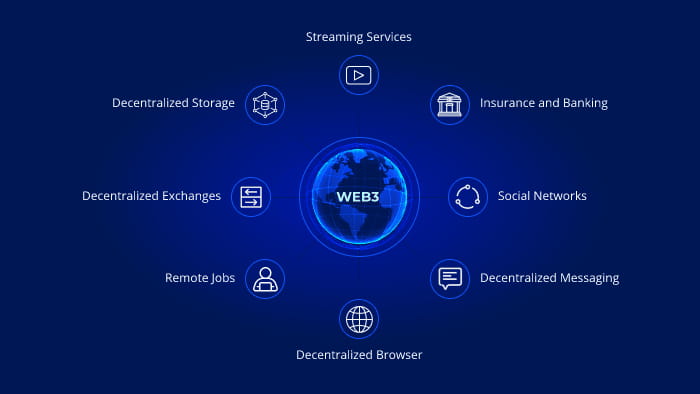
Decentralized Finance (DeFi)
In web 3.0, DeFi can enable financial inclusion, greater transparency and security, as well as new forms of value creation and exchange. DeFi applications can include decentralized exchanges, lending platforms, stablecoins, and insurance protocols.
Decentralized identity
Decentralized identity solutions such as DID and Verifiable Credentials have the potential to revolutionize identity management by enabling self-sovereign identities and reducing dependence on identity providers concentrate.
Supply chain management
Blockchain-based supply chain management solutions enable greater transparency and traceability in the supply chain, reduce the risk of fraud and counterfeiting, and improve efficiency and sustainability.
Gaming
Web 3 technologies such as blockchain and non-fungible tokens (NFTs) are increasingly being used in the gaming industry to enable new forms of ownership, value creation and player incentives.
Social Media
Web 3 technology has the potential to transform social media by enabling new models of content ownership, incentives and moderation. Decentralized social media platforms like Mastodon and Peepeth have gained users' attention.
Health care
Blockchain and decentralized technologies can enable secure, private, and interoperable sharing and management of health data, improving patient outcomes and reducing healthcare costs.
Decentralized Autonomous Organizations (DAOs)
DAOs are organizations governed by rules encoded in smart contracts, rather than by a centralized authority. DAOs enable new forms of collaboration, incentives and value creation, with applications in areas such as governance, finance and philanthropy.
Energy and sustainability
Web 3.0 technology can enable greater transparency and traceability in energy markets, enabling the creation of new energy production, consumption and trading models. Blockchain-based solutions can also be used to incentivize sustainable practices and carbon offsets.
summary
Web 3.0 represents a paradigm shift in the way we think about the internet, with the potential to transform a wide range of industries and sectors. By enabling greater decentralization, transparency, and user control, Web 3 technologies have the potential to create a more equitable and user-centric internet that better serves the needs of individuals. and community.
Although Web 3.0 faces a number of challenges, including scalability, interoperability, user experience, regulatory and legal challenges, security, education and awareness, the challenges This is not insurmountable. By working together, the Web 3.0 community can address these challenges and drive widespread adoption of Web 3 technologies.
In the future, we can expect to see new Web 3.0 applications and use cases, transforming industries and sectors in ways we cannot yet imagine. By embracing Web 3.0 and its potential, we can create a more decentralized, transparent, and user-centered internet that better serves the needs of individuals and communities across the world. world.
(Source: compiled by Aliniex)