


Plasma feels like it was designed by people who spent too much time watching stablecoins succeed in the real world while the onchain experience stayed unnecessarily complicated, because the whole project is basically a response to one simple truth: stablecoins already won the behavior battle, but most blockchains still force users to behave like crypto natives, buy a separate gas token, learn network quirks, and accept that “payments” can sometimes fail or cost more than they should, and Plasma is trying to erase that friction at the chain level instead of pushing the burden onto apps.
At its core, Plasma is positioning itself as a Layer 1 built for stablecoin settlement first, which means the chain is not trying to be a general-purpose everything machine that hopes payments work well as a side effect, but instead it treats stablecoin transfers as the default activity that the network must handle smoothly at high volume and low cost, and that framing changes everything because it forces every technical decision to be judged by one question: does this make stablecoin payments feel like money, or does it keep them stuck in “crypto mechanics.”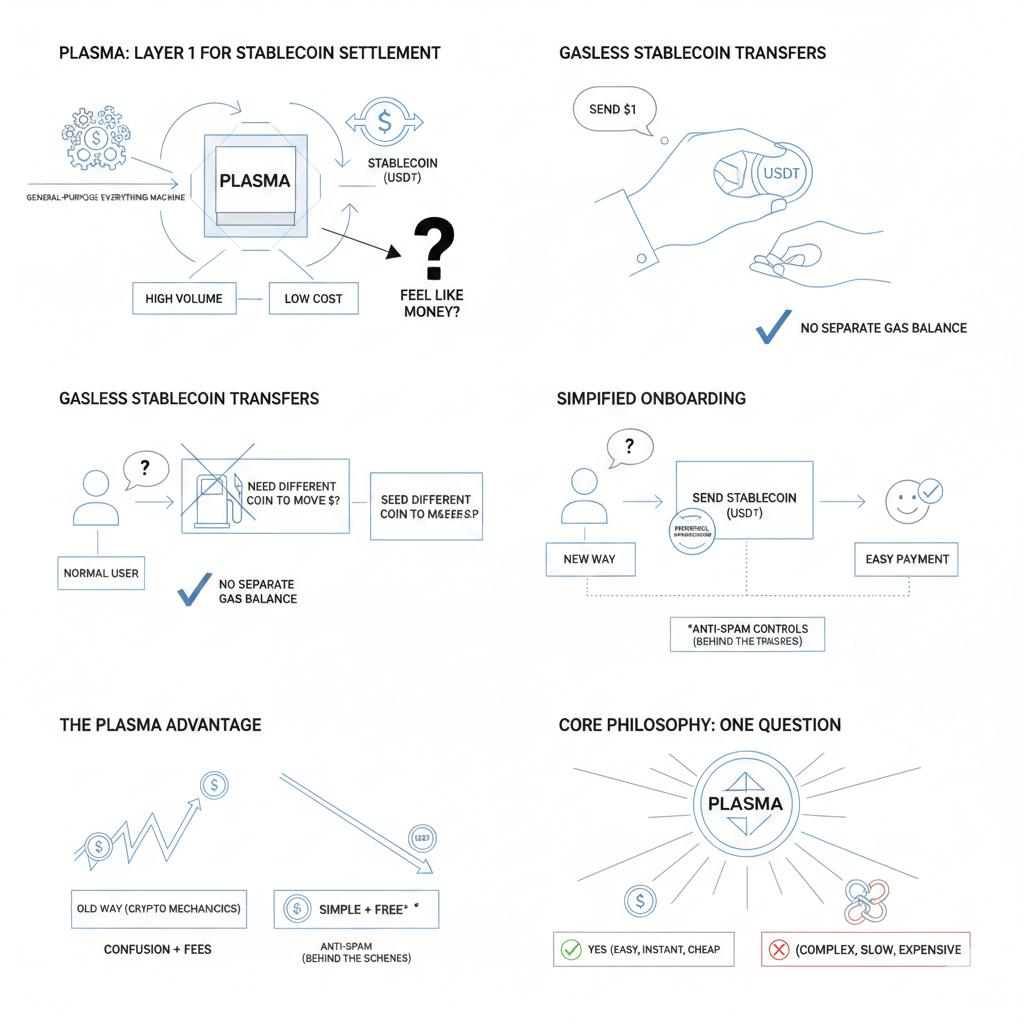
One of the most important ideas Plasma leans into is the promise of gasless stablecoin transfers, especially around USD₮, because if you’ve ever tried onboarding normal users into stablecoins you already know where the process breaks most often: they can understand sending a dollar, but they immediately get confused when they need a different coin just to move that dollar, and Plasma is trying to remove that moment entirely by building a system where the protocol can sponsor specific transfer types so the basic “send stablecoin” action can happen without the user holding a separate gas balance, while still keeping controls behind the scenes that prevent the system from being abused by spam.
The second piece that quietly matters just as much is the stablecoin-first gas concept, because even if gasless transfers cover the simplest payment action, a real ecosystem still needs a general way to pay transaction fees for contracts and apps, and Plasma’s direction points toward a world where approved ERC-20 assets can be used for gas so the user experience stays consistent with what the chain is meant to do, which is make stablecoins feel native instead of treating them like passengers riding inside another token’s economy.
Plasma also emphasizes full EVM compatibility, and that choice isn’t just a technical checkbox, it’s a distribution strategy, because EVM is where builders already are and where tooling is mature, so Plasma is essentially trying to let developers ship familiar smart contracts and products without forcing them into a new VM or a new programming world, while quietly giving them a payment-focused base layer underneath that removes the onboarding pain that usually shows up when you try to scale stablecoin use to everyday people and businesses.
Then there is the finality story, which matters a lot more in payments than it does in speculation, because traders can tolerate a few seconds or a minute of uncertainty, but payments cannot feel uncertain, and Plasma’s narrative around fast finality is really about changing how a transfer feels psychologically, because when a payment is meant to represent real value moving between real people, “it will confirm soon” is not the same thing as “it is final,” and Plasma is trying to push toward that clean, immediate sense of completion that real payment rails are expected to deliver.
The part that gives Plasma an infrastructure vibe rather than a hype vibe is how it talks about validators and decentralization, because instead of pretending everything is perfectly decentralized from day one, it signals a progressive approach where reliability and performance are hardened first and then validator participation expands through stages, which is the kind of mindset you usually see when a system is aiming to be dependable for settlement rather than just exciting for a cycle, and that approach can be controversial in crypto culture but it is also realistic if the goal is to carry serious payment volume without operational fragility.
Plasma also frames Bitcoin anchoring as a way to strengthen neutrality and censorship resistance, and while the exact shape of “anchoring” can mean different things in different designs, the intention it communicates is clear: if this chain wants to be a global stablecoin settlement layer, it wants to borrow credibility from Bitcoin’s neutrality to reinforce the idea that this is not a system that can be easily bent by single-party influence, which becomes more important the closer you get to real-world money flows where political and institutional pressure is not hypothetical.
When you look at the project through this lens, Plasma is less about inventing a new category and more about professionalizing what already exists, because stablecoins are already the dominant unit of account in crypto for many users, and the gap is not demand, the gap is the experience and the settlement quality at scale, and Plasma is trying to close that gap by making the stablecoin use case the chain’s first-class citizen instead of something that has to fight for blockspace, fight for predictable fees, and fight for a user-friendly flow.
That also makes the token story feel different compared to most networks, because Plasma’s native token XPL is not being framed as something the average stablecoin user must hold to move money, and that is intentional because the entire mission is to avoid forcing users into gas-token dependency for basic usage, so XPL’s meaning shifts toward the infrastructure layer of the network, where it supports transaction facilitation, validator incentives, and the long-term coordination of the chain as it decentralizes and expands, which is a more “network backbone” role than a “user must buy it” role, and that difference matters because it aligns the token’s purpose with the chain’s payment-first design instead of fighting it.
What I find most interesting is that the “behind the scenes” work on Plasma is basically the hard part most people underestimate, because making stablecoin transfers gasless or stablecoin-first is not a simple switch, it requires careful design around relaying, sponsorship rules, abuse prevention, and economic sustainability, and Plasma’s documentation direction suggests it is thinking about those mechanics directly rather than hand-waving them, which is a big sign that the team understands the difference between a nice idea and a system that can survive real usage.
In terms of what’s happening right now, the clearest signals tend to show up through ongoing public communication and the chain’s visible footprint through its explorer, because these are the places where you can see whether a project is building a coherent story while the network activity continues to mature, and recent public writeups have continued to reinforce the stablecoin-first narrative and the gasless transfer angle, which matters because consistency is one of the most underrated indicators in infrastructure projects that are trying to earn trust over time rather than chase short-term attention.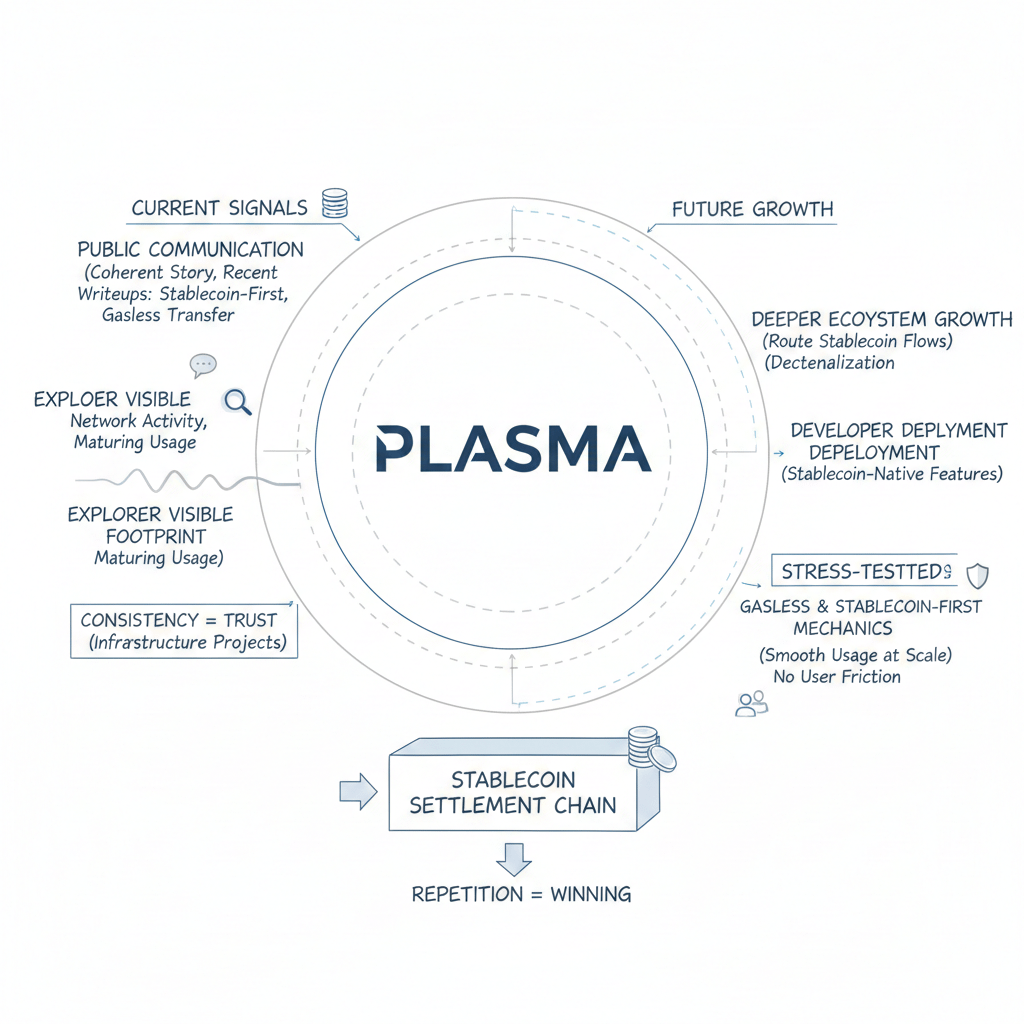
Looking forward, the “what’s next” for Plasma naturally points toward deeper ecosystem growth and stress-tested reliability, because a stablecoin settlement chain wins through repetition, meaning more integrations that route stablecoin flows through the network, more developer deployment that benefits from the stablecoin-native features, more validator expansion milestones that gradually strengthen decentralization, and more proof in practice that the gasless and stablecoin-first mechanics stay smooth even when usage ramps up, because the only thing that ultimately validates this design is real money moving through it at scale without the user feeling any of the usual friction.
My takeaway is that Plasma is aiming for the kind of success that looks boring from the outside and unstoppable from the inside, because the real endgame for a payment-focused chain is not that people talk about it every day, it’s that people stop thinking about it entirely while they keep using it, and Plasma is clearly trying to earn that position by reshaping stablecoin settlement into something that feels immediate, predictable, and natural, while keeping developer compatibility and long-term network credibility in view at the same time.


