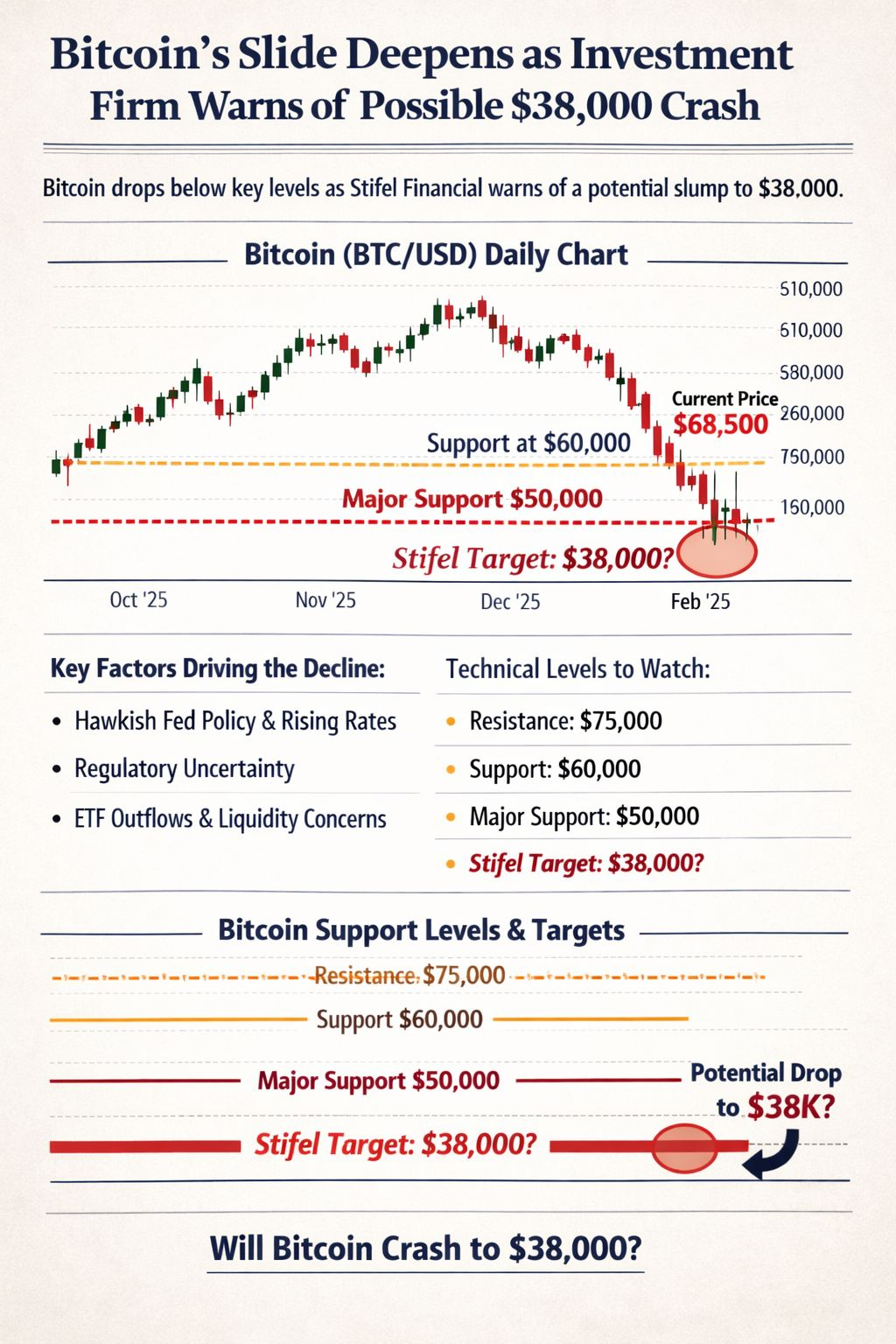
“Here’s Why $Bitcoin Price Keeps Falling As Investment Firm Warns of $38,000 Crash.
$BTC Bitcoin’s Slide Deepens as Investment Firm Warns of Possible $38,000 Crash
February 5, 2026 — Bitcoin’s price continues its downward trend, slipping below key psychological levels and igniting fresh concern among traders, analysts, and institutional investors. The flagship cryptocurrency has struggled recently amid broader risk-off sentiment in global markets, and a new warning from a major investment firm has intensified bearish forecasts.
Market Pressure Mounts: Bitcoin Below $70,000
Bitcoin, once trading near all-time highs above $126,000 in late 2025, has dropped sharply — now sitting below the $70,000 mark as of this week. Broader cryptocurrency markets, including Ethereum and XRP, have also been hit by selling pressure.
Stifel’s Bearish Forecast: $38,000 Possible
Investment banking firm Stifel Financial Corp. issued a stark warning that Bitcoin could fall as low as $38,000 — roughly half of its current levels — if current trends persist. Stifel’s analysis points to several major factors behind this potential downturn:
Tighter U.S. Federal Reserve monetary policy, which has reduced liquidity and made speculative assets like Bitcoin less attractive.
Slowing progress on clear crypto regulations in major markets, particularly the U.S.leaving institutional investors hesitant.
Shrinking market liquidity and capital flows, which can exacerbate price declines in risk assets.
Persistent outflows from Bitcoin exchange-traded funds (ETFs), indicating waning confidence among large investors.
These elements together have pushed key sentiment indicators into “Extreme Fear” territory — a psychological measure that often accompanies deeper sell-offs.
Technical and Macro Drivers Amplify Downtrend
Beyond Stifel’s warning, technical analysts point to structural signs that sellers remain in control rather than buyers stepping in. Recent price behavior shows successive failures to sustain rallies, a hallmark of bearish pressure.
Macroeconomic forces are also at play. Rising interest rates and tighter liquidity conditions globally have driven investors away from high-risk assets like stocks and cryptocurrencies toward safer investments such as bonds and precious metals. Some analysts note that Bitcoin’s performance now often tracks broader risk appetite rather than its own standalone fundamentals.
ETF Outflows and Liquidity Concerns
Bitcoin ETFs have historically been a source of consistent capital inflows into the market. However, recent data show that these flows have not only slowed but in some cases reversed, signaling declining institutional demand. Reduced demand means fewer buyers to absorb selling pressure, which can steepen price declines.
Investor Sentiment and Broader Risk Aversion
Investor psychology has shifted sharply. When global markets face uncertainty, capital often rotates out of risky assets — including Bitcoin — and moves into traditional safe havens like gold or government bonds. The current climate of risk aversion has fueled selling across crypto markets, deepening losses.
Is a Bottom in Sight?
Some long-term holders and analysts caution that extreme fear can sometimes signal that a market bottom is near, as over-sold conditions may eventually draw in value investors. However, a lasting recovery likely depends on improvements in liquidity conditions, clearer regulatory frameworks, and renewed demand from institutional capital.
Conclusion
Bitcoin’s recent fall reflects a convergence of structural, macroeconomic, and sentiment-driven forces. The warning from Stifel Financial that the cryptocurrency could revisit $38,000 underscores how sensitive $BTC Bitcoin’s price has become to external pressures and broader market risk trends. While crypto remains a highly volatile asset class, investors will be watching whether sentiment can stabilize and what this means for future price direction.
#BitcoinDropMarketImpact #ETHETFsApproved #EFTvsBTC