
I keep looking at Dusk Network as a project that was never built to impress retail with noise, because from day one it has been trying to solve a problem that only becomes obvious when you imagine real finance moving on-chain and then realize how impossible that looks on a fully transparent ledger. Dusk is positioned as a privacy Layer-1 for financial applications, but what makes it feel different is that it does not treat privacy like a cosmetic feature or a marketing checkbox, it treats privacy like the operating condition that serious markets require, while still respecting the fact that regulated systems must be able to prove states, validate ownership, and satisfy audits when the time comes.
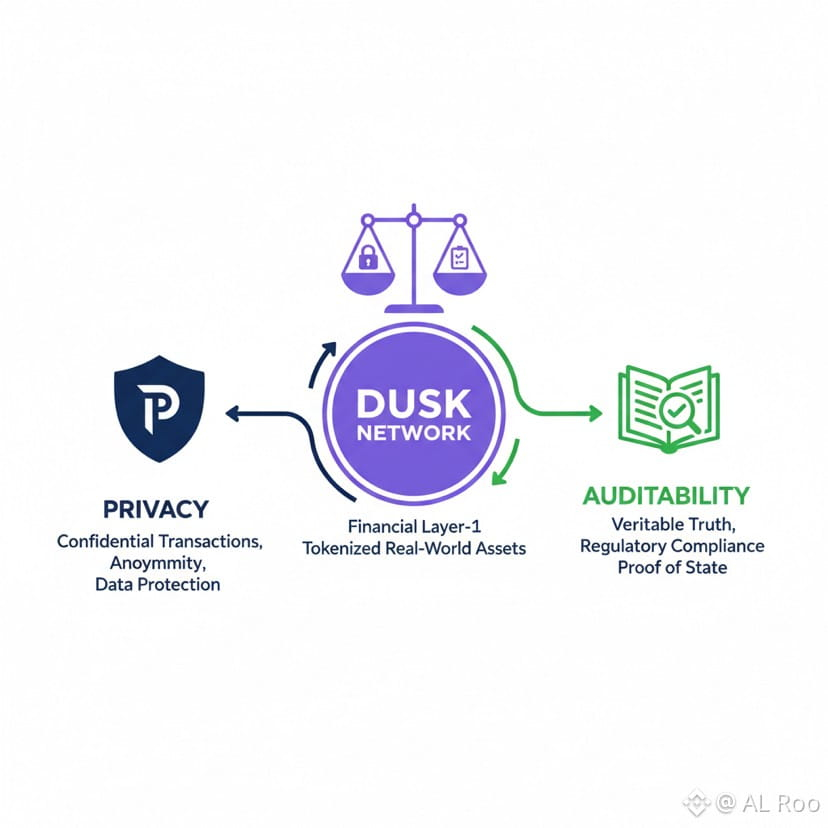
In most crypto networks, the moment you attempt to build something that resembles a real security or a regulated financial product, you immediately collide with exposure that would be unacceptable in traditional markets, because counterparties, balances, positions, and flows become visible in ways that destroy confidentiality and invite front-running, competitive leakage, and risk. Dusk is designed around a more realistic assumption, which is that privacy cannot be optional for financial assets, but auditability cannot be sacrificed either, because regulators and institutions do not accept systems that cannot produce verifiable truth. That balance is where Dusk tries to live, and that balance is why it matters if the world actually moves toward tokenized real-world assets, compliant issuance, and on-chain settlement that has to stand up to professional scrutiny.
At the heart of the Dusk story is the idea that the network should support confidential smart contracts through a standard approach that can model security-like behavior, which is where concepts like Confidential Security Contracts, often discussed as XSC, become relevant to how the ecosystem is framed. Instead of assuming that every asset on-chain behaves like a simple token, the project leans into the reality that financial assets have lifecycle events, compliance constraints, and ownership rules, and that a proper system needs to support things like controlled participation, transfers that respect eligibility, and ownership visibility that can be revealed to the right parties without forcing that visibility onto the entire public internet.
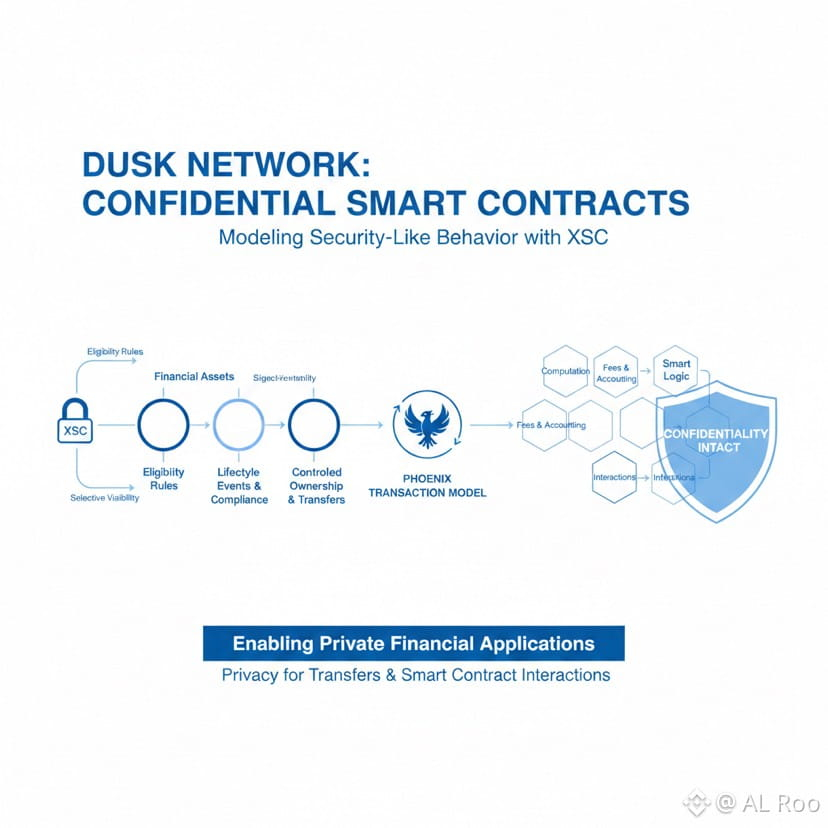
The Phoenix transaction model is one of the most important building blocks here because it represents a transaction design meant to support privacy not only for basic transfers but also for interactions that touch smart contract logic. The reason this matters in practice is that smart contracts introduce complexity around computation and fees, and many “privacy” ideas become fragile when execution is involved, because privacy can break when the system needs to compute and account for costs. Phoenix is presented as a way to keep confidentiality intact while still enabling smart contract interactions, which is exactly the type of foundation you would want if your target use case is financial applications that cannot afford to leak sensitive information simply because they interacted with a contract.
Then you get to Zedger, which is where Dusk starts to look less like a generic privacy chain and more like a purpose-built financial infrastructure stack. Zedger is described as a hybrid privacy-preserving model designed specifically for security tokens, and the value of that framing is that it acknowledges the non-negotiables of regulated assets, because in real markets you cannot ignore requirements like whitelisting, controlled transfers, receiver approval, and the ability to reconstruct ownership structures at specific points in time. The idea is not to make everything public, but to make it possible for the system to prove ownership and compliance states when it is required, which is the only kind of privacy model that can realistically coexist with regulated markets at scale.
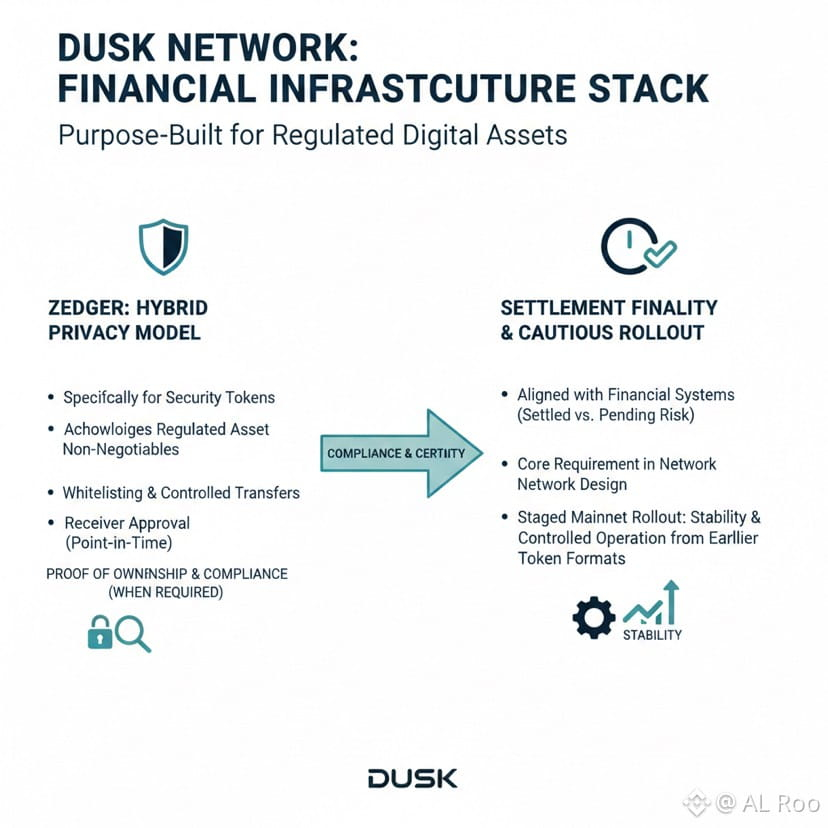
Dusk’s approach also signals that it cares about settlement finality in a way that is aligned with how financial systems operate, because in finance, finality is not a buzzword, it is the difference between something that is settled and something that is pending risk. The network’s design documents emphasize finality as a core requirement, and even the way the team handled mainnet rollout reflects a cautious infrastructure mindset rather than a one-click hype launch, with staged steps that prioritize stability, controlled operations, and the practical reality of migration from earlier token formats into a live network environment.
On the token side, DUSK exists as an ERC-20 on Ethereum, and that matters because it shows the bridge between the earlier distribution environment and the network’s own operational future, but the more important point is that the token is tied to the network’s security and usage economics through staking and transaction costs. When you think about the long-term story, the token’s strongest value narrative is not simply that it exists, but that it secures the chain and funds execution in a network that is explicitly built for financial activity that requires confidentiality and verifiable compliance. If Dusk becomes real rails for issuance, settlement, and compliant financial applications, then the token becomes connected to activity, security demand, and real usage rather than being stuck as a symbol waiting for attention.
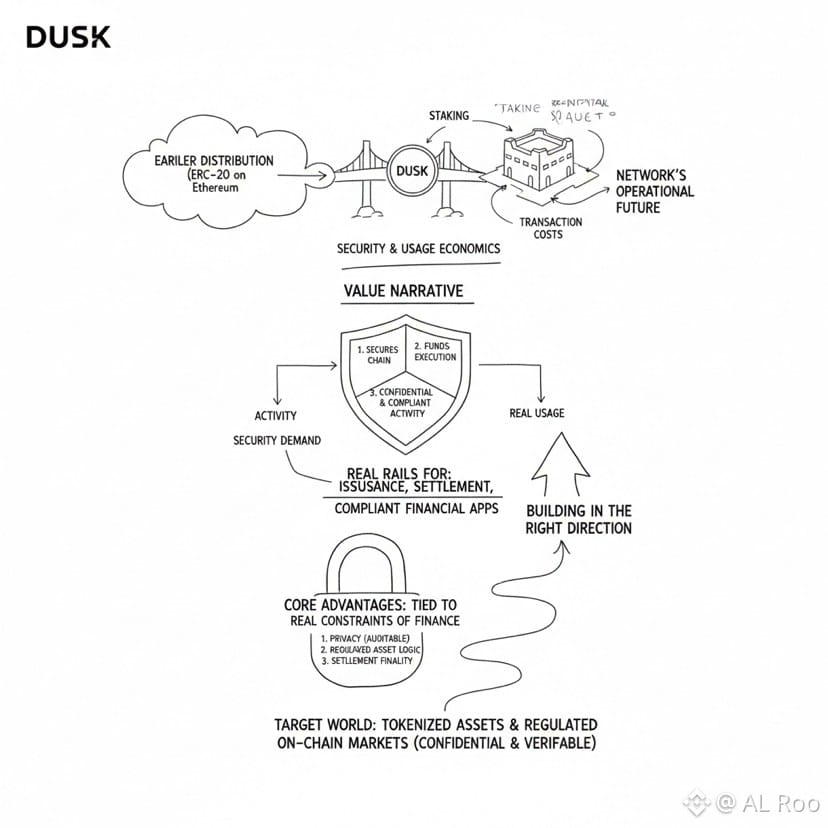
What I personally find most compelling about Dusk is that its benefits are not generic promises that every chain repeats, because the core advantages are tied to the real constraints of finance, meaning privacy that does not collapse the moment auditability is demanded, asset logic that is designed to handle regulated lifecycle behavior, and a settlement mindset that treats finality as foundational. That combination does not guarantee success, because adoption is always the hardest part, but it does mean Dusk is at least building in the right direction for the world it claims to target, which is a world where tokenized assets and regulated on-chain markets need systems that are both confidential and verifiable.
When people ask what is next for a project like Dusk, the most meaningful answer is rarely a single announcement, because the real signal comes from whether the stack keeps maturing into something developers can build on easily and institutions can trust operationally. The next phase should look like more usable tooling, more stable infrastructure, more real applications that prove the compliance-and-privacy model in practice, and more demonstrations that the security-token lifecycle ideas can operate smoothly under real conditions where users, issuers, and auditors all have different needs and different permissions.
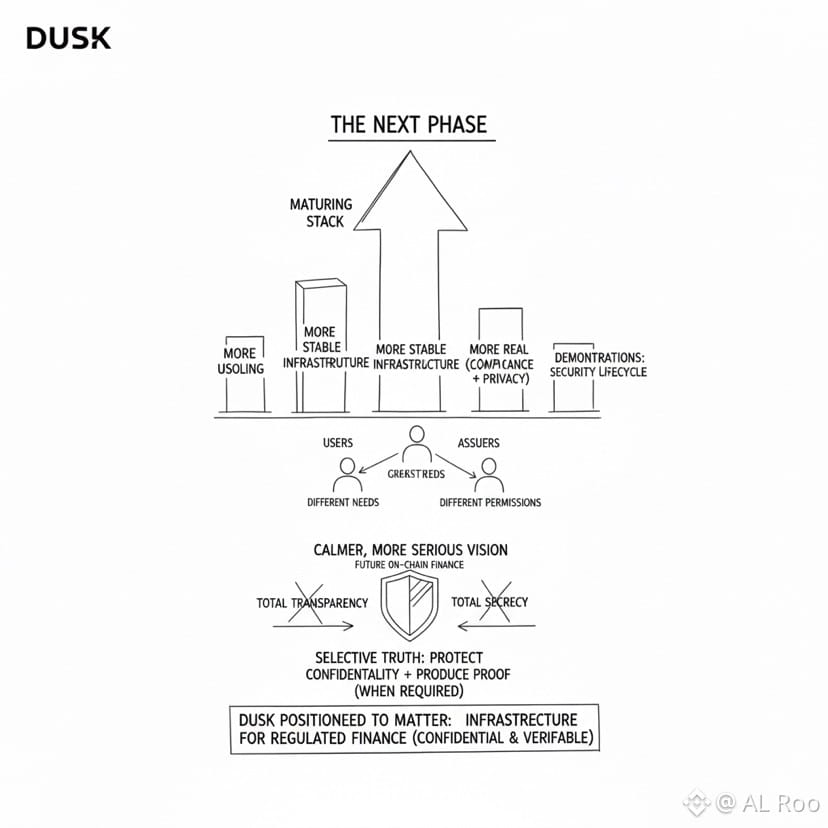 My takeaway is that Dusk Network feels like it was designed with a calmer, more serious vision than most projects, because it assumes that the future of on-chain finance will not be built on total transparency or total secrecy, it will be built on selective truth, where the system can protect confidentiality by default while still producing proof when it is required. If that future arrives the way many people expect, then Dusk is positioned to matter, not because it is loud, but because it is building the kind of infrastructure that regulated finance can actually use without exposing everything to the world.
