
Financial markets can postpone, but they never forget. In the short term, price can move ahead of reality, expectations can substitute for data, and policy can buy time. But any movement built on an incomplete foundation leaves traces behind. A gap on the chart is not a random event; it is a visible manifestation of unresolved structural issues that were never truly confronted. And sooner or later, the market always returns to those places.
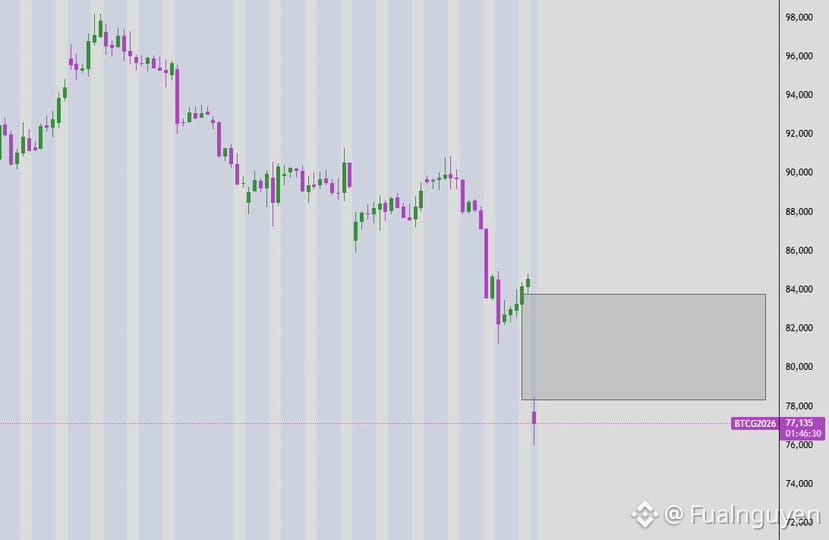
Over the past weekend, Bitcoin formed a wide CME gap between 78,000 and 83,000 USD as futures markets were closed. During that period, spot markets continued trading and price moved without the participation of institutional flow from the CME. When futures reopened, price did not simply continue lower by momentum. Instead, it staged a technical rebound to fill the lower portion of the gap between 78,000 and 79,000 USD. This was not a sign of renewed strength, but a structural response: the market was forced to revisit a price zone that had never been validated by real liquidity.
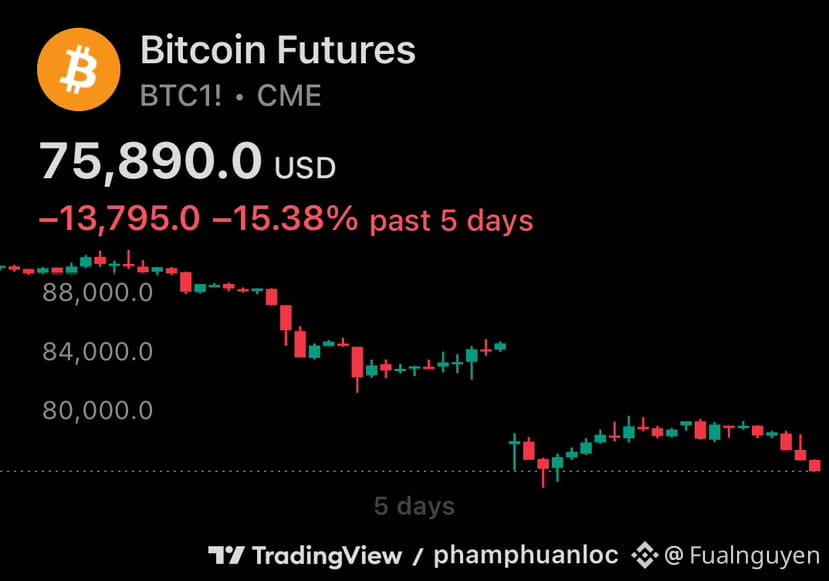
The remaining portion of the gap between 79,000 and 83,000 USD still exists. This does not guarantee that price must return there, but it does signal that the current market structure remains incomplete. In a weakening trend, such gaps do not disappear on their own. They persist as unanswered questions, and markets rarely move far while those questions remain unresolved.
What makes this more important is that the same phenomenon extends far beyond the chart. At the macro level, the global financial system is operating on similar unresolved issues—problems postponed by policy decisions and masked by expectations, but never addressed at their core. The gap between price and value in technical analysis mirrors the gap between policy and reality in macroeconomics.
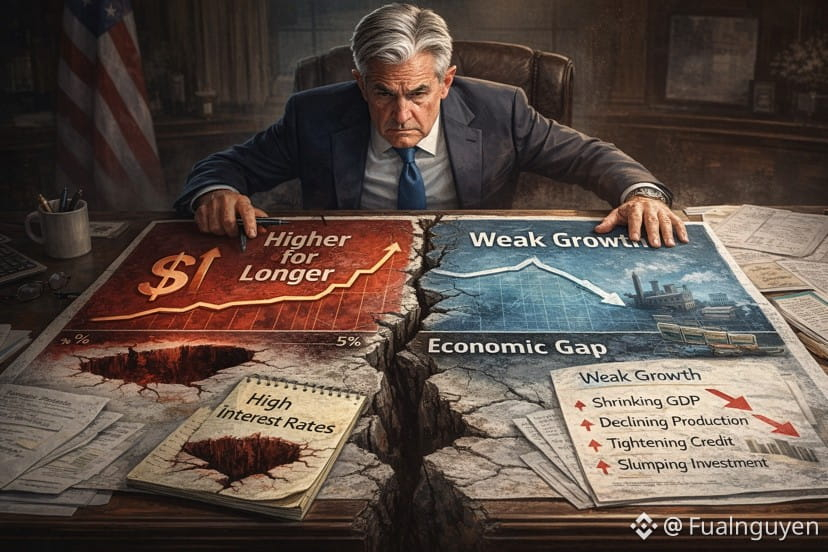
Jerome Powell and the U.S. Federal Reserve represent one of the clearest examples of this disconnect. Interest rates have been kept elevated for an extended period to control inflation, but the cost has been slowing growth, tightening credit conditions, and increasing pressure on the corporate sector. Meanwhile, asset markets have repeatedly behaved as if rate cuts were merely a matter of time. Policy and expectations have moved out of sync, creating a structural imbalance that has yet to be fully priced in.

On the fiscal side, Janet Yellen and the U.S. Treasury have not solved the debt problem; they have managed it through time. By prioritizing short-term Treasury bill issuance, immediate pressure on long-term yields has been reduced, but the debt itself has not disappeared. It has simply been pushed into the future, accumulating into a larger systemic risk. This is a classic unresolved issue, similar to a price gap temporarily obscured by a technical rebound—stable on the surface, fragile underneath.
Europe, under the leadership of Christine Lagarde, finds itself in a comparable position. The ECB speaks of financial stability, yet the region continues to face prolonged weak growth, declining consumption, and persistent geopolitical pressures. Monetary policy is neither loose enough to generate a clear recovery cycle nor decisive enough to force a necessary adjustment. A macro gray zone has emerged, much like the remaining 79,000–83,000 USD gap on Bitcoin’s chart: not invalidated, but far from safe.
The common thread across these examples is the postponement of the most difficult decisions. The Federal Reserve remains “data dependent,” the Treasury rotates debt maturities, and central banks emphasize stability over structural solutions. Markets may not trust words, but they closely observe actions. And when those actions reveal that problems are merely being deferred, unresolved risks inevitably begin to express themselves through price behavior.
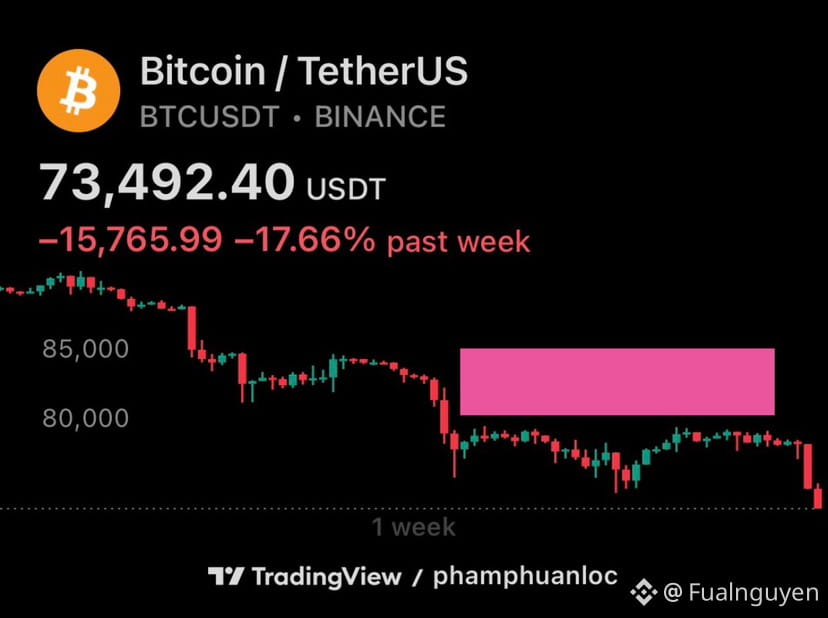
Returning to Bitcoin, the move to fill the 78,000–79,000 USD portion of the CME gap should not be interpreted as confirmation of a new uptrend. It simply indicates that the market has begun to confront what was previously ignored. The remaining gap between 79,000 and 83,000 USD stands as a reminder that risk has not disappeared - it is waiting to be priced more fully.
Markets fill gaps not because of a mechanical rule, but because neither technical structures nor macro systems can move forward on unresolved issues. Price can delay, policy can buy time, but ultimately, reality always finds its way back onto the chart.
#Fualnguyen #LongTermAnalysis #LongTermInvestment
