
When I hear Walrus (WAL) described as “asynchronous security” in a storage protocol, my brain immediately translates it into something less flattering: you’re refusing to assume the network behaves nicely, so you’re going to charge someone somewhere for that distrust. In Walrus, the cost doesn’t show up as a fee line item. It shows up as a liveness tax during challenge windows, when reads and recovery are paused until a two f plus one quorum can finalize the custody check. The design goal is auditable custody without synchrony assumptions, but the way you get there is by carving out periods where the protocol prioritizes proving over serving.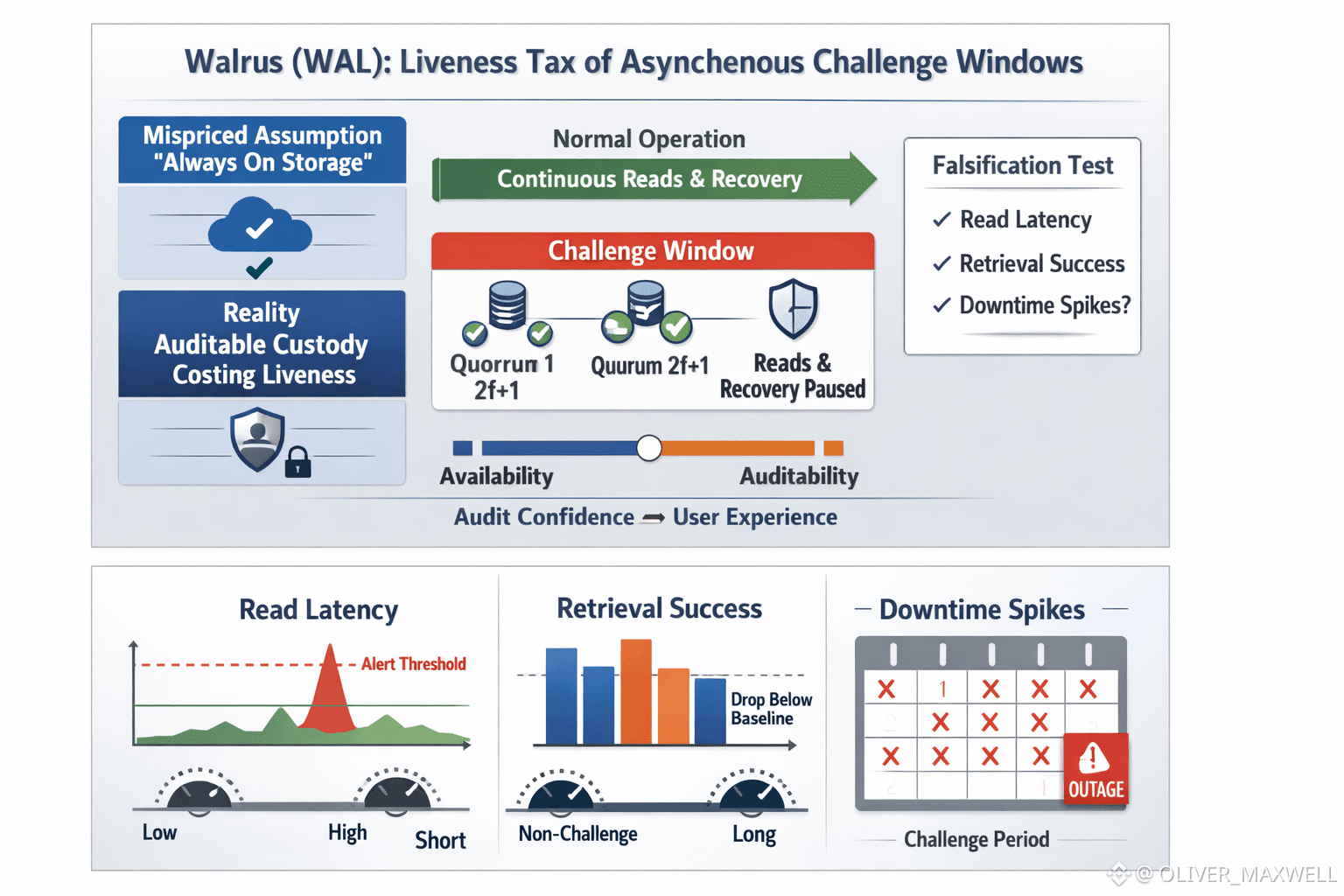
The core tension is simple: a system that can always answer reads in real time is optimizing for availability, while a system that can always produce strong custody evidence under messy network conditions is optimizing for auditability. Walrus wants the second property without pretending it gets the first for free. That’s exactly why I think it’s mispriced: the market tends to price decentralized storage like a slower, cheaper cloud drive, when it is actually a cryptographic service with an operational rhythm that can interrupt the “always-on” illusion.
Here’s the mechanism that matters. In an asynchronous setting, you can’t lean on tight timing assumptions to decide who is late versus who is dishonest. So the protocol leans on challenge and response dynamics instead. During a challenge window, the protocol moves only when a two f plus one quorum completes the custody adjudication step. The practical consequence is that reads and recovery are paused during the window until that two f plus one agreement is reached, which is the price of making custody proofs work without timing guarantees.
If you think that sounds like a small implementation detail, imagine you are an application builder who promises users that files are always retrievable. Your user does not care that the storage layer is proving something beautiful in the background. They care that the photo loads now. A design that occasionally halts or bottlenecks reads and recovery, even if it is rare, is not competing with cloud storage on the same axis. It’s competing on a different axis: can you tolerate scheduled or probabilistic service degradation in exchange for a stronger, more adversarially robust notion of availability?
This is where the mispricing shows up. People anchor on “decentralized storage” and assume the product is commodity capacity with crypto branding. But Walrus is not selling capacity. It’s selling auditable custody under weak network assumptions, and it enforces that by prioritizing the challenge window over reads and recovery throughput. The market’s default mental model is that security upgrades are additive and non-invasive. Walrus forces you to accept that security can be invasive. If the protocol can’t assume timely delivery, then “proving custody” has to sometimes take the driver’s seat, and “serving reads” has to sit in the back.
The trade-off becomes sharper when you consider parameter pressure. Make challenge windows more frequent or longer and you improve audit confidence, but you also raise the odds of user-visible read-latency spikes and retrieval failures during those windows. Relax them and you reduce the liveness tax, but you also soften the credibility of the custody guarantee because the system is giving adversaries more slack. This is not a marketing trade-off. It’s an engineering choice that surfaces as user experience, and it is exactly the kind of constraint that markets routinely ignore until it bites them.
There’s also an uncomfortable second-order consequence. If “always-on” service becomes an application requirement, teams will try to route around the liveness tax. They will add caching layers, replication strategies, preferred gateways, or opportunistic mirroring that can smooth over challenge-induced pauses. That can work, but it quietly changes what is being decentralized. You end up decentralizing custody proofs while centralizing the experience layer that keeps users from noticing the protocol’s rhythm. That’s not automatically bad, but it is absolutely something you should price as a structural tendency, because the path of least resistance in product land is to reintroduce privileged infrastructure to protect UX.
Risks are not hypothetical here. The obvious failure mode is that challenge windows become correlated with real-world load or adversarial conditions. In calm periods, the liveness tax might be invisible. In stress, it can become the headline. If a sudden burst of demand or a targeted disruption causes more frequent or longer challenge activity, the system is effectively telling you: I can either keep proving or keep serving, but I can’t guarantee both at full speed. That is the opposite of how most people mentally model storage.
And yet, this is also why the angle is interesting rather than merely critical. Walrus is making a principled bet that “availability you can audit” is a more honest product than “availability you assume.” In a world where centralized providers can disappear data behind policy changes, account bans, or opaque outages, the ability to verify custody is real value. I’m not dismissing that value. I’m saying many people price it as if it has no operational rhythm, but Walrus does, and the challenge window is the rhythm. Ignoring that shape is how you misprice the risk and overpromise the UX.
So what would falsify this thesis? I’m not interested in vibes or isolated anecdotes. The clean falsifier is production monitoring that shows challenge periods without meaningful user-visible impact. If, at scale, the data shows no statistically significant increase in read latency, no observable dip in retrieval success, and no measurable downtime during challenge windows relative to matched non-challenge periods over multiple epochs, then the “liveness tax” is either engineered away in practice or so small it’s irrelevant. That would mean Walrus achieved the rare thing: strong asynchronous custody auditing without forcing the user experience to pay for it.
Until that falsifier is demonstrated, I treat Walrus as a protocol whose real product is a trade. It trades continuous liveness for auditable storage, and it does so intentionally, not accidentally. If you’re valuing it like generic decentralized storage, you’re missing the point. The question I keep coming back to is not “can it store data cheaply,” but “how often does it ask the application layer to tolerate the proving machine doing its job.” That tolerance, or lack of it, is where the market will eventually price the protocol correctly.

