


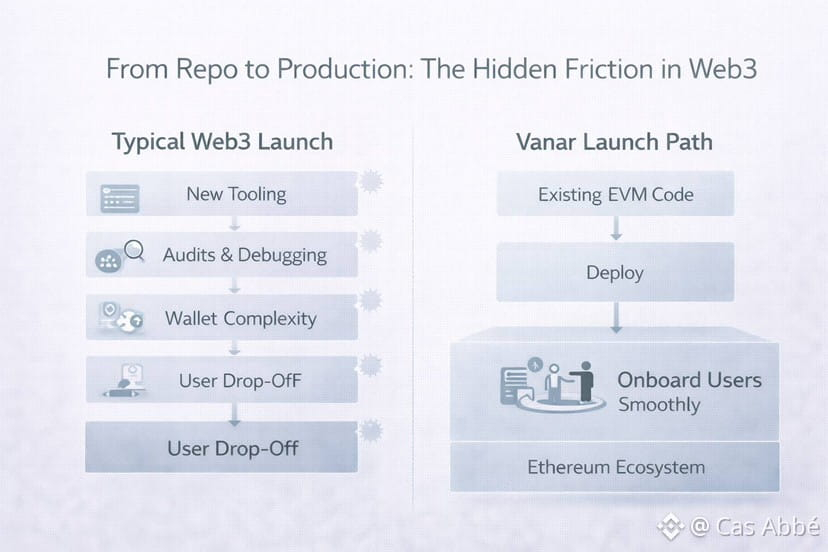
The majority of chains attempt to outbid each other with such huge figures: TPS, TVL, partnerships, AI. Vanar is more silent in his larger stride. It attempts to eliminate any friction in the background that prevents the actual launching of real products: the complexity of wallets, onboarding drop-offs, tooling missing, and the nightmare of having to re-write everything when the developers switch to a different chain.
When you do not pay attention to the slogans, Vanar is establishing a chain where people who build to the Ethereum can give something that is already running and deliver it to more people with a few less sharp edges. That is not glitzy, however, that is what infrastructure is made out of.
EVM compatibility is not something checked, but an adoption approach
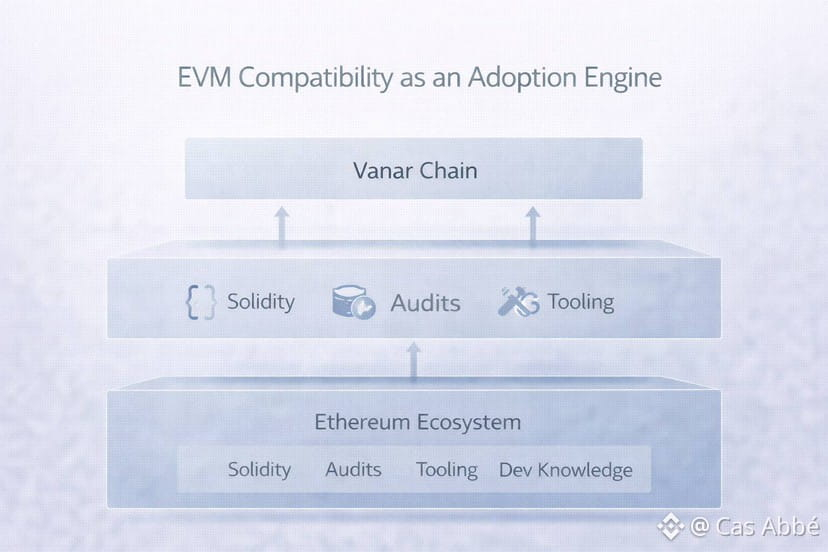
EVM compatible has been said as a feature. As a matter of fact, it is a plan to use a whole ecosystem: Solidity patterns, audits, tools, the habits already in place by developers, and pipelines that connect things. Vanar says so explicitly: it is constructed in such a way that developers are not required to migrate their brain to a new stack before they can build.
That is important as the largest software expense is not often compute. It’s time and risk. Whenever a team is considering joining a new chain, they ask themselves: will we require new tools/audits/new hires/new debugging skills? The response of Vanar is: take your existing EVM apps, and we will reduce the operating pain around them.
This reverses the tradition of L1 competition. The chain does not just compete based on raw speed but on speed based on how quick a team can take to go through a repository and on to a production.
The actual constriction is not transactions, but onboarding
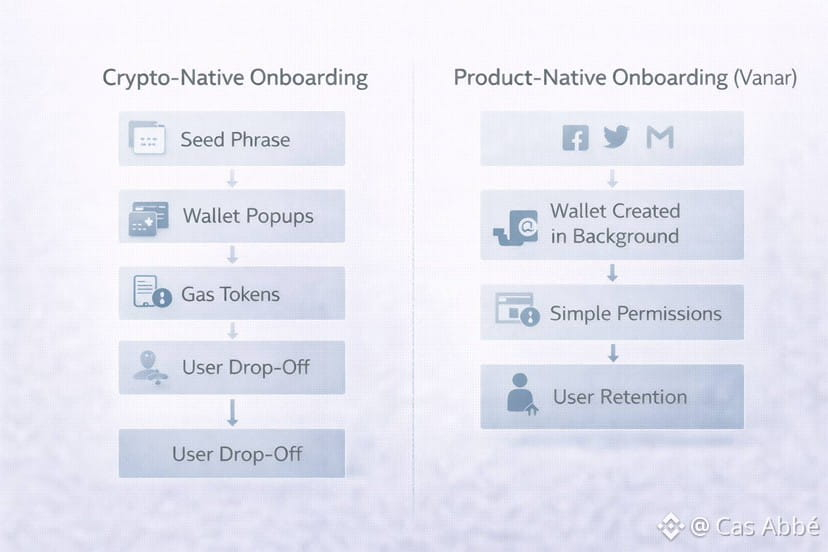
It is here that we have the awkward reality of the Web3 applications: the reason most people do not use a particular application is not that the chain is slow, but that wallets are threatening: seed phrases, approvals, and gas tokens, weird pop-ups, and the fear that they will make a bad choice.
The documentation the developer of vanar provides indicates it is using the account-abstraction patterns, such as ERC-4337, to eliminate that friction, even going as far as to allow a project to create a wallet on behalf of the user and be able to use familiar log-out flows such as social sign-on or email/password.
That is a big deal. It implies that Vanar believes that the chain is not only a ledger, but a backend, which allows the front-end to feel like default software. It is not merely through solving onboarding that you would receive more sign-ups but new types of products.
The fact that one can make a wallet behind the scene and retrieve it as a regular app changes all things to mainstream markets. It allows Web3 applications to be adopted by individuals that do not wish to identify as crypto users. They simply desire a functioning product.
The aspect of infrastructure is distribution, and Vanar appears to understand it.
The first pages of Vanar ecosystem display a typical Kickstart style the layout emphasizing on partner tools and benefits to builders such as discounts, onboarding support, and co-marketing. That is not merely an extra that is nice but structural benefit. A chain will be a viable option, not a conjecture, should it assist a builder to save on cost, launch time, and friction to go to market.
That is the tedious truth of platform development: the finest chains are not simply selling blockspace, but giving it a push.
There are standard tools which indicate seriousness.
A common method of determining the actual desire of a chain to be adopted is to check its location in the world of available developers. As an illustration, one can purchase Vanar on third-party tool ecosystems such as Thirdweb, with an embedded chain ID.
It is a big deal, but maybe, that. Chain integration with popular developer platforms reduces deployment, contract interaction, and application building friction. Majority of developers are not interested in starting afresh; they prefer a chain that will fit in current teams shipment of software.
Infrastructure is made invisible in this way. And transcendent infrastructure heights.
When a chain is expecting humans, it is not the same to having a chain that is expecting software.
The other angle that is important is that there are those chains that are constructed around the way people behave as well as the construction of software that behaves in a certain way. Software operates continually and sometimes human users come.
Vanar communication is now more focused on the idea of the chain as something that works with workflows, where applications run all the time, not only when an individual clicks a button. The larger the chain is accommodating standard patterns of developer, predictable operations, and smoother onboarding, the more it is accommodating machine-driven activity.
Despite disregarding all the buzzwords, the trend is obvious: Vanar is creating a software-oriented chain. It desires developers to release products that look like regular applications, and the crypto complexity is moved to the background.
What makes this a good bet despite it being overlooked in the market in the short run.
Spectacle is frequently rewarded with markets, and not usefulness. It is the reason why the most essential changes in infrastructure may be underestimated - they do not give us fireworks, they give us reliability.
However, it is reliability that businesses, consumer applications with serious intentions, and long-term constructors really purchase. Should Vanar be successful in reducing the onboarding load, the migration load, and the ecosystem load, it will earn something uncommon developer trust.
Even minor increments in developer trust will pay off.
When a developer launches once, he/she is likely to repeat it. In case a team is able to attract users with no need to concern with seed phrases, it is likely to develop. Where the project is able to work with tools that people are already familiar with, then the project will proceed at a faster rate. These are not long term stories, these are the actual reasons why change occurs.
A more fundamental argument: the following generation of users will not know that they are engaging in Web3.
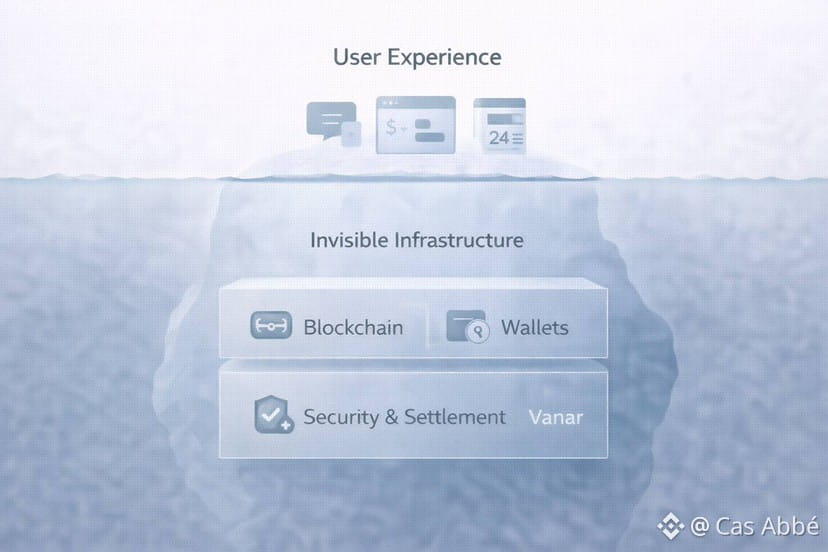
Unless Vanar continues to follow the same design decisions, there is no intention to attract more crypto enthusiasts. It is to take an average user to use a product that simply works on a blockchain.
It is why it is important to pay attention to the way developers work. Good technology will not be the only thing in winning chains. They will make the construction process ordinary, the employee induction process safe, and the process of launching fast.
Vanar is set to be such a kind of infrastructure: it is not the noisiest blockchain, but the one that developers can conveniently use, without making users experts. It is generally what proves successful in the long-term.

