
The session ended without asking for attention.
Inside Virtua Metaverse, that’s normal. Presence carries forward. Inputs resolve. The world doesn’t stop to explain itself. When the moment closed, the scene didn’t blink, and the flow didn’t break. The assumption, learned from years of entertainment products built for mass usage, was that completion would feel like continuity.
It did.
What didn’t appear was a place to point at afterward.
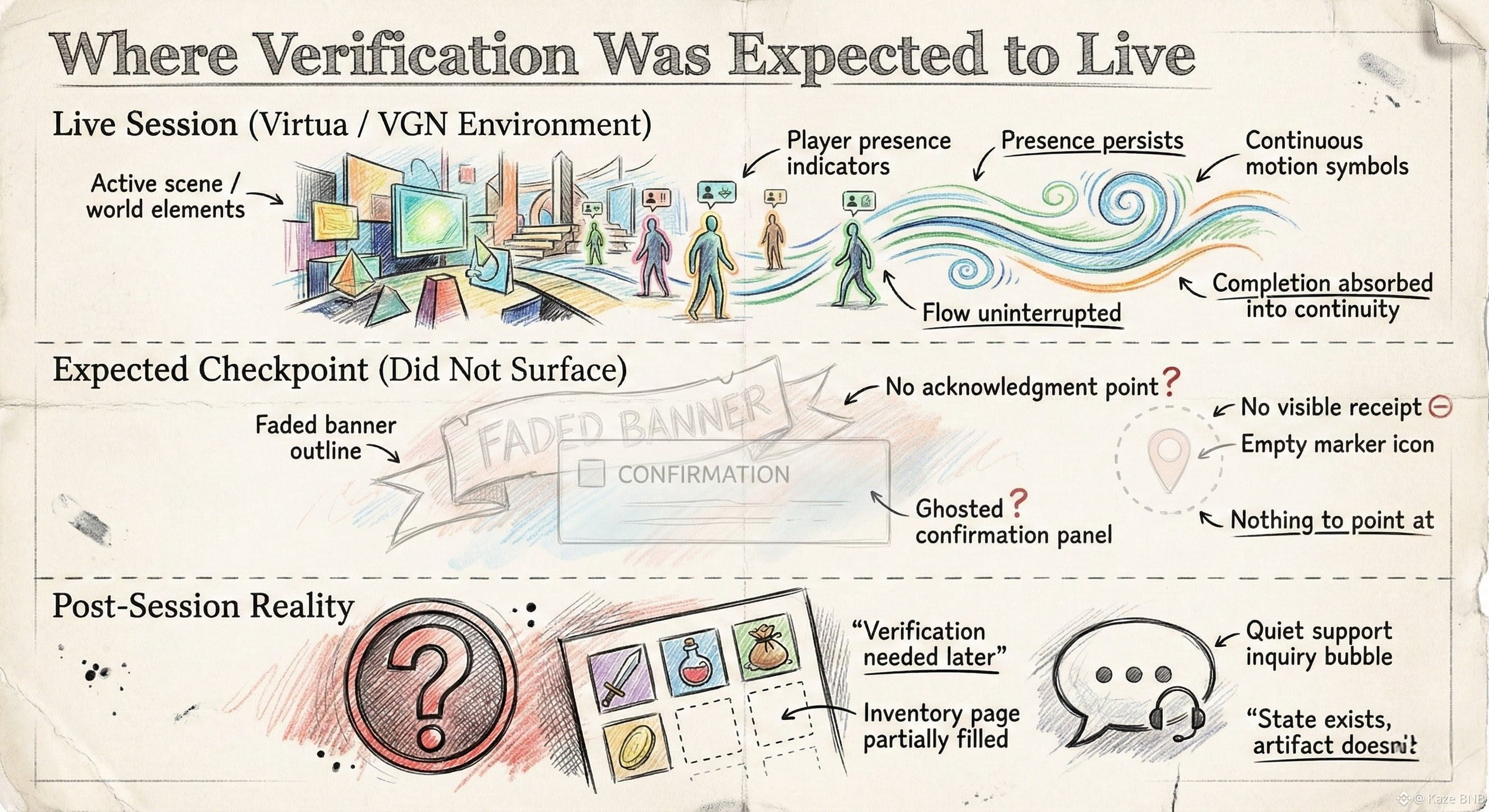
No banner surfaced. No wallet-shaped interruption arrived late. No panel asked me to acknowledge what had just happened. The session ID clearly existed; the environment wouldn’t have progressed without it. But it stayed where it belonged, off the surface, while the experience kept moving.
That absence felt deliberate.
In spaces tied to VGN Games Network, sessions don’t end so teams can tidy up. They overlap. They persist. They carry assumptions forward while players keep moving. The world treats completion as something that happens inside the flow, not as a ritual performed afterward, especially for non-crypto-native users who never came to learn a chain.
I waited for the checkpoint anyway.
It never came.
The question showed up later, not during play. Someone asked whether the action could be verified. The screen had already moved on. The world had already accepted the result. When we went looking, the inventory page stayed empty longer than anyone expected, not because something failed, but because nothing had been staged for inspection at the moment it would usually appear.
There was nothing to reference without leaving the moment that had already passed.
By the time certainty was needed, the experience had already moved on without it. Whatever normally creates confidence had been displaced, pushed out of the session and into a quieter, less obvious place. The flow hadn’t stalled. It had simply stopped offering a shared point of acknowledgment.
That kind of gap doesn’t register as an error.
In most blockchain products, the chain insists on being seen. A confirmation interrupts the experience to create a receipt-shaped memory. In entertainment, that interruption is the failure. Momentum collapses the second attention is redirected, especially in persistent worlds where presence is the product.
This is where Vanar Chain shows its intent. Vanar isn’t trying to teach people how blockchains work mid-session. It treats the gap between blockchain ceremony and real-world adoption as something to be absorbed, not surfaced. The chain stays quiet during the user’s moment, even when that means pushing the burden of certainty elsewhere.
You feel the tradeoff when questions arrive without a step to reference.
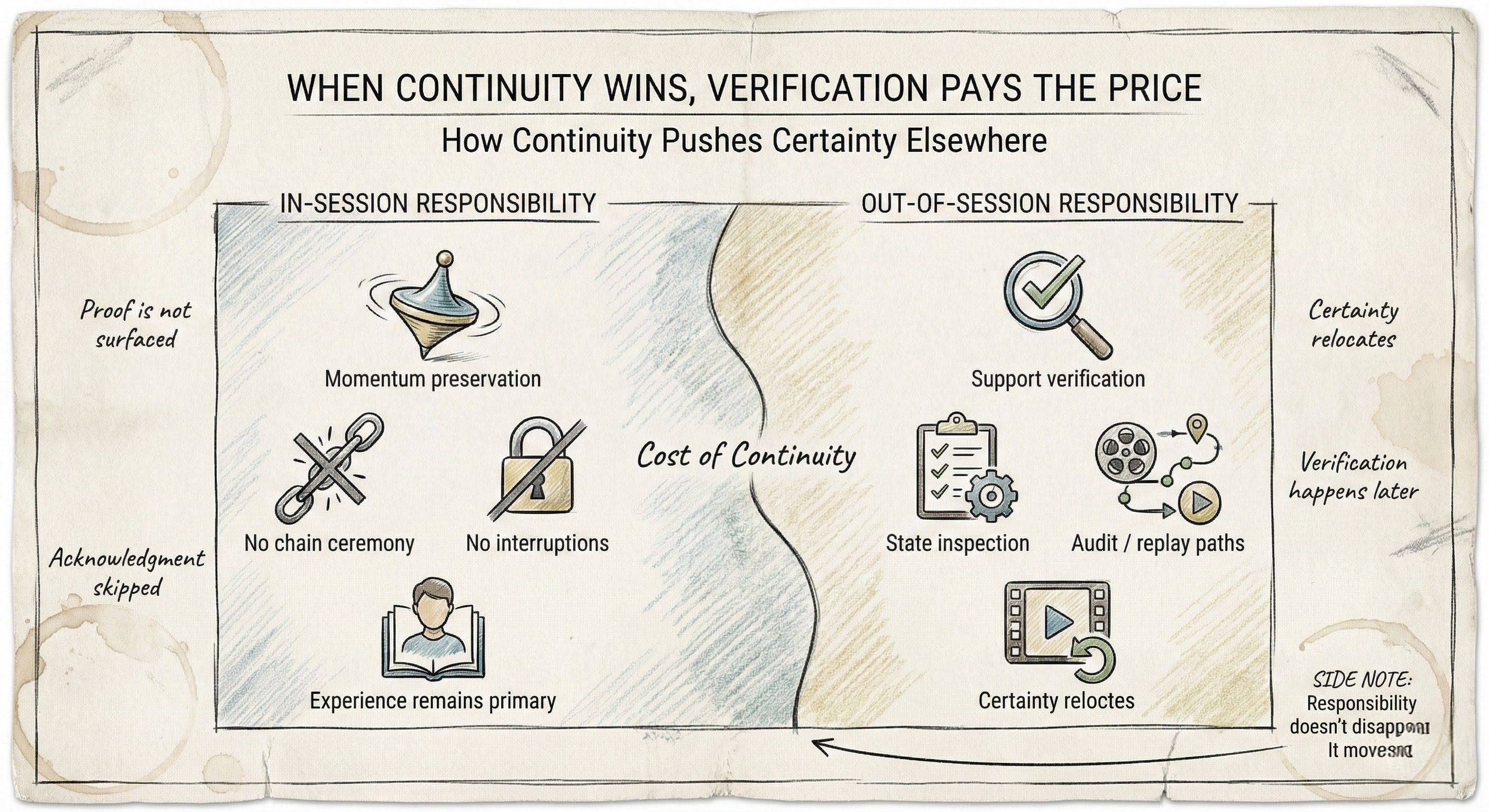
Support doesn’t ask what broke; it asks where the marker lives. “Did it go through?” becomes “the app says yes,” and that’s the whole artifact. Audit and replay don’t attach to a visible ceremony; they attach to state that was never meant to be seen. Responsibility doesn’t disappear, it relocates.
That relocation is the cost of continuity.
Inside Virtua, the environment keeps moving. Inside VGN loops, hesitation is punished by disengagement. The session ends, another begins, and the missing checkpoint remains exactly that, missing. Even Vanar ($VANRY ) stays in the background here, present as connective tissue rather than a surface anyone has to touch.
At some point, it becomes clear the experience was never designed to prove anything in the moment. It was designed to continue, because Vanar was built for entertainment presence, not dashboard proof.
The session finished. The world accepted it. And the place where verification usually lives never showed up, because showing up would have been the interruption.
The system doesn’t announce that choice.
It doesn’t justify it.
It just keeps running, long after the session is over.
