
Determinism is rarely discussed as a monetary concept, yet it sits at the foundation of every functioning financial system. Money, at scale, does not tolerate ambiguity. When value moves, the outcome must be known in advance: how much will be transferred, when it will settle, what it will cost, and whether the result is final. In traditional finance, this predictability is assumed rather than debated. Payment rails, clearing systems, and settlement networks are engineered so outcomes are consistent even under stress. Blockchain systems, however, emerged from a different lineage—one focused on permissionless experimentation rather than monetary reliability. Plasma begins from a different premise: that determinism itself is a core monetary property, and without it, digital money cannot mature into real financial infrastructure.
In most blockchain ecosystems, determinism is treated narrowly, as a property of smart contract execution within a virtual machine. If the same inputs produce the same outputs, the system is labeled deterministic. This definition is technically correct yet economically insufficient. From a monetary perspective, determinism extends far beyond contract logic. It includes execution latency, fee behavior, transaction ordering, settlement finality, and system behavior under load. A system where execution logic is deterministic but outcomes vary due to congestion, fee spikes, or reordering is not deterministic in any meaningful financial sense. Plasma reframes determinism as an end-to-end system guarantee rather than a local technical characteristic.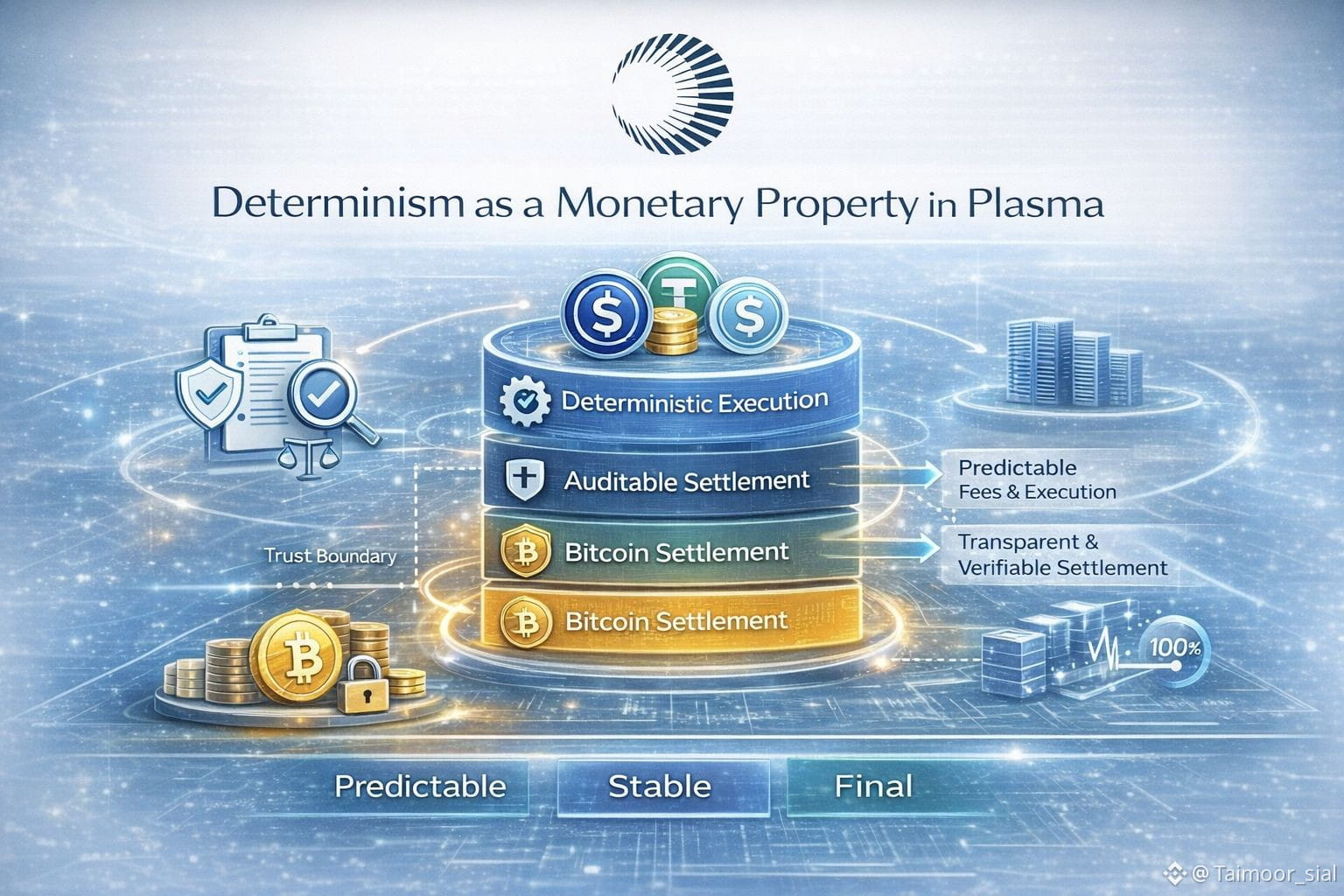
Money functions as coordination infrastructure. Every participant in a monetary system—users, merchants, institutions, regulators—relies on shared expectations. When those expectations break, trust erodes quickly. This is why traditional financial systems are conservative by design. They avoid unnecessary complexity, constrain optionality, and prioritize stability over flexibility. Plasma adopts this same philosophy, recognizing that stablecoins are not experimental assets but transactional instruments. If stablecoins are to function as digital cash equivalents, the system supporting them must behave with the same predictability as existing payment infrastructure. Determinism, in this context, is not an optimization; it is the price of admission.
General-purpose blockchains struggle with determinism precisely because they are general-purpose. They allow arbitrary workloads to coexist, forcing unrelated activity to compete for the same execution and settlement resources. During periods of market stress, speculative demand overwhelms payment flows, causing fees to spike and execution times to degrade. From a monetary standpoint, this is catastrophic. A payment that becomes expensive or delayed precisely when demand increases is not reliable money. Plasma treats this failure mode as unacceptable. Its architecture is explicitly designed so that stablecoin execution does not compete with speculative computation, preserving deterministic behavior regardless of external conditions.
Fee volatility is one of the clearest examples of how nondeterminism undermines monetary function. In traditional finance, transaction costs are known in advance or vary within narrow, predictable bounds. In many blockchain systems, fees are auction-based, fluctuating wildly depending on network demand. This may be tolerable for speculative transactions, but it is incompatible with payments, payroll, settlement, and treasury operations. Plasma recognizes that unpredictable fees introduce monetary uncertainty, effectively turning every transaction into a market bet. By aligning execution economics with stablecoin use cases, Plasma restores cost determinism, allowing users and institutions to reason about value movement with confidence.
Settlement finality is another dimension where determinism becomes monetary rather than technical. Probabilistic finality may be acceptable for experimental systems, but financial actors require clarity: when is a transaction truly complete? When can funds be released, reconciled, or reused? Plasma’s consensus design emphasizes fast, deterministic finality so that settlement outcomes are not subject to reinterpretation. This mirrors traditional clearing systems, where finality is a contractual and operational guarantee rather than a statistical likelihood. In monetary systems, ambiguity about finality is equivalent to risk, and Plasma’s design explicitly minimizes that risk.
Transaction ordering further illustrates the monetary importance of determinism. In speculative environments, transaction ordering is often treated as a game, with actors competing for priority through fees or specialized extraction strategies. In financial systems, ordering must be neutral and predictable. Payment outcomes should not depend on who can outbid whom in a fee auction. Plasma’s approach removes ordering as a source of economic advantage, ensuring that stablecoin flows behave consistently and fairly. This neutrality is essential for institutional adoption, where even perceived unfairness can be disqualifying.
Determinism also underpins auditability, a critical requirement for regulated finance. Auditors and regulators do not merely ask whether transactions are valid; they ask whether systems behave consistently across time and conditions. A system that produces different outcomes under identical circumstances cannot be reliably audited. Plasma’s deterministic execution and settlement model ensures that transaction histories can be reconstructed, verified, and reconciled without ambiguity. This transforms on-chain data from raw activity logs into reliable financial records, suitable for compliance, reporting, and oversight.
Privacy, often viewed as being in tension with transparency, also benefits from deterministic design. In nondeterministic systems, privacy features can obscure not just sensitive data but also system behavior, complicating compliance and risk analysis. Plasma’s approach to privacy-preserving settlement maintains determinism at the system level while allowing selective confidentiality at the data level. This ensures that institutions can protect sensitive information without sacrificing the predictability required for monetary operations. Determinism becomes the foundation that allows privacy and compliance to coexist rather than conflict.
Liquidity behavior further reinforces determinism’s monetary role. In financial markets, liquidity must be dependable. A system where liquidity becomes inaccessible or inefficient during periods of stress fails precisely when it is needed most. Plasma’s stablecoin-first design ensures that liquidity flows remain predictable, enabling large-scale settlement without cascading failures. By treating liquidity as infrastructure rather than incentive-driven speculation, Plasma preserves deterministic access to value even as usage scales.
The choice to anchor security to Bitcoin reflects Plasma’s broader commitment to conservative, deterministic design. Bitcoin’s strength lies not in flexibility but in reliability. By respecting Bitcoin as a settlement anchor rather than attempting to replicate or replace it, Plasma inherits a layer of monetary certainty that reinforces its deterministic guarantees. This layered approach mirrors traditional finance, where fast execution systems ultimately settle on the most secure and trusted ledgers. Determinism, in this sense, is extended across layers rather than confined to a single component.
From an institutional perspective, determinism is not optional. Financial institutions operate within strict risk frameworks that assume system behavior can be modeled and predicted. A blockchain that behaves unpredictably introduces unquantifiable risk, regardless of its theoretical capabilities. Plasma’s architecture aligns with institutional expectations by making system behavior legible and stable. This does not make Plasma more restrictive; it makes it usable. Institutions do not demand flexibility—they demand reliability.
Critically, determinism does not eliminate innovation; it redirects it. By constraining the system around stablecoin execution and settlement, Plasma shifts innovation away from speculative complexity and toward operational excellence. Developers build applications knowing the underlying system will behave consistently. This lowers integration risk, shortens development cycles, and enables long-term planning. In this way, determinism becomes an enabler of sustainable innovation rather than a limitation.
The broader implication of treating determinism as a monetary property is a redefinition of what blockchain systems are for. Not every network needs to maximize expressiveness or experimentation. Some networks must function as infrastructure—quietly, reliably, and predictably. Plasma embraces this role. It does not attempt to be the most flexible or the most expressive system. It aims to be the most dependable environment for stablecoin-based value movement.
As stablecoins increasingly resemble digital money rather than crypto assets, the systems supporting them must evolve accordingly. Monetary systems are judged not by peak performance metrics but by their behavior over time, across conditions, and under stress. Determinism is the common thread that ties together cost predictability, settlement finality, auditability, and trust. Plasma’s architecture recognizes this and elevates determinism from an implementation detail to a core design principle.
In the long arc of financial infrastructure, the most successful systems are often the least visible. They do not draw attention to themselves; they simply work. Plasma’s emphasis on determinism reflects an understanding that digital money does not need novelty—it needs reliability. By treating determinism as a monetary property rather than a technical checkbox, Plasma positions itself not as another blockchain experiment, but as a foundation for the next generation of financial systems.
Ultimately, the significance of determinism in Plasma lies in what it enables. It enables stablecoins to function as real money. It enables institutions to trust on-chain settlement. It enables regulators to reason about digital flows. And it enables users to transact without worrying about the underlying mechanics. In this sense, determinism is not just a feature of Plasma—it is its monetary philosophy.
