
The Reality Most Protocols Try to Ignore
Decentralized systems are often designed under an uncomfortable illusion: that networks behave predictably. Messages are assumed to arrive on time. Nodes are expected to remain online. Delays are treated as exceptions rather than the norm.
In real networks, this assumption collapses almost immediately.
Latency fluctuates. Nodes disconnect without warning. Messages arrive late, out of order, or not at all. Network partitions happen. Churn is constant. These conditions are not edge cases they are the default state of decentralized infrastructure.
Most storage protocols treat this uncertainty as a problem to be minimized.
Walrus takes the opposite approach.
Instead of fighting uncertainty, Walrus embraces it. Instead of trying to eliminate asynchrony, it builds security on top of it. What other systems see as a weakness, Walrus turns into a structural advantage.
This article explores how Walrus transforms network unpredictability from a liability into a core security feature and why this shift represents a fundamental evolution in decentralized storage design.
The Traditional Fear of Asynchrony
In classical distributed systems theory, asynchrony is dangerous. When there is no reliable global clock and no guaranteed message delivery time, it becomes difficult to distinguish between:
A slow node
A failed node
A malicious node
Many protocols respond to this ambiguity by imposing timeouts, synchronized rounds, and strict response windows. If a node fails to respond on time, it is treated as faulty.
This approach works reasonably well in controlled environments. It breaks down badly in open, permissionless networks.
Honest nodes are penalized simply because of latency. Attackers can exploit timing assumptions. Security becomes entangled with network performance a deeply fragile dependency.
Walrus rejects this entire paradigm.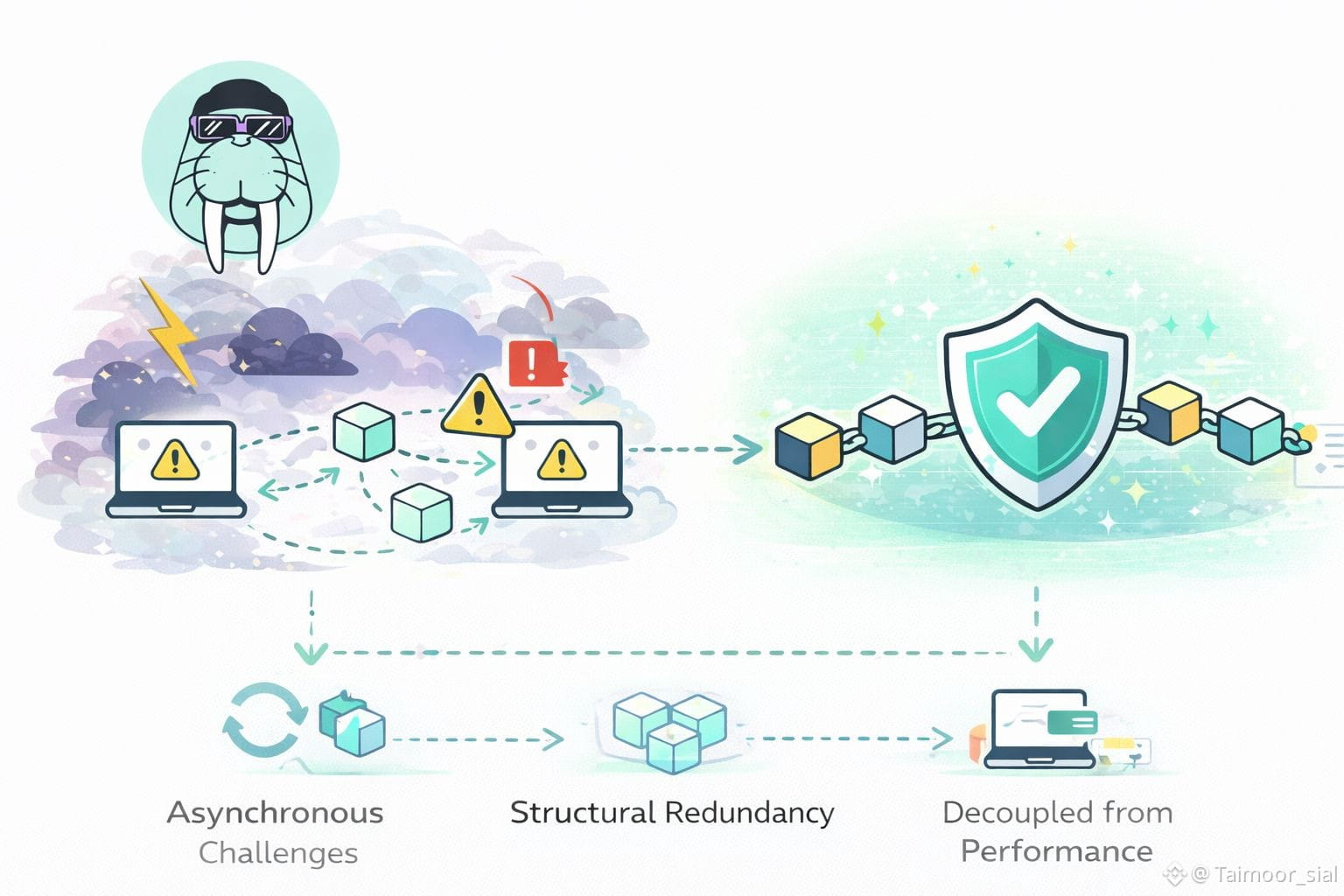
Walrus Core Design Shift: Stop Trusting Time
The most important conceptual shift in Walrus is this:
Time is not a reliable security signal.
If security depends on synchronized responses, then security collapses under real-world conditions. Walrus instead bases security on structure, redundancy, and sufficiency, not punctuality.
In Walrus:
Late responses are not suspicious by default
Missing responses are tolerated up to a threshold
Correctness is determined by cryptographic evidence, not speed
This change alone reshapes how uncertainty is handled.
From Network Chaos to Predictable Guarantees
Network uncertainty has three main dimensions:
Latency variability
Node churn
Unreliable communication
Most systems attempt to smooth over these issues. Walrus designs around them.
Instead of requiring:
All nodes to respond
Responses to arrive within a fixed window
Global coordination
Walrus asks a simpler question:
Is there enough independent evidence that the data exists in the network?
Once that question is answered, the exact timing of responses becomes irrelevant.
Asynchronous Challenges: Security Without Coordination
At the heart of Walrus approach is the asynchronous challenge protocol.
Traditional challenge systems operate in rounds. A challenge is issued, nodes respond within a deadline, and results are evaluated synchronously. This design implicitly assumes stable connectivity.
Walrus removes this assumption entirely.
Challenges in Walrus:
Do not require synchronized participation
Do not depend on strict deadlines
Do not punish slow but honest nodes
Nodes respond independently, using the data they locally store. Proofs are aggregated over time. As long as a sufficient subset of valid proofs is eventually collected, the system is secure.
Network delays no longer weaken verification they are simply absorbed by the protocol.
Why Uncertainty Strengthens Walrus Security Model
This design has a counterintuitive effect: greater network uncertainty can actually improve security.
Here’s why.
Attackers often rely on predictability. They exploit known timing windows, synchronized rounds, and coordination assumptions. When verification depends on exact timing, attackers can strategically appear responsive only when it matters.
Walrus removes these attack surfaces.
Because challenges are asynchronous:
Attackers cannot “wake up just in time”
There is no single moment to exploit
No advantage to coordinated behavior
Security becomes probabilistic and structural, not temporal.
Structural Redundancy Over Temporal Guarantees
Walrus encodes data in a way that ensures availability through redundancy rather than responsiveness.
Instead of relying on:
One node responding quickly
Walrus relies on:
Many nodes storing interdependent fragments
The system does not care which nodes respond, only that enough correct fragments exist.
This is a powerful shift.
It means:
Individual failures are irrelevant
Delays do not undermine correctness
Adversaries must compromise structure, not timing
Uncertainty becomes noise, not a threat.
Decoupling Security from Network Performance
One of the most dangerous design choices in decentralized systems is coupling security to performance.
If security depends on low latency:
Congestion becomes an attack vector
DDoS attacks double as security attacks
Honest nodes suffer during peak load
Walrus avoids this trap entirely.
Because verification is asynchronous:
High latency does not reduce security
Congestion affects speed, not correctness
Performance degradation does not cause false penalties
This separation makes the system far more resilient under stress.
Churn Is No Longer a Problem
Node churn nodes joining and leaving is a fact of life in decentralized networks. Many protocols struggle to maintain security guarantees when participation fluctuates.
Walrus treats churn as expected behavior.
Because:
Storage responsibility is distributed
Proofs do not depend on fixed participants
Challenges do not require full participation
Nodes can come and go without destabilizing the system.
In fact, churn can improve decentralization by preventing long-term concentration of data.
Dynamic Shard Migration Reinforces Uncertainty
Walrus goes even further by actively introducing controlled unpredictability through dynamic shard migration.
As stake levels change:
Shards move between nodes
Storage responsibility shifts
Long-term data control is disrupted
This constant movement makes it difficult for any participant to accumulate lasting influence over specific data.
In other words, Walrus doesn’t just tolerate uncertainty it creates it deliberately to enhance security.
Uncertainty as an Anti-Centralization Tool
Centralization thrives on stability. If data placement is static, powerful actors can optimize around it. If responsibilities are predictable, influence accumulates.
Walrus breaks this pattern.
Because:
Network conditions fluctuate
Storage assignments change
Verification is asynchronous
There is no stable target to capture.
Uncertainty prevents ossification. It keeps power fluid and distributed.
Economic Accountability Without Timing Assumptions
Even incentives and penalties in Walrus are designed to function under uncertainty.
Nodes are not punished for being slow. They are punished for being wrong.
This distinction matters.
Penalties are based on:
Failure to provide valid proofs
Structural absence of data
Cryptographic evidence
Not on:
Missed deadlines
Temporary disconnections
Network hiccups
As a result, economic security remains fair even when networks misbehave.
Why This Matters at Scale
As decentralized storage grows:
Data sizes increase
Global participation expands
Network diversity explodes
Under these conditions, predictability disappears.
Protocols that depend on synchrony degrade. Protocols that depend on uncertainty thrive.
Walrus is built for this future.
A Philosophical Shift in Distributed Systems Design
At a deeper level, Walrus represents a philosophical change.
Instead of asking:
“How do we control the network?”
Walrus asks:
“How do we remain secure despite losing control?”
This mindset aligns with reality. Open systems cannot be controlled they must be resilient.
From Fragile Guarantees to Robust Security
Traditional systems offer strong guarantees under narrow conditions. Walrus offers slightly weaker guarantees under ideal conditions — but much stronger guarantees under real ones.
This tradeoff is deliberate and wise.
Security that fails under stress is not security at all.
Designing for Reality, Not Perfection
Walrus turns network uncertainty into a security feature by refusing to fight the nature of decentralized systems.
By:
Eliminating timing assumptions
Embracing asynchrony
Building on structural redundancy
Decoupling security from performance
Walrus creates a storage protocol that becomes stronger as conditions become more chaotic.
In a decentralized world, certainty is fragile.
Walrus proves that uncertainty, when designed correctly, is strength.

