
For a long time, I assumed flexibility was always an advantage in system design. More options meant more use cases. More expressiveness meant more innovation. In most areas of software, that intuition holds up reasonably well.
It starts to fail when the system’s primary job is settlement.
Settlement systems are not judged by how many things they can do. They are judged by how few interpretations they allow. When money moves, ambiguity is not optional complexity. It is a liability.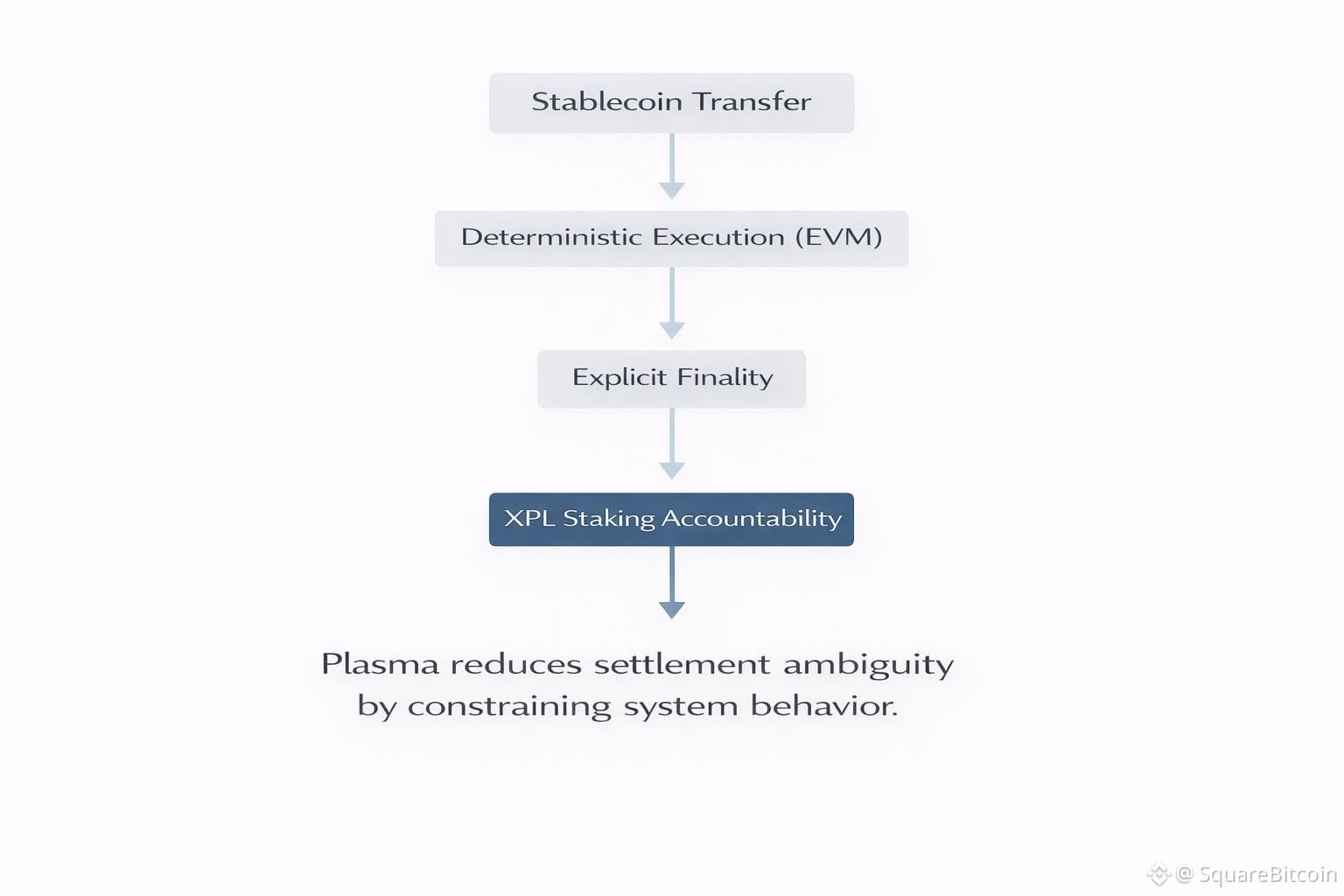
That distinction becomes obvious once stablecoins stop being a trading instrument and start behaving like infrastructure. Payroll, merchant settlement, treasury movement, internal transfers. These flows are repetitive, time sensitive, and tightly coupled to accounting processes. They do not benefit from creative execution paths. They benefit from outcomes that are boringly consistent.
This is where Plasma’s design begins to make sense to me.
Plasma does not appear to optimize for possibility space. It deliberately narrows it. Instead of maximizing what can happen, it focuses on minimizing the number of ways things can go wrong. That sounds conservative, but in settlement systems, conservatism is often a form of clarity.
Consider finality. Many systems treat finality as a probabilistic concept. After enough confirmations, a transaction is assumed to be safe. This works when users are willing to wait, hedge, or absorb occasional edge cases. Traders can live with that. Settlement workflows cannot.
From an operational standpoint, a transaction is either done or it is not. Anything in between creates overhead. Monitoring, reconciliation, delay buffers, manual review. These costs rarely show up in performance benchmarks, but they dominate real world usage.
Plasma’s approach treats finality as an explicit boundary rather than a sliding scale. When the system says a transfer is complete, it removes the need for interpretation. Other systems can proceed without waiting longer just to feel comfortable. Accounting closes. Obligations settle. Attention moves elsewhere.
This reduction in outcome ambiguity shows up again in how Plasma handles transaction costs for stablecoin transfers. Instead of allowing fees to fluctuate freely as a coordination signal, the system limits how much variability leaks into everyday usage. Costs still exist, but they are prevented from turning into a timing decision.
On many chains, fees are part of the user’s reasoning loop. Demand rises, fees spike, users wait or batch activity. This dynamic makes sense in environments where optimization is expected. It makes far less sense for payments. A payroll transfer should not depend on network sentiment. A merchant settlement should not feel like a strategic choice.
By constraining fee behavior, Plasma reduces another dimension of uncertainty. Sending money stops being a question of when. It becomes a routine operation again.
This pattern extends beyond UX considerations. It reflects a broader design philosophy. Plasma consistently chooses fewer valid states over more expressive ones. Fewer ways to interpret finality. Fewer fee outcomes to reason about. Fewer execution surprises for developers.
The decision to remain fully EVM compatible fits cleanly into this framework. At first glance, it can look unambitious. Many new networks try to differentiate by discarding familiar execution models. Plasma does the opposite.
For settlement infrastructure, familiarity is a risk control. Established tooling reduces accidental complexity. Known execution semantics reduce edge cases. Developers building payment systems are rarely looking for novelty. They are looking for fewer unknowns. EVM compatibility narrows the range of behaviors they need to consider.
There is also a deeper economic dimension to this narrowing of outcomes. Plasma does not distribute settlement risk across all participants. It concentrates it. Stablecoins move value. They are not staked, slashed, or exposed to protocol failure. Users are not asked to reason about finality risk at all.
That risk lives with validators staking XPL.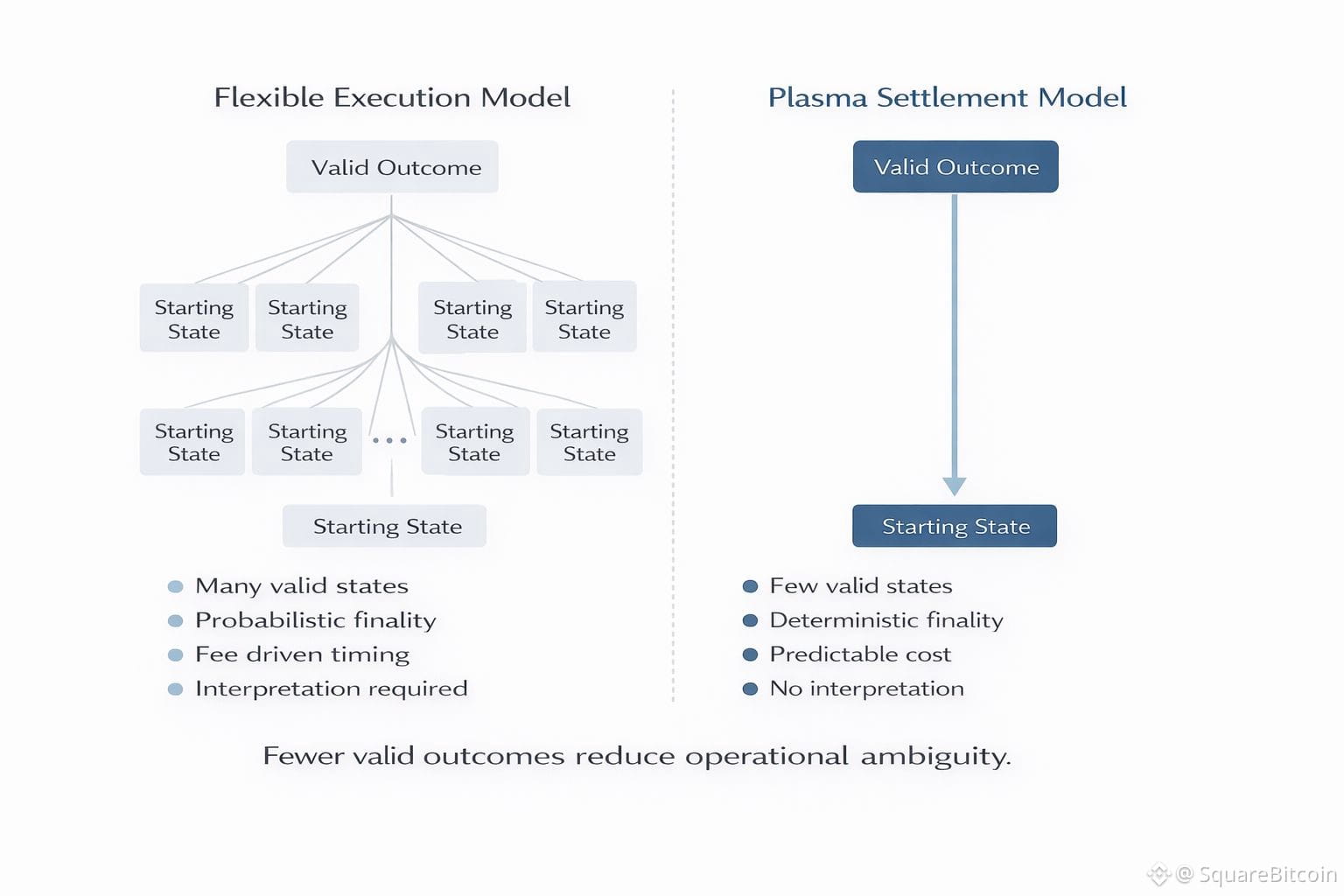
This is another way Plasma reduces ambiguity. Responsibility is explicit. If settlement rules are violated, the cost is borne by a specific layer designed to absorb it. The system does not rely on social coordination or informal recovery. It relies on economic consequences applied at finality.
From my perspective, this is one of Plasma’s most important and least discussed design choices. Many systems maximize flexibility at the cost of clarity. Plasma does the opposite. It trades optionality for discipline.
There are real trade offs here. Narrowing outcome space limits experimentation. It constrains what kinds of applications make sense. It requires saying no to optimizations that might look attractive in isolation. Maintaining that discipline at scale is difficult. It demands consistency in governance and implementation.
Plasma seems aware of that cost. It does not position itself as a general playground. It behaves more like infrastructure that expects to be relied on, not explored.
The same logic applies to Plasma’s approach to security anchoring. Anchoring part of the settlement model to Bitcoin can be read less as a branding exercise and more as an attempt to reduce interpretive freedom. External anchoring strengthens the perception that outcomes cannot be altered arbitrarily. Again, fewer possible interpretations, clearer results.
None of these ideas are novel in isolation. Deterministic finality exists elsewhere. Fee abstraction exists elsewhere. Risk staking exists elsewhere. What stands out is how consistently Plasma aligns these choices around a single constraint.
Settlement should remove doubt, not manage it.
Viewed through this lens, Plasma is not trying to compete on excitement. It is trying to make itself forgettable in daily operation. Payments that require attention are expensive. Systems that fade into the background scale more easily.
If Plasma struggles, it will likely be because enforcing this level of constraint over time is hard. Pressure to expand possibility space is constant. New use cases, new optimizations, new narratives. Each one adds branches to the outcome tree.
If Plasma succeeds, the result will not be dramatic. Stablecoins will move quietly. Settlement will stop being a topic of discussion. Fewer things will need explanation.
And in infrastructure, fewer explanations are often the sign that the system is doing its job.
