What happened over the last 48 hours wasn’t random, and it wasn’t a “thesis break.”
Gold, silver, and Bitcoin didn’t suddenly fail at the same time.
They all cracked for the same reason.
When positioning, leverage, and narrative line up in one direction, markets become fragile. All it takes is a small shift — and the unwind does the rest. Roughly $5.5 trillion was erased not because fundamentals changed overnight, but because risk got too crowded.
This was a cross-asset deleveraging event. Ugly on the surface. Logical underneath.
Crowded Trades Always Break the Same Way
Gold and silver came into the week stretched. Not just trending — extended.
Inflation hedging, dollar weakness, and speculative momentum had pushed both metals into fresh ATH territory. Everyone was leaning the same way.
Then the tone shifted.
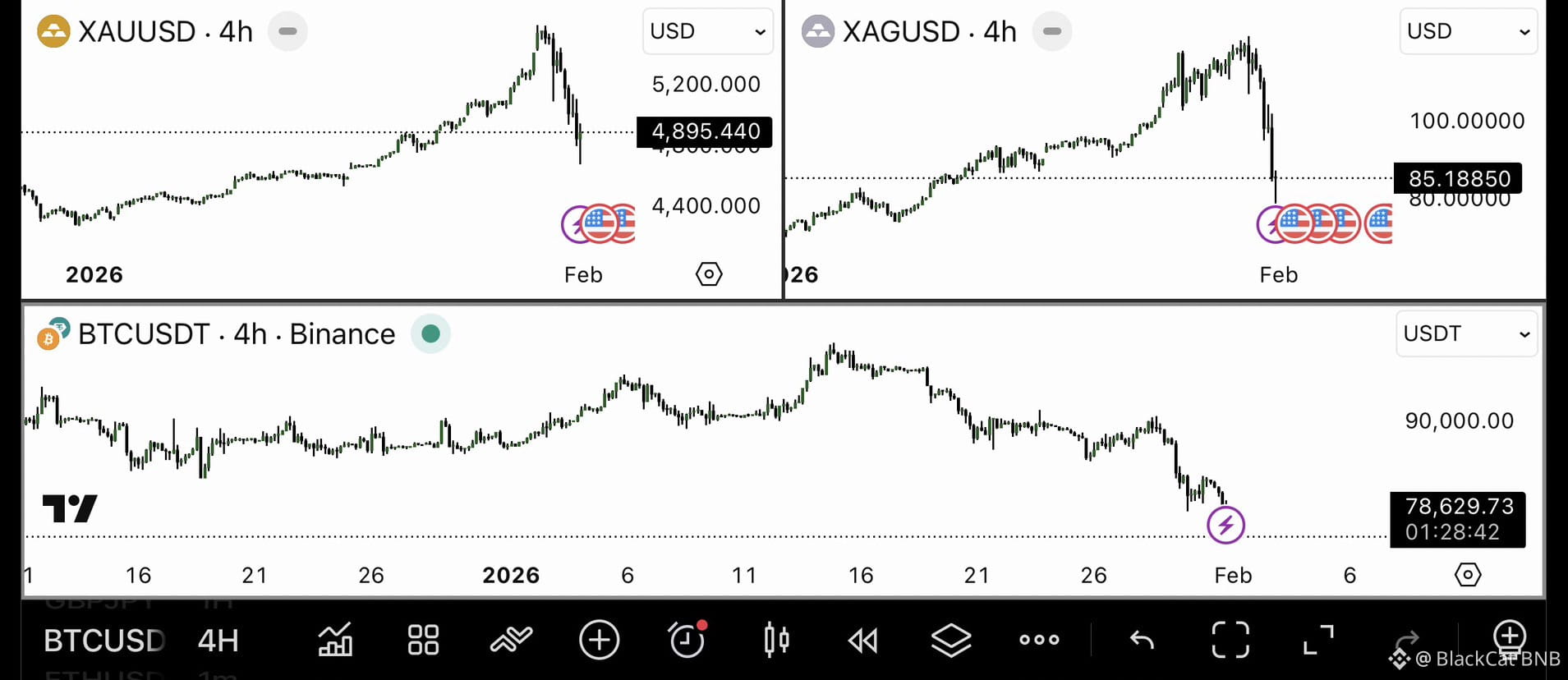
Talk around potential Fed leadership changes and a more hawkish policy path didn’t need to be confirmed. It only needed to introduce doubt. Momentum stalled. Price slipped.
That’s when things got dangerous.
Leverage Is the Real Catalyst
Futures markets don’t care about narratives. They care about margin.
Once gold slipped below key psychological and technical levels, leveraged longs were forced into decisions: add capital or exit. Many exited. Silver, thinner and more speculative by nature, unraveled faster and harder.
This wasn’t investors abandoning metals as a hedge.
It was leverage being unwound.
Rising volatility triggered higher margin requirements. Stops cascaded. Liquidity dried up. What started as profit-taking turned into a straight flush.
That’s how these moves accelerate.
Why Crypto Got Hit So Hard
Bitcoin didn’t drop because its fundamentals broke.
It dropped because $BTC is still treated as high-beta liquidity during risk-off moments. When desks need dollars fast, they sell what they can sell fast. Crypto is always near the top of that list.
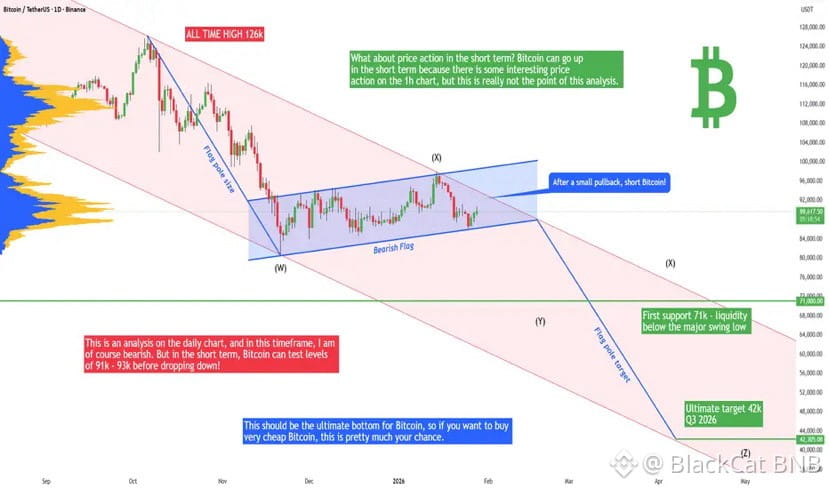
As $XAU and $XAG started behaving like risk assets, volatility spiked across markets. Multi-asset traders cut gross exposure. In crypto derivatives, the effect was immediate:
• Long liquidations
• Funding collapsing
• Open interest bleeding out
Once forced selling starts, structure stops mattering. Price overshoots. That’s why BTC move felt excessive relative to the news.
It wasn’t trading headlines.
It was trading the unwind.
Correlation Goes to One — Every Time
This is the part most people miss.
Gold didn’t lose its macro role.
Bitcoin didn’t suddenly stop being Bitcoin.
What failed was positioning discipline.
When markets enter deleveraging mode, correlations spike. Everything becomes a source of liquidity. Individual stories don’t matter. Timing does.
What Actually Matters Now
The important question isn’t what just happened.
It’s what happens next.
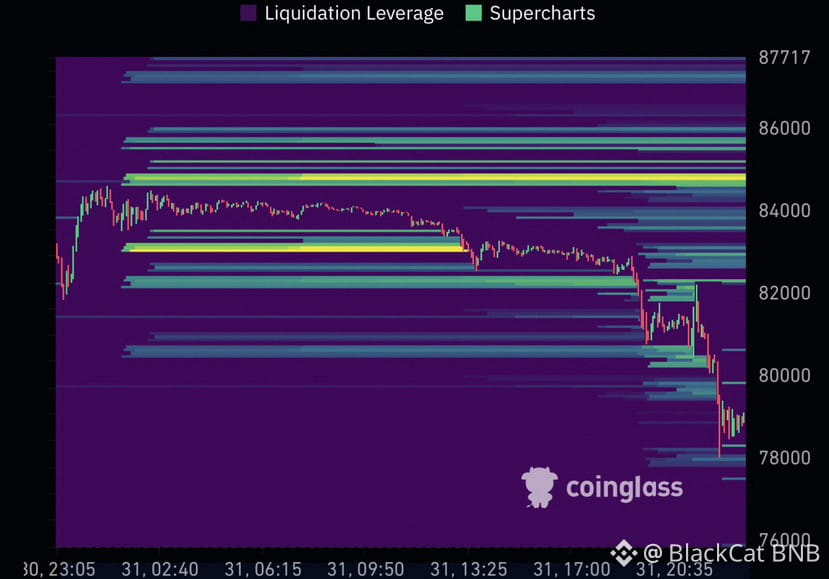
If this was mainly a forced flush:
• Liquidations should slow
• Funding should normalize
• Open interest should stabilize
• Price should chop and base, not accelerate lower
That’s how deleveraging phases usually end.
If macro pressure continues — stronger dollar, firmer rate expectations, tighter conditions — then metals and crypto may need time to rebuild structure before any sustainable upside.
Through a Trader’s Lens
This is not the moment for emotional reactions or jumping narratives.
It’s a moment for:
• Patience
• Level awareness
• Waiting for confirmation
Forced selling creates opportunity — but only after it exhausts.
Final Take
This was a liquidity event, not a thesis failure.
Excess got cleansed.
Leverage got punished.
From here, structure decides, not headlines.
Risk first.
Conviction second.