

At a time when most networks optimize for throughput, narratives, or short-term liquidity, Dusk has taken a fundamentally different approach: designing a Layer-1 specifically for confidential, compliant financial markets. Its architecture is not aimed at anonymous payments or retail DeFi loops, but at enabling institutions to operate on-chain without violating regulatory, reporting, or disclosure requirements. This distinction matters, especially as tokenized real-world assets (RWAs) move from pilot programs into early production.
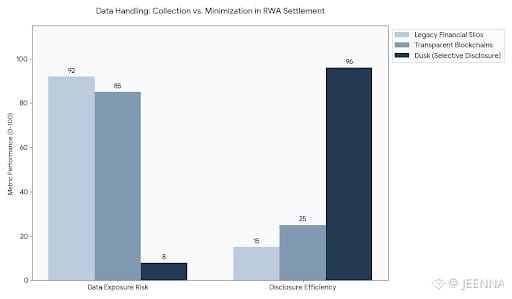
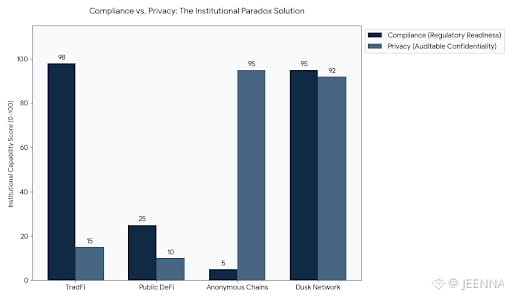
Dusk’s core innovation lies in what it calls auditable privacy. Transactions on the network can remain confidential by default, while still allowing selective disclosure to regulators, auditors, or counterparties when legally required. This is a critical departure from both fully transparent blockchains, which leak sensitive financial data, and privacy chains built around absolute anonymity, which struggle to integrate with regulated environments. Dusk’s cryptographic primitives are designed to mirror how financial confidentiality works off-chain: private by default, inspectable by permission.
With mainnet live and stabilizing, recent updates signal a shift from protocol development to ecosystem execution. The opening of the DuskTrade waitlist, developed in collaboration with licensed exchange partners such as NPEX, marks a meaningful step toward regulated on-chain trading of tokenized securities. This is not a sandbox experiment; it is infrastructure aligned with European regulatory frameworks, including MiFID II and the EU DLT Pilot Regime. In practical terms, Dusk is preparing for assets that must meet real legal standards, not just technical ones.
Importantly, Dusk’s roadmap has remained disciplined. Rather than expanding into unrelated verticals, the network continues to double down on its original thesis: enabling issuance, trading, and settlement of RWAs under compliance constraints. This includes work on regulated stable assets, institutional tooling, and integrations that support custody, reporting, and lifecycle management. The goal is not to maximize TVL, but to reduce friction for institutions that already manage significant capital off-chain.
Market behavior around the DUSK token has, at times, been volatile, reflecting broader cycles in privacy narratives and RWA speculation. However, token price action is not the primary signal to watch here. Dusk’s success will be determined by whether regulated entities choose to issue and transact on the network because it solves problems that other chains cannot. In that context, slow adoption is not a weakness; it is often a feature of infrastructure that must pass legal, operational, and reputational scrutiny.
What differentiates Dusk most clearly is its understanding of who its user actually is. The network is not built for yield farmers, meme traders, or rapid experimentation. It is built for issuers, exchanges, custodians, and regulators who require confidentiality without opacity, transparency without exposure, and decentralization without legal ambiguity. This positioning places Dusk in a much narrower market — but also a far more defensible one.
As 2026 unfolds, the real test for Dusk will be execution at the edges: onboarding regulated participants, supporting live asset issuance, and proving that auditable privacy can operate reliably under real financial stress. If successful, Dusk will not just be another Layer-1 — it will be a reference architecture for how regulated finance can move on-chain without compromising its core constraints.
In an industry often driven by speed and spectacle, Dusk is choosing patience and precision. For infrastructure aimed at real capital, that choice may ultimately be its strongest signal.
