

Bitcoin’s long-term price structure continues to tell a remarkably consistent story — one that is often misunderstood by short-term market participants.
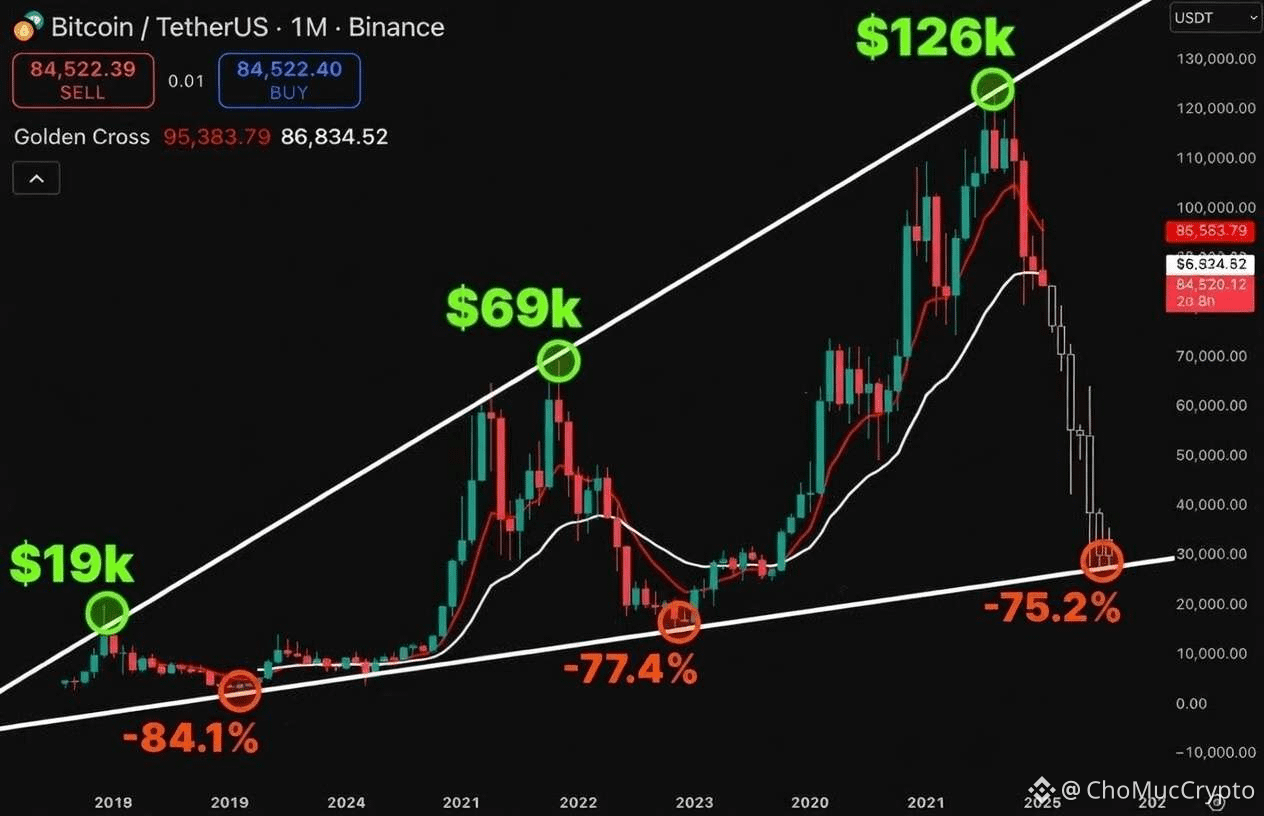
Looking at the chart, three major cycle tops stand out clearly: around $19K, $69K, and most recently $126K. Each of these peaks followed an extended uptrend along a rising macro trendline, reflecting Bitcoin’s secular growth trajectory. However, what truly defines Bitcoin’s behavior is not just the upside expansion, but the severity and repetition of its corrections.
After the 2017 peak near $19K, Bitcoin experienced an 84% drawdown, wiping out late-cycle euphoria and forcing the market into a prolonged accumulation phase. A similar pattern repeated after the 2021 peak at $69K, with a correction of roughly 77%, once again shaking out leverage, weak conviction, and speculative excess. In the current cycle, the decline from the $126K region has already reached approximately 75%, placing it firmly within Bitcoin’s historical correction range.
This is a crucial point: while these drawdowns feel catastrophic in real time, they are structurally normal for Bitcoin. Each cycle’s correction has been slightly shallower than the previous one, suggesting a gradual maturation of the asset, increased liquidity, and a broader base of long-term holders. Despite increasingly larger market capitalization, Bitcoin still adheres to its high-volatility, reflexive nature.
Another important observation is how price repeatedly returns to long-term moving averages and macro trend support after parabolic advances. These zones have historically represented areas of maximum fear but optimal long-term value. The market does not collapse because Bitcoin is broken; it resets because leverage and speculative positioning become unsustainable.
What’s often overlooked is that these deep corrections are not signs of failure — they are requirements for continuation. Without violent deleveraging phases, Bitcoin would not be able to sustain multi-year exponential growth. Every major drawdown has ultimately laid the foundation for the next expansion leg, transferring coins from weak hands to stronger conviction holders.
In the current environment, price action suggests we are once again in a late-stage corrective phase, not unlike prior cycle resets. Momentum has cooled, volatility has compressed relative to the initial sell-off, and sentiment remains fragile. This is typically when narratives turn bearish, long-term confidence is questioned, and patience becomes the rarest asset in the market.
Historically, those who accumulated Bitcoin during these uncomfortable, uncertain periods — rather than chasing euphoric highs — captured the majority of long-term returns. While no one can perfectly time the bottom, the data consistently shows that risk-reward asymmetry improves dramatically during deep cycle drawdowns.
Bitcoin doesn’t reward excitement.
It rewards discipline, time, and the ability to endure boredom and doubt.
Cycles repeat — not because history is identical, but because human behavioris.
