



When Plasma $XPL launched, many people thought it was just another blockchain joining the crowded space. But what happened next shocked almost everyone watching closely.
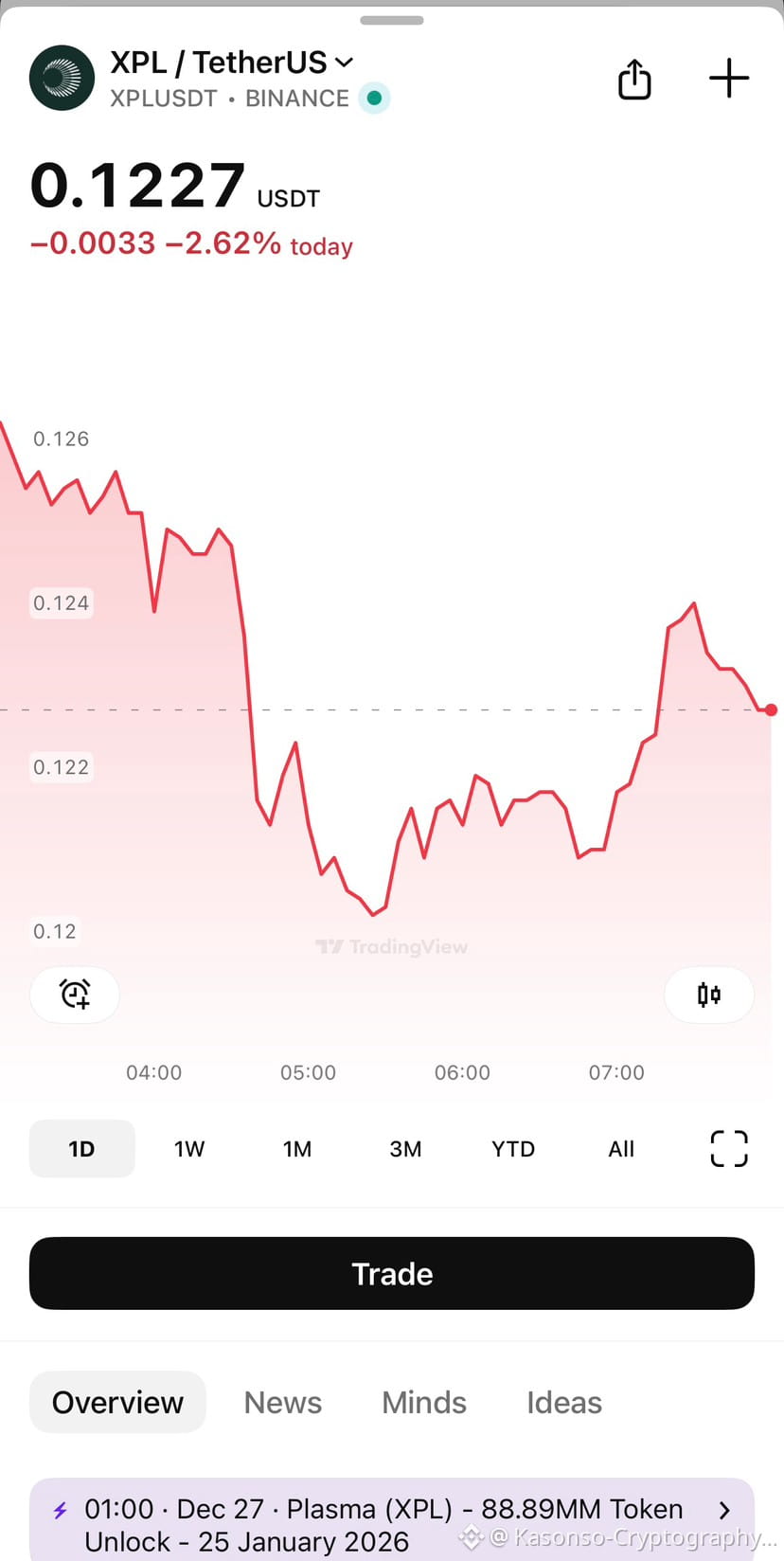
In just 6 days, Plasma crossed $1 billion in total market size. That is something most chains struggle to achieve in years, not days. This wasn’t hype money moving around for fun. It was real usage, real liquidity, real demand.
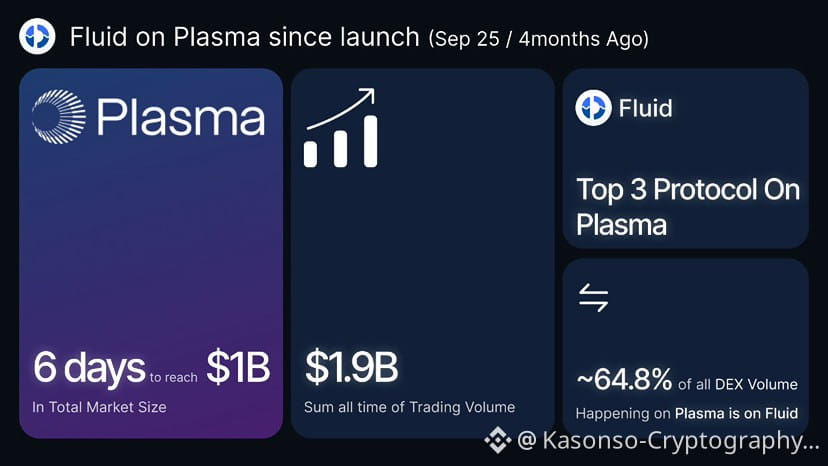
Now let’s talk about Fluid, because this is where things become very interesting.
Since launch, Fluid has processed over $1.9 billion in trading volume, and today it controls roughly 64.8% of all DEX volume happening on Plasma. That alone tells you one thing clearly: users didn’t spread liquidity randomly — they concentrated it where execution is best.
Step 1: Why stablecoin liquidity matters first
Every serious payments business lives and dies by stablecoins.
If you are a card issuer, you don’t want price volatility.
If you are a fintech app, you don’t want slippage.
If you are settling payroll, remittances, or merchant payments, you need deep pools that can handle size without breaking.
Imagine trying to send $500,000 USDT on a weak chain.
You get bad rates, delayed confirmations, and sometimes failed transactions. That kills trust instantly.
Plasma was built with this problem in mind, not as an afterthought.
Step 2: Fluid turns Plasma into real infrastructure
Fluid isn’t just another DEX sitting on top of Plasma. It behaves more like financial plumbing.
Because Fluid holds most of the liquidity on Plasma, trades don’t bounce around different pools hunting for price. They settle fast, with minimal slippage, even when size increases. This is exactly what payment companies need.
Think of it like this:
Other chains = many small water pipes
Plasma + Fluid = one wide highway pipeline
When volume comes, it flows smoothly instead of clogging.
Step 3: Builders don’t struggle to bootstrap
On most blockchains, builders face the same nightmare: “You have a good product, but no liquidity.”
On Plasma, builders plug directly into existing deep stablecoin liquidity through Fluid. That means:
No begging liquidity providers
No fake incentives that collapse later
No broken user experience on day one
A new payments app, card program, or wallet can launch and immediately operate at scale. That’s rare in crypto.
Step 4: Why this beats many other projects
Many blockchains talk about “adoption,” but Plasma is showing it with numbers:
Fast growth
Real volume
Concentrated liquidity
Clear product-market fit
Other chains focus on narratives. Plasma focused on execution.
That’s why Fluid becoming a top 3 protocol on Plasma is not luck. It’s the result of architecture designed for real financial use, not speculation games.
Therefore let's now end up like this.
Deep stablecoin liquidity is not a luxury anymore. It’s the foundation.
Plasma understood this early.
Fluid delivers it efficiently.
Together, they turn blockchain from an experiment into something payments companies can actually rely on today, not “someday.”
This is how real infrastructure is built.

