In the AI era, memory isn’t a nice‑to‑have feature — it’s a foundational requirement. Traditional AI assistants regularly forget context, forcing users to repeat information over and over. This “AI amnesia” isn’t just inconvenient; it signals a deeper problem: current systems lack a persistent, private, and verifiable memory layer that can securely hold context, knowledge, and reasoning across sessions and platforms. @Vanarchain Vanar Chain’s myNeutron addresses this gap by positioning memory as a privacy‑centric primitive in AI infrastructure — not an application‑level add‑on, but a core part of the decentralized stack built for real intelligence.
At its heart, myNeutron is part of Vanar’s Neutron decentralized knowledge ecosystem. Neutron captures scattered information — emails, files, documents, chats, and web content — and automatically transforms it into structured, AI‑enriched knowledge units called Seeds. These Seeds aren’t simple blobs of data; they are compact, meaningfully indexed units that capture the essence of content in a way that is both searchable and context‑aware.
What makes this important is that privacy is woven into how this memory layer works. Instead of storing raw data on public ledgers where anyone could potentially access it, myNeutron uses client‑side encryption by default and ensures that even on‑chain metadata remains private unless the user chooses to share it. This means that your memory, your context, and your reasoning artifacts are protected at every step — staying yours first, and verifiable as needed.
In Neutron’s dual‑storage architecture, most Seeds are stored off‑chain for performance and flexibility, while optional on‑chain storage provides immutable verification, ownership tracking, and auditability. Importantly, even when anchored on Vanar Chain, the data remains encrypted and fully private unless explicitly shared. This gives enterprises and individuals a rare combination: the speed and efficiency of modern storage with the trust and tamper‑proof guarantees of blockchain.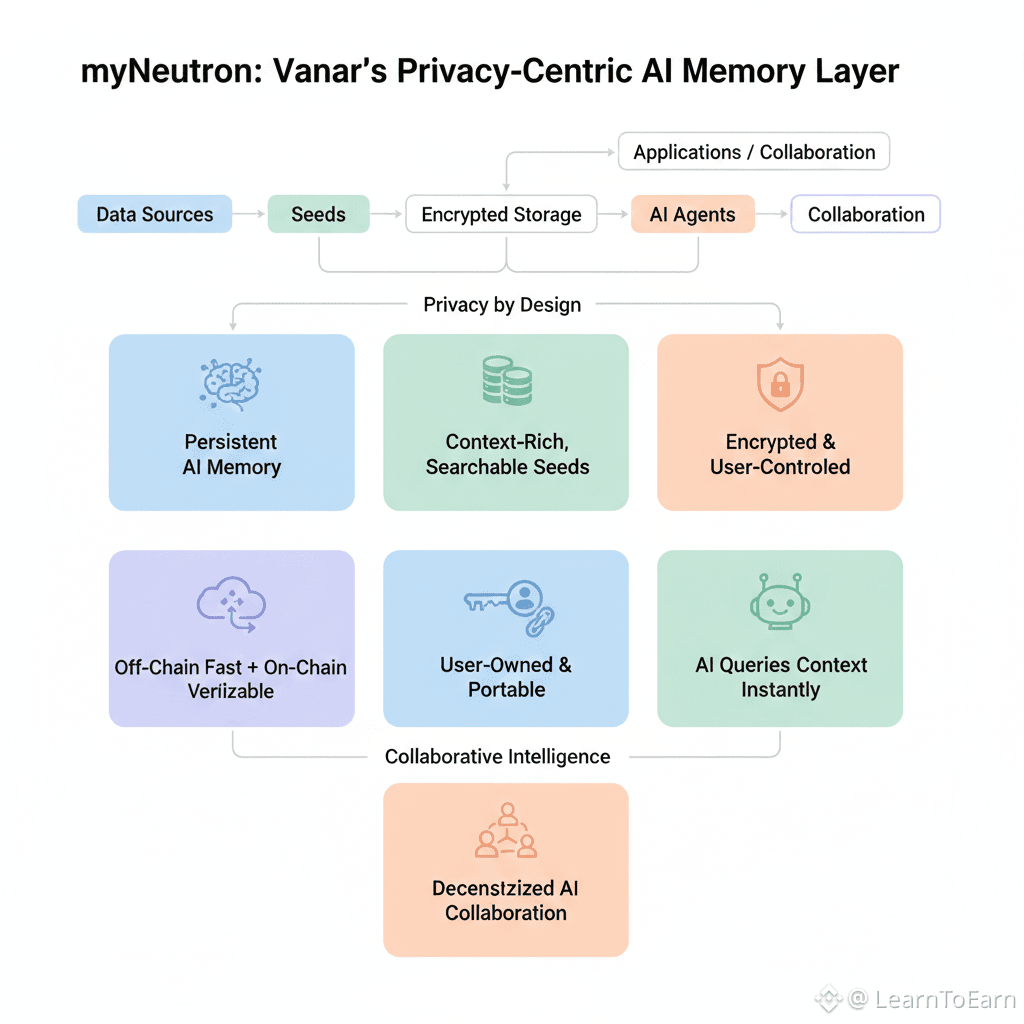
By turning memory into modular, searchable, context‑rich Seeds, myNeutron transforms how AI systems think and reason. Instead of being stateless tools that treat every query as new, future AI agents built on Vanar will be able to pull from persistent memory — contextual knowledge that travels with the user and is ready for use across workflows and applications. This means no more repeated explanations, no more context resets, and no fragmented AI interactions that lose track of crucial insights.
Unlike traditional AI tools that rely on centralized servers for memory and context, myNeutron’s design ensures that privacy is not sacrificed for convenience. All sensitive information is encrypted before it’s ever stored or indexed, and only the document owner can decrypt it. This approach allows AI agents to reason over private context without exposing it to third parties, making it suitable for enterprise use cases and personal knowledge work alike — from research and compliance to confidential business workflows.
Ownership is another big shift. With myNeutron, Seeds can be anchored onchain and cryptographically tied to a user’s keys. This means your knowledge doesn’t just live in a siloed app — it becomes a portable, verifiable digital asset that can be reused across AI models, across devices, and across chains. Whether you capture a PDF, an email thread, or a series of research notes, that memory travels with you and stays yours forever.
The practical benefits are already emerging. Users are leveraging myNeutron to capture everything from PDFs and images to detailed project notes and email threads, turning them into organized Seeds that AI assistants can reference instantly. With the integration of semantic search and context‑aware recall, AI workflows become smoother, faster, and more accurate — because the AI remembers, rather than starts from scratch each time.
Moreover, recent integrations — such as myNeutron’s connection with Fetch.ai’s ASI:One — show how this privacy‑preserving memory layer can serve decentralized AI collaboration. Agents across networks can share AI‑ready context while still protecting individual privacy and data ownership, creating a foundation for truly collaborative intelligence in Web3 environments.
In a world where AI power is often limited by fragmented memories and centralized data silos, myNeutron stands apart by offering a memory layer that is private by design, decentralized by architecture, and intelligent by nature. It anchors user context not just in a database, but in a portable, verifiable structure that can evolve with each interaction and scale with the needs of future AI agents. As the AI landscape grows more complex, tools like myNeutron aren’t just useful — they are foundational, setting a new standard for how intelligent systems should store, protect, and reason with human knowledge.
AI isn’t merely another application layer on top of existing blockchain technology; it fundamentally changes what a blockchain must be. Today’s popular blockchains excel at transaction throughput and decentralization, but the next wave of innovation, where AI agents act, reason, learn, and transact autonomously, cannot rely on retrofitted privacy and data-handling solutions. AI demands privacy as a native protocol primitive, not as an add-on feature bolted onto existing infrastructure. Vanar Chain addresses this need by redesigning the stack from the ground up for AI, privacy, and real usage. Unlike traditional blockchains, Vanar is built with the intelligence layer in mind, ensuring that privacy, memory, reasoning, and settlement are foundational, not optional.
The coming AI-native economy requires a new kind of blockchain. Today’s decentralized infrastructure is built for transparency, a feature that is excellent for trustless settlement but often at odds with privacy, sensitive data handling, and AI’s contextual memory needs. AI systems generate, process, and retain semantically rich internal states, such as learned insights, private user intent, or reasoning context, that cannot simply be exposed on public ledgers without creating privacy, compliance, and security risks. While traditional systems attempt privacy with application-level solutions such as encryption on smart contracts or ZK-proof-based methods, these approaches are fragmented, complex, and partial. They treat the symptom rather than addressing the underlying architectural gap. AI-ready blockchains need privacy as a core layer, integrated into the very fabric of the protocol.
Privacy is essential for AI because these systems do not merely execute tasks; they remember, reason, automate, and settle outcomes continuously. Agents need to retain persistent context, ranging from user preferences to semantic insights, without exposing that data publicly. This goes beyond encryption at the application level. AI agents also perform reasoning that uses private inputs, and if intermediate states are exposed, sensitive information could leak. Furthermore, autonomous agents must act with accountability and compliance. Without privacy integrated into the core protocol, auditing and validation require trade-offs between visibility and confidentiality, a compromise that cannot scale. In short, AI systems require privacy infrastructure that is as fundamental as consensus itself.
Vanar Chain approaches this challenge by embedding privacy and intelligence into the protocol from the ground up. It is not an ordinary Layer-1 blockchain. Instead of treating transactions as the sole primitive, Vanar builds infrastructure around intelligence, ensuring that memory, reasoning, and automated actions operate natively and securely. At the core of this stack is myNeutron, Vanar’s semantic memory layer. MyNeutron compresses rich data into AI-readable “Seeds,” which AI agents can query directly on-chain without exposing full raw data. This ensures that AI retains useful internal state while protecting user privacy, a foundational requirement embedded in the protocol rather than tacked on.
Neutron’s memory alone is not sufficient. Kayon, Vanar’s decentralized reasoning engine, allows on-chain natural language queries, automated decision-making, and reasoning, all within the privacy framework. By keeping reasoning on-chain, Vanar prevents sensitive intermediate logic from being exposed to external systems, enabling autonomous AI agents to operate without compromising confidentiality. Building on these layers, Flows and other components translate reasoning into tangible, automated on-chain actions. These actions adhere to the same privacy principles, allowing AI-driven operations to be executed, verified, and audited safely.
Transaction privacy alone is insufficient for AI. Traditional privacy tools focus on hiding sender and receiver balances, but AI systems require broader and deeper protections for sensitive reasoning outputs, user preference embeddings, model adaptations, and semantic data representations. These requirements cannot be met with application-level fixes alone. AI-ready systems need privacy as an architectural core, a challenge that Vanar meets by embedding cognition and privacy as protocol primitives.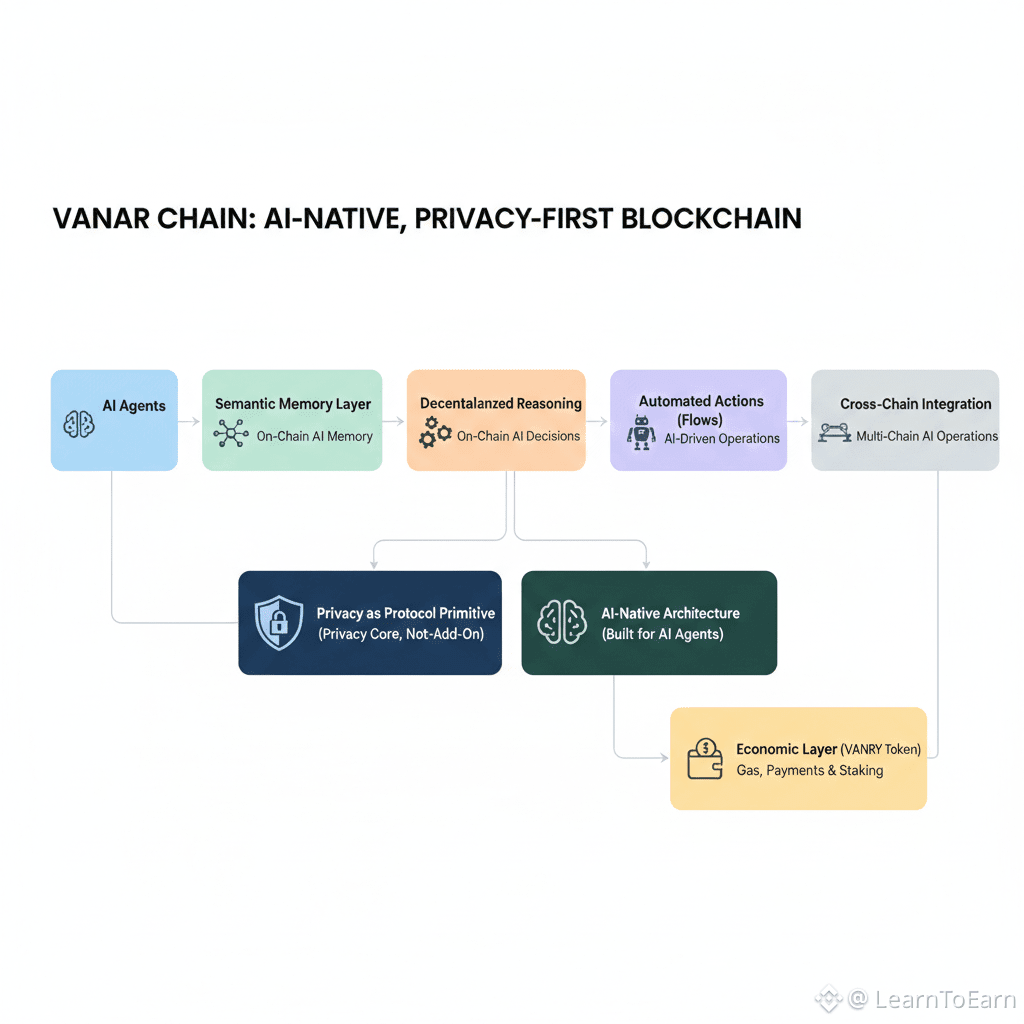
An economic layer is also critical for AI. Autonomous agents must transact, settling fees, paying for services, and interacting with tokenized real-world assets, all without exposing sensitive logic. Vanar’s native token, VANRY, serves as both the economic and compliance engine for the AI ecosystem. It facilitates gas and payments for AI infrastructure, supports staking for security and validator participation, enables monetization of semantic memory, and powers subscription and access revenue loops. Cross-chain availability, beginning with integration on Base, further expands Vanar’s reach, allowing privacy and AI reasoning primitives to operate across multiple networks and ecosystems. This ensures that AI infrastructure and economic activity scale together, unlocking wider adoption and usage.
Most blockchain platforms that claim AI support implement it as an application-level feature, dependent on centralized infrastructure or external services. These approaches inherently lack protocol-level privacy, on-chain reasoning integrity, seamless memory-action coordination, and economic settlement integrated into AI workflows. Vanar, by contrast, is built around these elements as core primitives, positioning VANRY and the Vanar architecture not as narrative-led technology, but as AI-native infrastructure ready for enterprise use, autonomous agents, and real-world adoption.
As AI systems mature and begin to act with autonomy and economic relevance, the underlying blockchain must rise to meet the demands of privacy, memory, reasoning, and settlement. Application-level privacy fixes will not scale because they rely on legacy designs never intended to support private AI states. Vanar Chain, with native semantic memory, decentralized reasoning, programmable action layers, and the VANRY token, demonstrates what privacy-ready, AI-native infrastructure looks like. Its design is not speculation — it is a foundation built to support AI agents operating across ecosystems with confidence in privacy, traceability, and real economic usage. In the AI era, privacy is not optional; it is a protocol primitive, and #Vanar is among the first to deliver it at scale.