
The AI era exposes an uncomfortable truth about blockchain infrastructure. The problem is no longer a lack of base networks. It is a lack of systems that can prove AI readiness beyond theory. New Layer 1 launches continue to appear, each promising better performance, cleaner design, or improved developer experience. Yet very few of them are built around the operational realities of autonomous systems.
Vanar exists because of that gap.
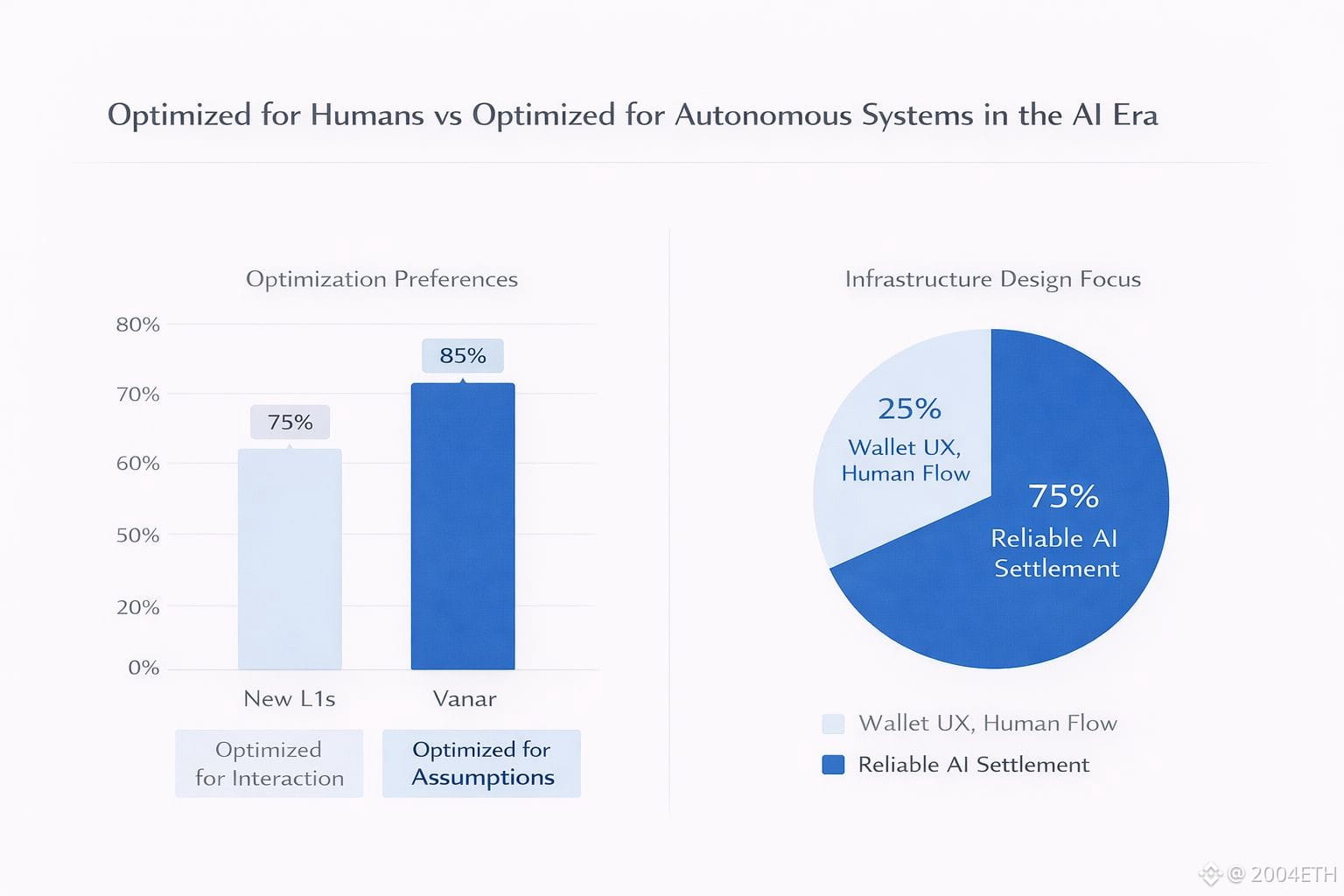
Most new L1s still launch with an implicit assumption that humans are the primary actors. A user signs a transaction. A developer monitors execution. If something breaks, someone steps in to fix it. This model has worked for years because humans are flexible. They tolerate delays, fee volatility, and partial failures. AI systems do not.
As soon as autonomous agents become first class participants, these assumptions break down.
The challenge for new L1s in the AI era is not raw capability. It is readiness. AI readiness is not about claiming support for agents, automation, or intelligence. It is about whether the infrastructure can sustain continuous operation without human supervision. That requirement changes how systems must be designed, tested, and deployed.
Most new L1s are not failing because they are poorly engineered. They are failing because they are optimized for the wrong actor.
Human centered blockchains treat settlement as an outcome. A transaction is sent, then eventually finalized. If conditions change along the way, the user adapts. Fees spike, the user waits. Finality takes longer, the user checks later. This flexibility is assumed at every layer of the stack.
Autonomous systems cannot operate this way.
For an AI agent, uncertainty is not an inconvenience. It is a failure mode. Every unpredictable delay introduces additional logic. Every fee spike requires retries or alternative paths. Every ambiguous outcome forces monitoring or escalation. Over time, these small inefficiencies compound into significant coordination costs.
This is where most new L1 launches struggle. They inherit architectures designed for human tolerance and attempt to retrofit AI capabilities on top. The result is a network that can host AI applications, but cannot support autonomous operation at scale.
Vanar starts from the opposite direction.
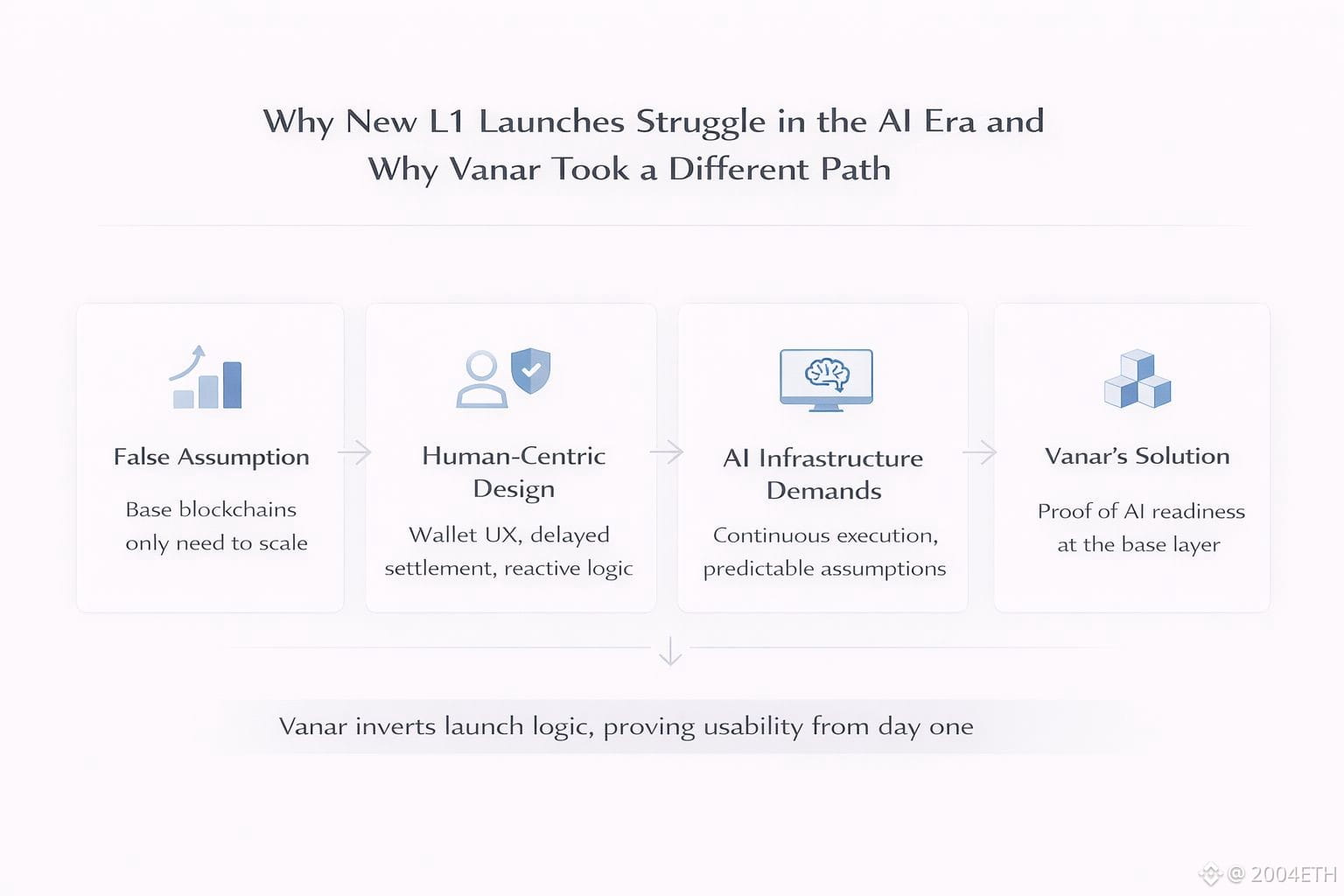
Instead of asking how to add AI features to a blockchain, Vanar asks what assumptions an autonomous system must be able to rely on. The answer is not intelligence. It is predictability. Memory, reasoning, and automation are useless if execution cannot be assumed to complete within known bounds.
This is why Vanar treats settlement as infrastructure rather than a service. Settlement is not something an agent negotiates with. It is something the agent builds around. When value movement becomes part of the execution loop itself, autonomy becomes feasible.
This design choice immediately separates Vanar from typical new L1 launches. Rather than chasing throughput metrics or headline performance, Vanar optimizes for stable assumptions. The goal is not to be the fastest network under ideal conditions, but the most reliable under continuous operation.
That distinction matters more in the AI era than any benchmark.
AI systems are not episodic users. They do not log in, perform an action, and leave. They persist. They observe state, retain context, make decisions, and act repeatedly. In this environment, the cost of uncertainty quickly outweighs the cost of computation.
New L1s often attempt to compensate for this by pushing complexity upward. They rely on middleware, off chain coordination, or human oversight to bridge gaps in reliability. This creates the illusion of AI readiness while quietly reintroducing human dependency.
Vanar does the opposite. It absorbs complexity at the infrastructure layer. By enforcing predictable execution and settlement, it reduces the number of assumptions an AI agent must make about the environment. The system becomes simpler at the edges because it is stricter at the core.
This philosophy is visible in Vanar’s live products. myNeutron demonstrates that semantic memory and persistent context can exist at the infrastructure layer. Kayon shows that reasoning and explainability do not need to live off chain. Flows proves that intelligence can translate into safe, automated action without constant human oversight.
These are not isolated features. They are evidence of a system designed to operate continuously.
This is also where the role of VANRY becomes clearer. VANRY is not positioned around incentivizing user activity or speculative engagement. It underpins participation in an ecosystem where value movement is expected to occur as part of automated processes. The token sits inside the execution path, not at the edge of interaction.
In new L1 launches, tokens often function as access keys. Users pay to submit transactions. Developers pay to deploy contracts. The economic model assumes discretionary usage. In Vanar’s model, usage is structural. Autonomous systems must settle value as part of their operation. VANRY secures that assumption.
This difference explains why Vanar emphasizes readiness over narratives. Readiness cannot be staged. Either the system can operate without constant intervention, or it cannot. There is no meaningful middle ground where an AI system is mostly autonomous but occasionally unreliable. From an operational standpoint, that distinction does not exist.
The AI era rewards infrastructure that is boring in the right ways. Systems that prioritize predictability over spectacle. Networks that measure success by how little attention they require once deployed. Vanar aligns with this reality.
New L1s will continue to launch. Many will showcase impressive technical innovations. But without proving AI readiness at the infrastructure layer, they will remain dependent on human tolerance. That dependency becomes a ceiling as autonomy scales.
Vanar’s path is quieter, but more deliberate. By designing around the constraints of autonomous systems rather than the preferences of users, it positions itself for a future where machines are not guests on the network, but primary participants.
In that context, Vanar is not competing for attention. It is competing for relevance. And in an AI driven environment, relevance is defined by what can run without supervision.
That is why new L1 launches struggle in the AI era. And that is why Vanar took a different path.
