
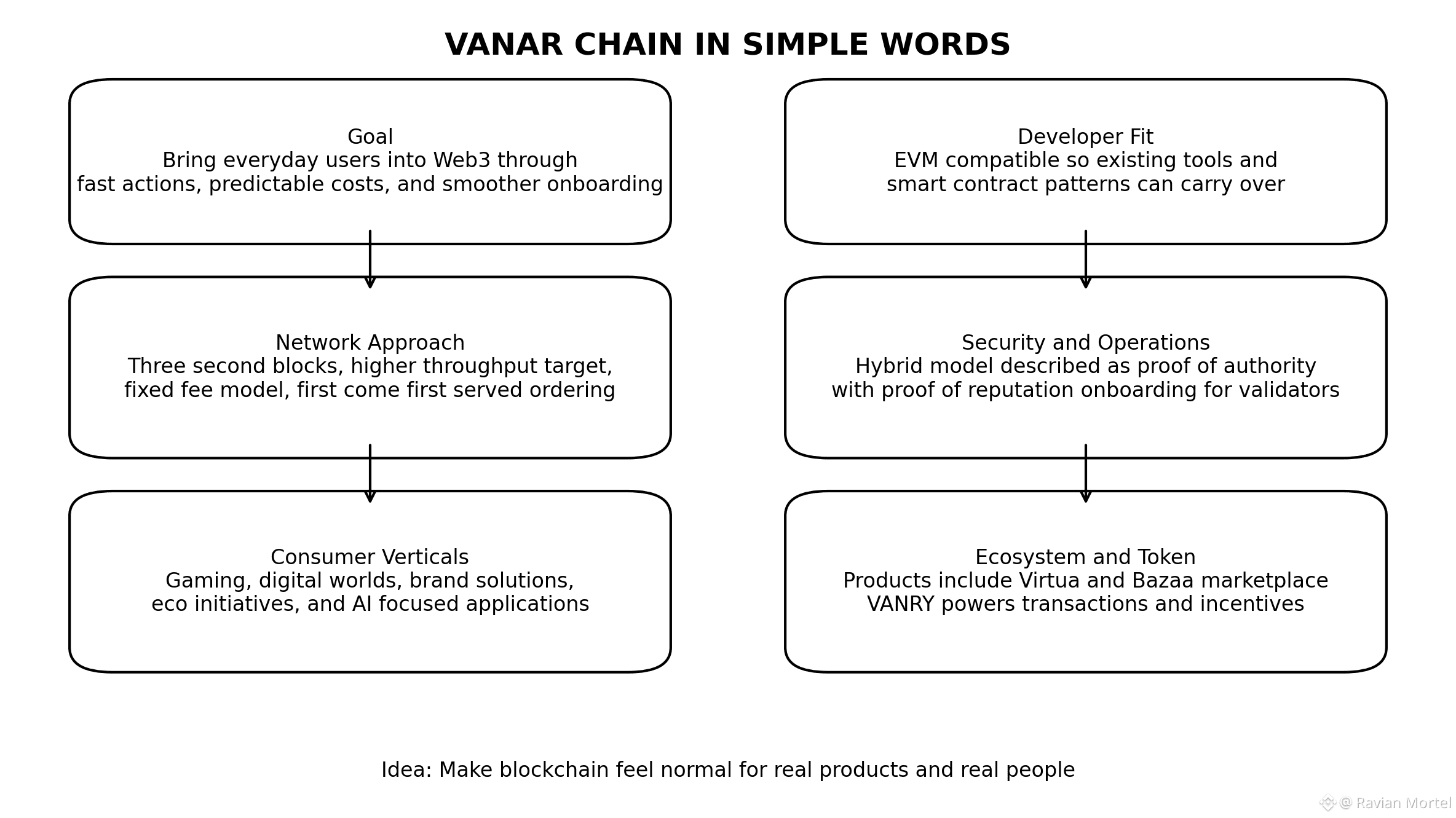


Im going to explain Vanar like I would explain it to someone who is curious but tired of complicated crypto language, because the real meaning of this project is not hidden in fancy words, it is hidden in a very human problem that keeps repeating, which is that most people do not want to learn a new world just to enjoy a game, collect a digital item, join a community experience, or get a brand reward that feels fair and personal. Theyre not rejecting blockchain because they hate the idea of ownership, theyre rejecting it because the first experience often feels slow, confusing, and risky, and Vanar describes its mission as building a chain that makes sense for mainstream adoption by focusing on the parts that ordinary users actually feel, which are speed that keeps the experience flowing, predictable costs that do not create fear, and onboarding that does not make people feel like they might lose everything with one wrong step.
When you trace what Vanar is trying to do from the beginning to the end, you can see a practical mindset that says best fit matters more than chasing perfect theory, and that is why their documentation clearly states that Vanar is Ethereum virtual machine compatible, because they want developers to build with familiar tools and familiar smart contract patterns rather than forcing teams to start from zero. If it becomes easier for developers to ship, it becomes more likely that real products arrive, and that matters because mass adoption does not come from people reading about blockchains, it comes from people using apps that quietly work in the background without demanding technical loyalty from the user. Were seeing Vanar trying to reduce friction for builders so the chain can attract more experiments, more launches, and more everyday use cases that feel natural instead of forced.
Vanar also describes very specific choices that aim to make the network feel responsive for consumer apps, including a target block time of about three seconds and a higher throughput direction supported by a larger gas limit, and they explain that these choices are meant to keep actions moving quickly so users are not stuck waiting and losing interest. They also explain a fixed fee model and first come first served transaction ordering, and the emotional reason behind this matters because unpredictable fees do not just create budgeting problems, they create stress, and stress is the number one enemy of mainstream behavior because people leave the moment an experience feels uncertain. If it becomes predictable and calm, users relax, and when users relax they explore, and that is where adoption starts to feel like daily life rather than a complicated hobby.
Security and governance are another part of the story where Vanar makes a clear tradeoff choice, because the documentation describes a hybrid approach that relies primarily on proof of authority while adding a proof of reputation mechanism for onboarding external validators over time, with the foundation initially running validator nodes. Theyre essentially trying to protect stability for real world launches while describing a path toward wider participation, and this is one of the most important long term questions for the project because people want both reliability and openness, and those goals can pull in different directions if they are not handled carefully. If it becomes clear over time that the network truly broadens validator involvement in a credible way while keeping performance strong, trust grows deeper, and if it does not, critics will focus on that gap no matter how strong the product vision is.
The ecosystem side of Vanar is where the project tries to prove it is not only infrastructure but also a place where real consumer experiences can live, and that is why products like Virtua and the Bazaa marketplace are often mentioned, because Virtua publicly describes Bazaa as a decentralized marketplace built on the Vanar blockchain where people can trade dynamic items with real on chain utility, which is exactly the kind of mainstream style loop Vanar is aiming for. The token story also connects to this continuity, because Binance announced it completed the Virtua token swap and rebranding to Vanar at a one to one ratio, which shows how the earlier community identity was carried into the VANRY phase rather than being erased. Vanar also positions itself as an AI powered stack for areas like PayFi and tokenized real world assets, describing components such as Vanar Chain, Neutron Seeds, and Kayon, and whether you love or doubt the AI framing, the intention is clear, they want the chain to support richer data and compliance aware workflows so serious real world use cases can feel more natural. If it becomes a chain where everyday users can enter without fear, where builders can ship without constant friction, and where products feel fun instead of stressful, then Vanar could become the kind of quiet bridge that brings the next billions in without them even feeling the technology.