


Vitalik Buterin says the relationship between institutions — including governments and corporations — and the cypherpunk community is more nuanced than a simple “friend or foe” narrative. In his view, institutions tend to maximize control over what they can while minimizing reliance on external parties, which increasingly pushes them toward stronger data sovereignty and security.
Buterin argued that tools designed to enhance individual data self-sovereignty are often seen as niche or idealistic, but in reality many large institutions already operate with even stricter internal security and data-control policies than typical retail users. As a result, he expects institutions to further reduce external trust dependencies and seek greater operational guarantees in the years ahead.
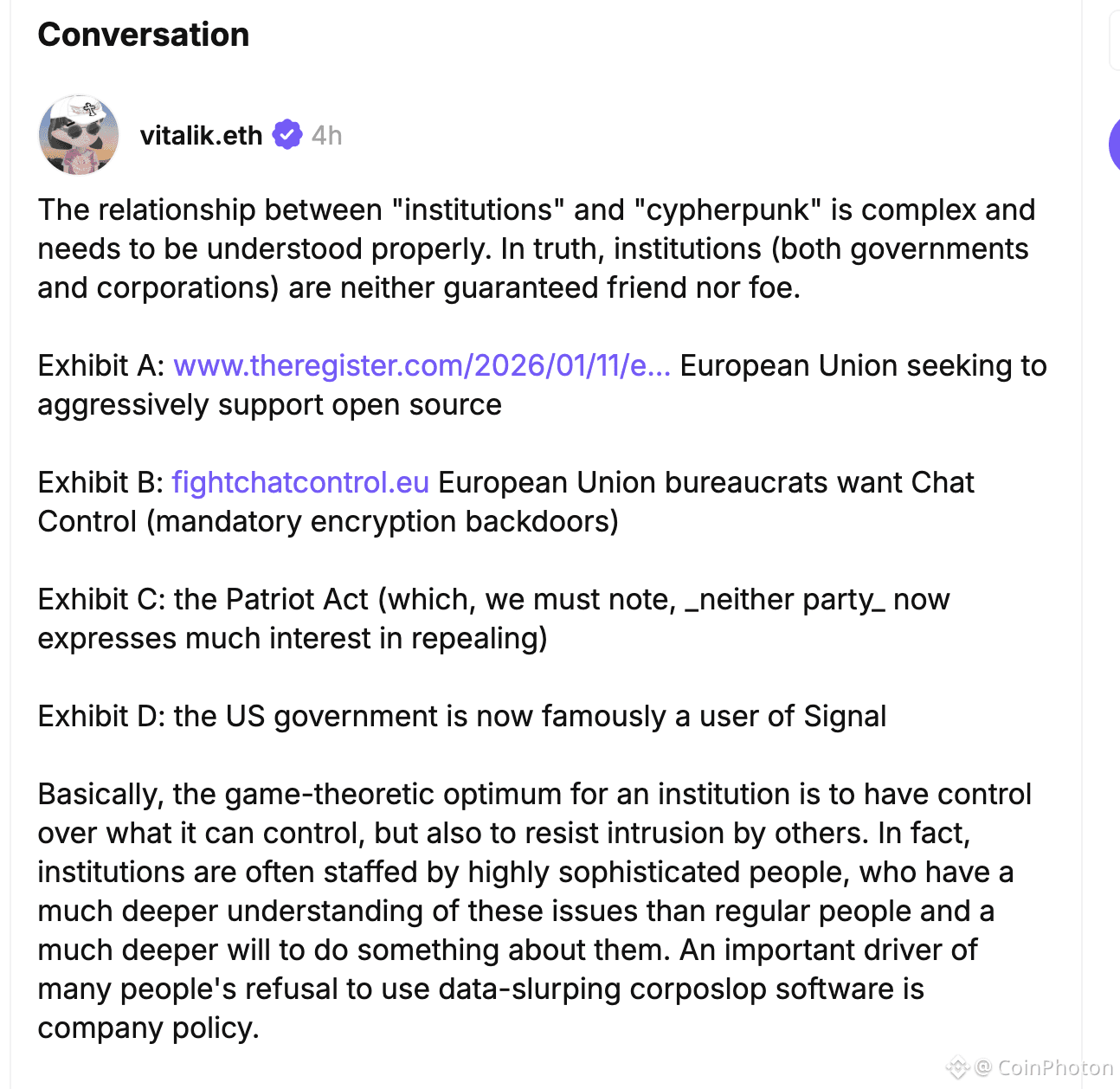
However, this does not mean institutions will try to reduce people’s dependence on them. That, Buterin said, remains the responsibility of the Ethereum community: to build tools that enable individuals to achieve true self-custody and digital sovereignty.
In the stablecoin sector, he suggested asset issuers will increasingly prefer blockchains whose governance is not overly concentrated in any single country. Governments are likely to push for expanded KYC requirements, while privacy technologies continue to evolve in parallel, particularly through zero-knowledge proofs. He expects ongoing ideological and technical debates around mechanisms such as ZK-based proofs of source of funds.
Buterin also predicted that institutions will want direct control over their own wallets and, if they stake ETH, over their own staking infrastructure. This trend could ultimately support greater decentralization of Ethereum staking. At the same time, building secure and user-friendly self-custody solutions for everyday users — such as smart contract wallets and social recovery systems — remains a key mission for Ethereum’s cypherpunk builders.
He reiterated that Ethereum is a censorship-resistant “world computer,” and not every use case that emerges on it will be universally approved. What matters, he said, is building financial, social and identity systems on Ethereum that protect individual freedom and self-sovereignty, and making those systems strong enough to thrive alongside — and compete with — centralized alternatives.
Rather than adopting blanket hostility toward institutions, Buterin supports a strategy of selective, win-win cooperation while firmly defending core cypherpunk values. The goal, he said, is to create digital infrastructure that safeguards personal freedom and autonomy, even as it interoperates with the traditional institutional world.
