
When you look at most blockchains, enforcement is emotional.
Someone breaks the rules. A validator misbehaves. A penalty triggers. Stake gets slashed. Everyone reacts. Then the system moves on.
The behavior is punished, but it is not remembered.
That design works if your only goal is short-term coordination. It does not work if you are trying to build financial infrastructure where trust accumulates over time and mistakes cannot be quietly erased.
This is where Dusk feels fundamentally different.
Dusk does not treat accountability as a moment. It treats it as state.
At the core of the network is a simple but uncomfortable idea: outcomes should only become final after they are collectively verified, and once they are final, they should persist as part of the system’s memory. Not just as data, but as context.
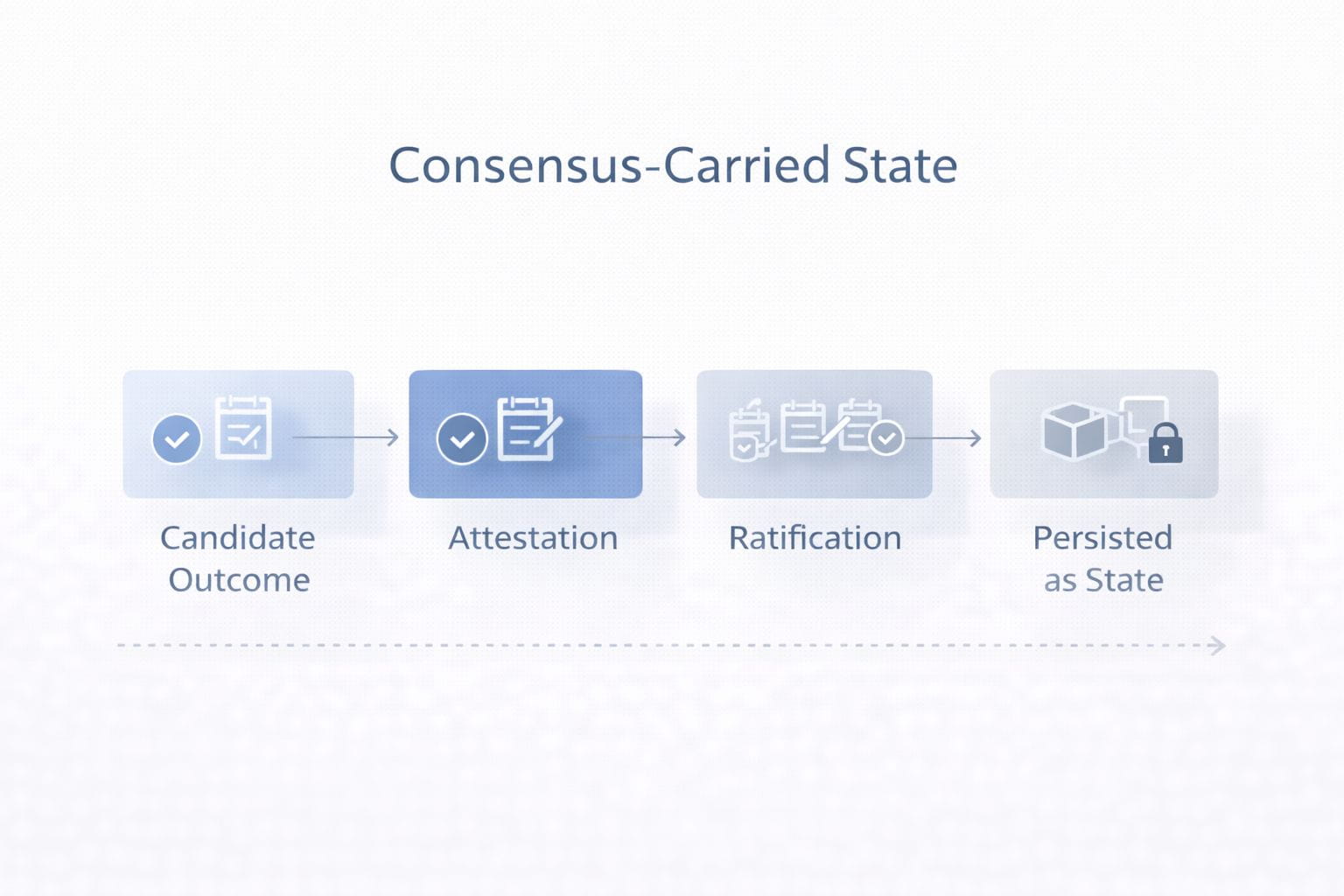
This is what Dusk means by consensus-carried state.
On Dusk, a transaction is not just executed and forgotten. Before anything becomes canonical, it passes through an attestation phase. Validators do not just check validity in the narrow technical sense. They attest to correctness under predefined rules. Only after that collective attestation does the outcome get ratified and written into state.
That state does not only reflect balances. It reflects behavior.
If a participant consistently behaves incorrectly, that behavior does not disappear after a slash event. It becomes traceable. Over time, this creates reputational gravity. Participants are not just reacting to penalties. They are operating inside a system that remembers.
This matters more than it sounds.
In many networks, slashing creates fear, but fear fades. Once the penalty is absorbed, the incentive pressure resets. The system becomes reactive and cyclical. Dusk intentionally avoids that loop.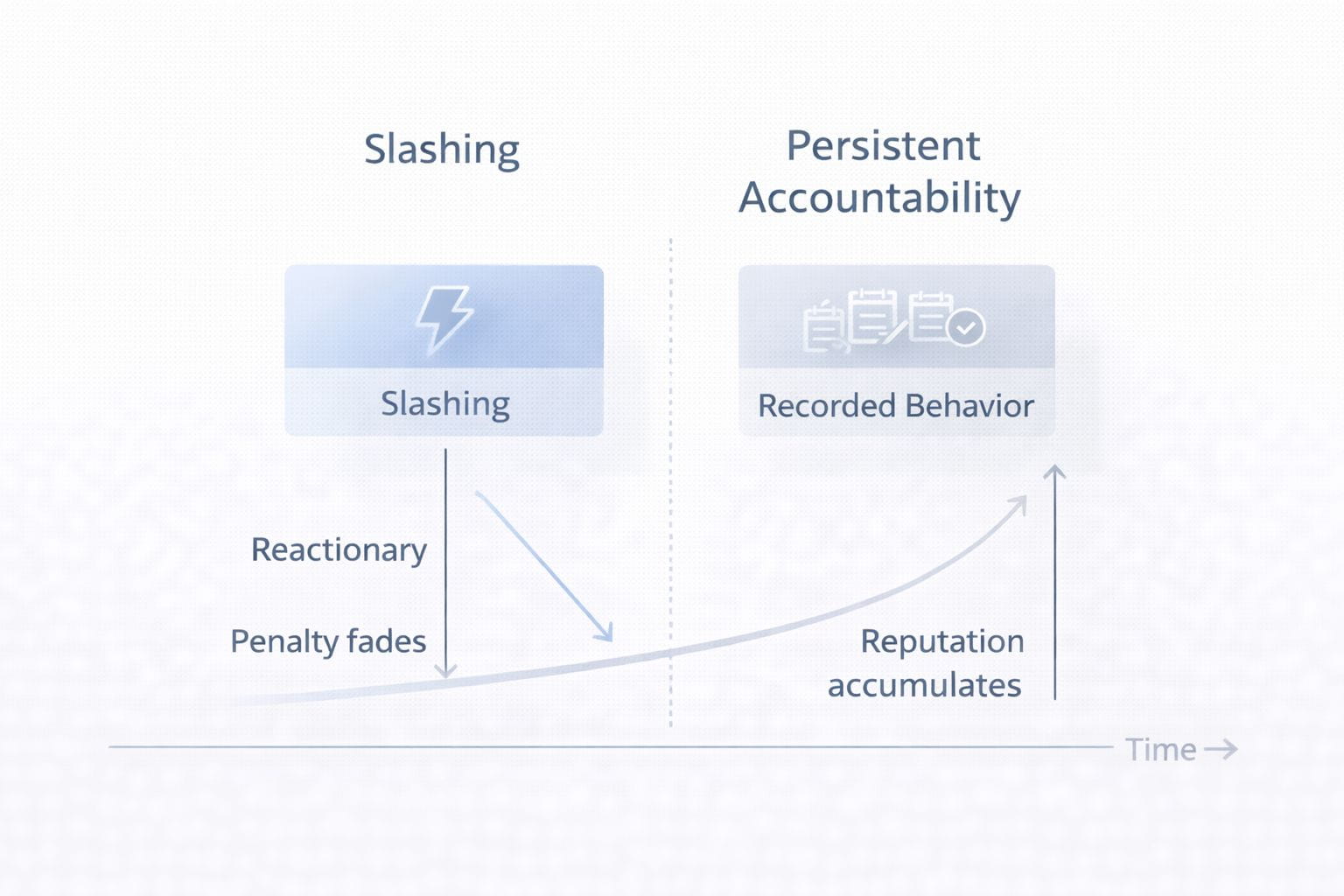
Instead of asking “How do we punish bad behavior harder?”, Dusk asks “How do we make correct behavior the only sustainable path?”
The answer is structural accountability.
Validators on Dusk stake not just to earn rewards, but to anchor responsibility. Their role is tied to settlement finality. They are part of the mechanism that decides when something is done, not just when something is fast.
This design choice explains why Dusk does not optimize aggressively for throughput or headline performance metrics. Speed without discipline is cheap. Finality with accountability is not.
From a finance perspective, this is exactly the trade institutions care about. Banks, exchanges, and issuers are not afraid of slower systems. They are afraid of ambiguity. They need to know when something is final, who verified it, and whether that verification can be defended later.
Dusk’s architecture is built around that need.
Privacy on Dusk follows the same logic. It is not about hiding everything. It is about controlled disclosure. Data is concealed by default, but provable when authorization exists. Auditors and regulators do not see the whole system. They see what they are allowed to verify, when they are allowed to verify it.
Again, the system remembers.
What makes this approach hard to market is that it looks quiet. There is no constant drama. No visible slashing events. No noisy on-chain theatrics. But that quietness is not inactivity. It is constraint.
Dusk is deliberately limiting itself so that when real value flows through the network, the rules do not bend.
For traders, this can feel boring. For infrastructure, it is the opposite.
The real question is not whether this design is elegant. It is whether Dusk can carry this philosophy into real usage. Can validators uphold these constraints under pressure? Can regulated applications trust this model enough to settle meaningful volume? Can accountability become a feature people rely on rather than a concept people debate?
That is the bet Dusk is making.
Not on hype. Not on fear.
On memory.
And in finance, memory is everything.
