
At some point, every technology that promises to change finance has to face a difficult truth. Finance does not run on idealism. It runs on rules, incentives, responsibility, and trust that has been tested under pressure. Blockchain spent many years avoiding this reality by framing transparency as a universal solution. Put everything onchain, expose every transaction, and trust will naturally emerge. That idea worked well in theory and even better as a narrative, but reality has a way of pushing back.
This is the point where Dusk Foundation enters the picture, not as a rebellion against finance, but as an acknowledgment of how finance actually works.
If you look closely at traditional financial systems, privacy is not a flaw. It is a structural necessity. Companies do not publish payroll details. Institutions do not broadcast liquidity strategies. Individuals do not want their spending habits mapped in public forever. These protections are not about hiding wrongdoing. They are about allowing people and organizations to operate without unnecessary exposure. When blockchain ignored this reality, it limited itself to experimentation rather than adoption.
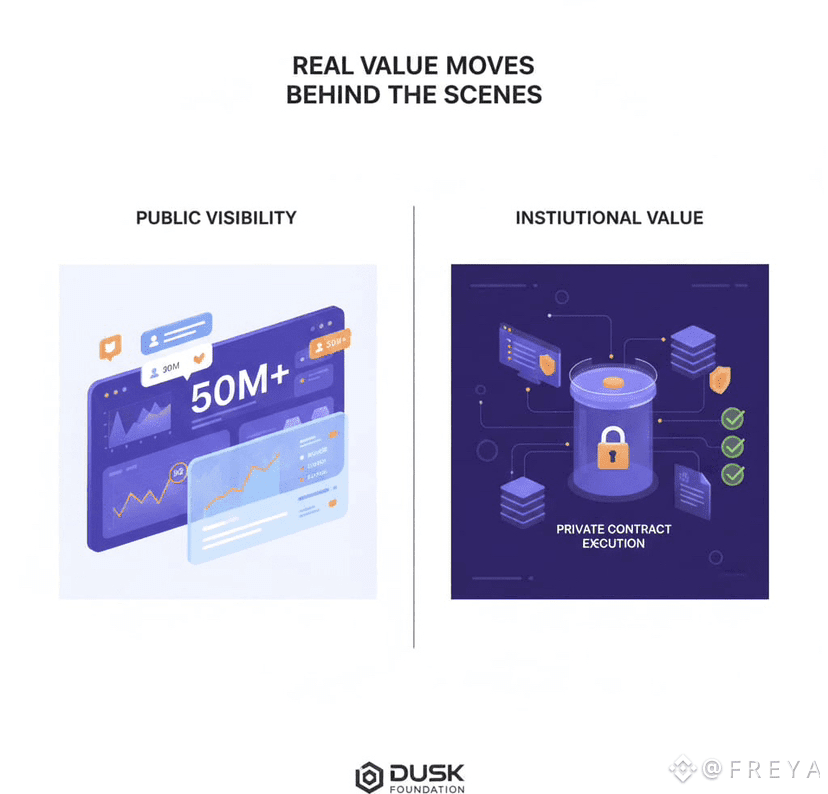
Dusk starts from a different assumption. It assumes that decentralization must coexist with discretion. Instead of treating privacy as something to be added later, Dusk builds confidentiality into its base layer. This is not privacy for privacy’s sake. It is privacy with accountability, where transactions can remain confidential while still being provable and auditable when required.
I’m seeing this design choice become more relevant as blockchain moves closer to regulated environments. Tokenized securities, compliant DeFi, and real-world asset infrastructure cannot function on systems that expose every detail by default. Regulators, institutions, and even users need selective disclosure, not radical transparency. Dusk offers a framework where this balance is possible.
What makes Dusk different from many privacy-focused projects is its attitude toward regulation. Rather than framing regulation as an enemy, Dusk treats it as a condition of reality. Financial systems do not exist outside the law, and infrastructure that pretends otherwise eventually hits a wall. By acknowledging regulatory requirements early, Dusk avoids building fragile systems that need constant workarounds.
This mindset also shapes how Dusk evolves. It moves deliberately, sometimes slower than trend-driven projects. But financial infrastructure is not judged by how fast it launches. It is judged by how it behaves over time. Stability, predictability, and correctness matter more than novelty. Dusk seems to understand this trade-off and accepts it.
There is also a psychological layer to financial privacy that often goes unnoticed. When people know that every transaction is public, behavior changes. Risk-taking becomes performative. Participation becomes cautious. Decision-making shifts from strategy to optics. This is not how finance operates in the real world, and it is not how it should operate onchain either. Dusk restores a level of discretion that allows participants to act without an audience, while still remaining accountable.
As blockchain adoption grows, the industry is being forced to redefine what trust actually means. Trust is not created by exposing everything. Trust is created by systems that behave consistently, enforce rules fairly, and protect participants from unnecessary risk. Dusk builds toward this definition of trust by aligning decentralization with practical governance and compliance.
I’m noticing that Dusk attracts builders who think in long time horizons. These are not projects chasing short-term hype or explosive metrics. They are teams thinking about how systems will be audited, regulated, and relied upon years down the line. That audience may be quieter, but it is also the one that determines whether blockchain becomes infrastructure or remains an experiment.
Another important aspect of Dusk is how it reframes privacy itself. Privacy is often treated as a binary state. Either everything is hidden or everything is visible. Dusk rejects that simplification. It treats privacy as a spectrum, where information can be revealed selectively based on context, authority, and necessity. This approach mirrors how financial systems operate in practice and makes integration far more realistic.
As more value moves onchain, these design decisions will matter more. Systems that ignore privacy will struggle to attract serious participation. Systems that remove accountability will struggle to earn trust. Dusk sits in the uncomfortable middle, where both privacy and responsibility are enforced.
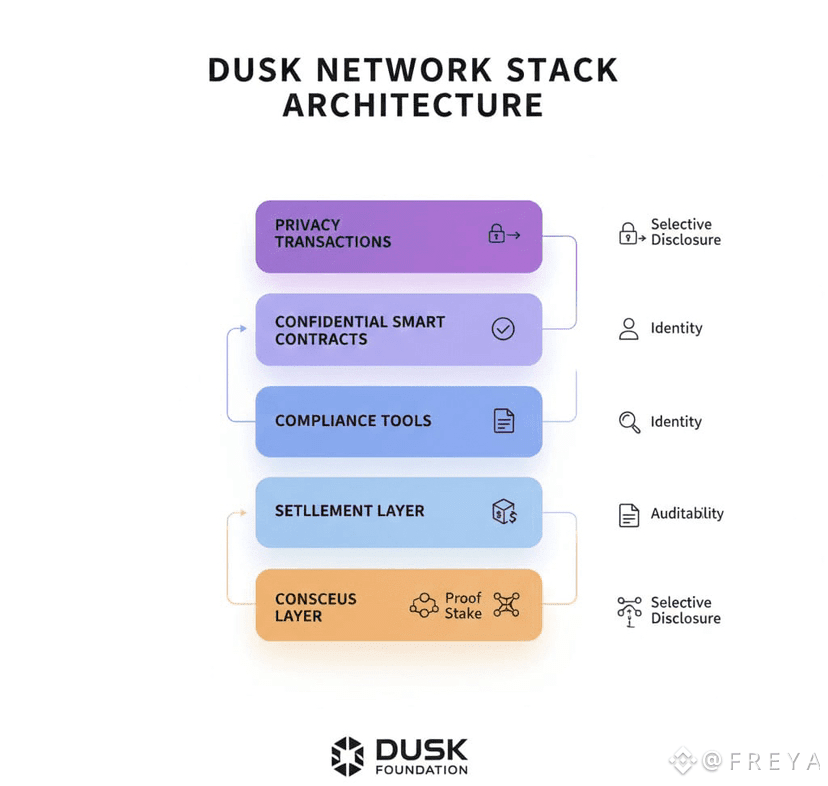
This is not an easy position to hold. It requires careful engineering, clear governance, and a willingness to resist simplistic narratives. But it is also the position that aligns most closely with real-world finance. Dusk is not trying to reinvent how finance works. It is trying to make blockchain compatible with it.
Looking ahead, the success of Dusk will not be measured by hype cycles or short-term adoption spikes. It will be measured by whether institutions feel comfortable using it, whether regulators understand it, and whether users trust it over time. Those are slow metrics, but they are durable ones.
If blockchain is going to grow beyond its experimental phase, it needs systems that respect the complexity of finance rather than denying it. Dusk represents an effort to build such a system, quietly, deliberately, and with an understanding that trust is earned through responsibility, not visibility alone.
Sometimes progress is not about showing more. Sometimes it is about knowing exactly what should remain private.
Dusk is built around that understanding.
