



Vanar Chain is designed around a clear and deliberate shift in how blockchain infrastructure should support the next generation of applications. Rather than competing in the already crowded race for faster execution and lower fees, Vanar focuses on a more fundamental requirement that modern systems increasingly depend on: persistent, verifiable intelligence. As artificial intelligence agents move from experimental tools into continuous, real-world workflows, the lack of durable context has become a structural limitation. Vanar positions itself as the chain that addresses this limitation directly by making memory a first-class primitive.
For most of blockchain’s history, execution was the primary concern. Networks optimized for transaction throughput, settlement speed, and cost efficiency. This focus was necessary at the time, but it has now largely converged. Execution is abundant across rollups, Layer 2s, app-chains, and parallel execution environments. While performance will continue to improve, it no longer defines what blockchains fundamentally enable. What differentiates systems today is not how quickly they execute instructions, but how intelligently they can operate over time.
This is where Vanar’s design philosophy diverges from traditional chains. Modern applications increasingly rely on agents that do more than respond to single requests. These agents monitor systems, coordinate tasks, manage workflows, and make decisions continuously. For this to work, intelligence must persist. An agent that forgets preferences, constraints, or prior decisions cannot compound knowledge or behave reliably. Stateless intelligence may appear capable in short sessions, but it breaks down under long-term use.
Vanar addresses this problem by treating memory not as an external database or a temporary cache, but as core infrastructure. The chain is built to support persistent semantic memory, meaning structured knowledge that agents can reuse, reason over, and evolve. This memory is not limited to raw logs or transcripts. It includes learned behavior, preferences, constraints, historical context, and decision-shaping information that allows agents to act consistently across time and tools.
At the foundation of this approach is Neutron, Vanar’s persistent semantic memory layer. Neutron allows agents and applications to store and retrieve meaningful context that does not disappear between sessions. This enables intelligence to compound rather than reset. Agents built on Vanar do not start from zero every time they interact with a user or a system. They build on what they already know, improving behavior gradually and predictably.
Above this memory layer sits Kayon, which enables reasoning directly over stored context. Kayon allows agents to explain decisions based on what they have learned, rather than producing opaque outputs. This is critical for trust and usability. When agents are expected to act autonomously, users and systems need to understand not just what happened, but why it happened. Reasoning over persistent memory transforms agents from reactive tools into accountable participants within workflows.
Flows extend this capability further by enabling context-preserving workflows. In many systems, even when individual steps are intelligent, context breaks between actions. Flows allow developers to design multi-step processes where memory and reasoning persist throughout the entire lifecycle. This makes complex automation possible without fragile handoffs or repeated context reconstruction.
Axon sits at the application layer, allowing full decentralized applications to be deployed without rebuilding intelligence from scratch. By abstracting memory, reasoning, and workflow logic into shared infrastructure, Axon enables faster development while maintaining consistency across applications. This approach recognizes that intelligence should be reusable and composable, not rebuilt for every new product.
A key design decision in Vanar’s architecture is that execution does not need to be centralized within the chain itself. Execution can live wherever it is most efficient. The intelligence layer is designed to follow agents across ecosystems rather than compete with execution chains. This separation reflects the reality of modern systems, where value settlement and intelligent decision-making are distinct concerns. Vanar focuses on the latter, providing leverage rather than redundancy.
This model is not theoretical. Persistent AI memory is already in active use through products like MyNeutron, where thousands of users rely on agents that remember, adapt, and improve over time. This real-world usage highlights a simple truth: once intelligence becomes persistent, reverting to stateless systems feels fundamentally broken. Users quickly recognize the difference between agents that remember and agents that reset.
Vanar’s emphasis on onchain memory also addresses issues of ownership and verification. Memory stored on centralized platforms is ephemeral, siloed, and controlled by service providers. Agents operating across protocols, chains, and tools require memory that is portable, verifiable, and owned by users. Onchain memory provides provenance. It allows systems to verify what an agent knew, when it learned it, and which context influenced a decision. This transparency is essential as agents begin to operate with greater autonomy.
The broader implication of Vanar’s design is a redefinition of where value accrues in blockchain systems. Execution chains increasingly resemble infrastructure utilities. Intelligence layers, by contrast, create leverage. They enable applications to learn, adapt, and improve over time. They turn static software into evolving systems. As agents become embedded in real workflows with real users and real economic activity, the importance of persistent context becomes unavoidable.
Vanar does not position intelligence as a future upgrade. It treats it as a present requirement. The intelligence layer is already here, and the primary bottleneck is no longer model capability, but context continuity. Without durable memory, intelligence cannot scale meaningfully. Agents remain brittle, workflows fragment, and knowledge evaporates.
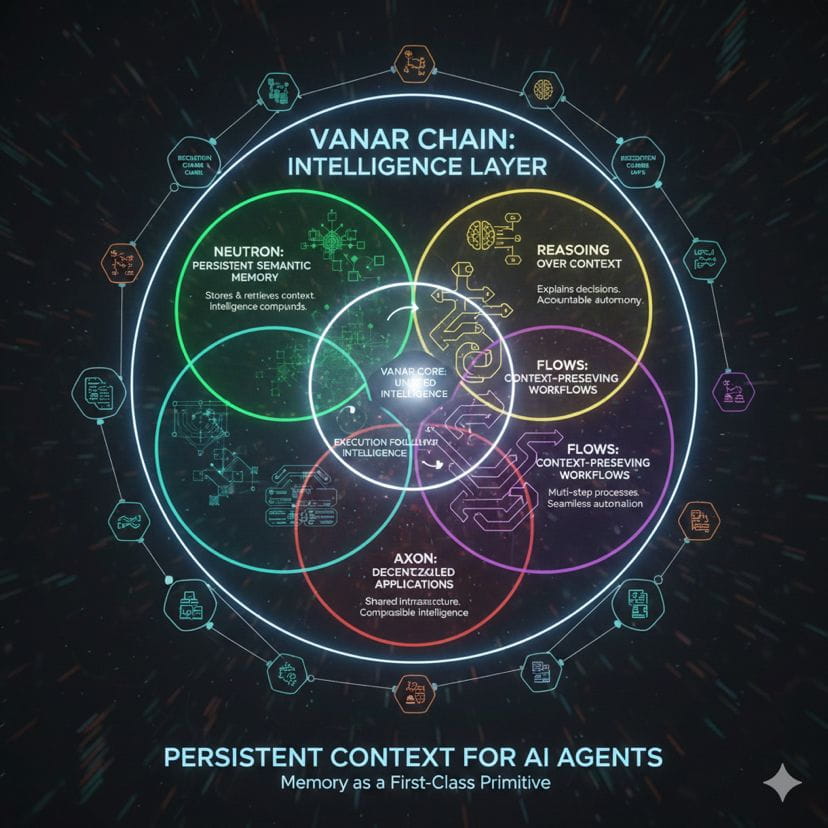
By making memory a first-class primitive, Vanar Chain provides infrastructure for agents to grow up. It enables intelligence that persists, reasons, and compounds across time. In doing so, it shifts the conversation away from marginal execution gains toward systems that can support real, long-lived, intelligent applications. This focus defines Vanar’s role in the evolving blockchain landscape and explains why its architecture is aligned with where the industry is heading, not where it has been.
