

Most people don’t realize how “old” on-chain money still feels until they actually try to use it like real money. Not trading coins on an exchange I mean paying someone across the world, settling a business invoice, moving stablecoin liquidity between accounts, or sending money in a way that feels as smooth as sending a message. The truth is, crypto promised a new financial system, but the everyday experience of moving value on chain is still messy. Fees change without warning, transactions compete for block space, confirmations can take longer than expected, and the whole process often feels designed for speculators, not real payments. That’s the exact problem Plasma is trying to solve and it’s why the project is starting to matter more than people think.
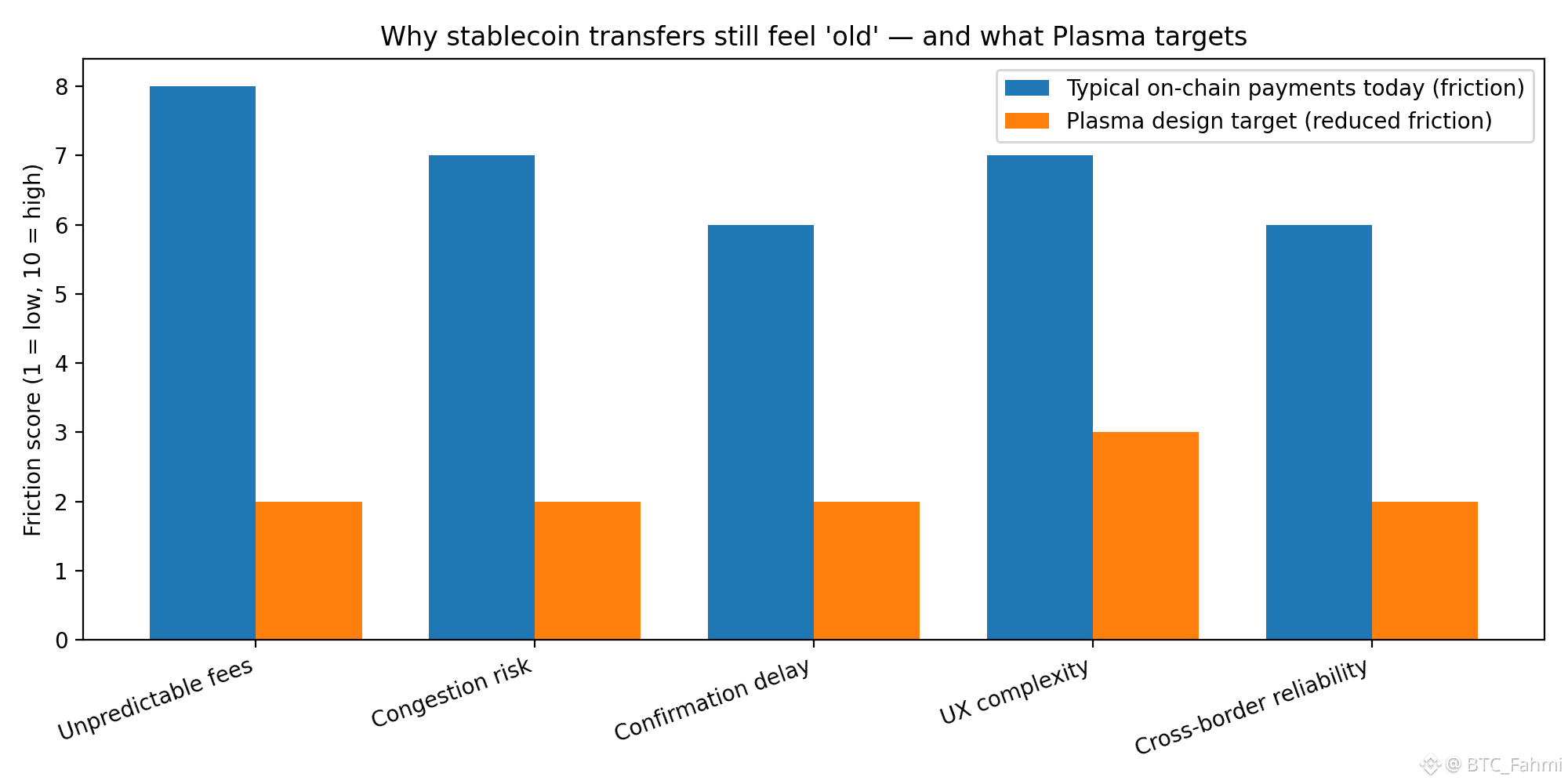
Plasma is built around one core idea: stablecoins are not a side feature of crypto anymore. They are the main financial product. For traders, stablecoins are the base currency. For investors, stablecoins are the bridge between risk and safety. For businesses, stablecoins are becoming the easiest way to move dollars globally without delays, bank friction, or weekend shutdowns. Yet most blockchains still treat stablecoins like “just another token.” Plasma flips that logic. It treats stablecoins as first-class citizens, then builds the chain around what stablecoins actually need to work at global scale.
To understand why this matters, you have to look at where on-chain finance is today. Almost all trading activity, DeFi liquidity, and cross-border crypto usage depends on stablecoins. USDT and USDC aren’t just popular they’re structural. But their usage is still limited by the underlying networks they run on. A trader moving stablecoins between exchanges cares about speed and reliability. A business paying suppliers cares about predictable fees. A payments company cares about throughput and consistent finality. The chain matters less than the experience and the experience today is still not good enough for serious global money movement.
That’s the gap Plasma is targeting.
The “concept to reality” shift comes from Plasma building for real constraints. If you want a chain to move stablecoin value globally, it can’t behave like a congested marketplace. It has to behave like infrastructure. That means low and predictable costs, high throughput, and fast finality but also something deeper: stablecoin flows should feel native, not improvised.
One way Plasma approaches this is by designing around the idea that stablecoin transfers should be cheap enough to be used constantly. Not “cheap when the network is quiet,” but cheap as a baseline behavior. That matters because the real world doesn’t move money in big dramatic chunks only. It moves money in thousands of small actions: payroll, subscriptions, supplier payments, transfers between trading accounts, remittances, refunds, and treasury rebalancing. When fees are unpredictable, these behaviors become inefficient and people fall back to banks. So Plasma is not just chasing performance numbers it’s chasing stablecoin usability.
The second big piece is familiarity for developers. Plasma is EVM-compatible, which is not a minor detail it’s the difference between an ecosystem forming quickly or struggling for years. EVM compatibility means Solidity, familiar tooling, familiar wallets, and a ready-made pool of developers. For traders and investors, this matters because liquidity follows developers and developers follow ease. When developers can deploy without friction, applications ship faster, integrations happen sooner, and markets mature quicker. In practice, EVM compatibility is not a “feature.” It’s a go to market weapon.
But there’s still a question that serious investors ask if the world already has many fast EVM chains, what makes Plasma more than just another one?
The answer is focus. Plasma isn’t trying to be everything for everyone. It’s not positioning itself as the best chain for NFTs, gaming, meme coins, or experimental DeFi primitives. It’s targeting one highly valuable category: stablecoin-based finance and payments. That focus changes design decisions. It changes what gets optimized. It changes what partnerships matter. And most importantly, it changes how the chain’s success will be measured. Instead of chasing the loud metrics, Plasma has the chance to chase the meaningful ones payment volume, transaction reliability, settlement speed, and integration into real cash flow.
This is where the emotional side comes in, because anyone who has tried to use crypto as money knows the frustration. You’re staring at a wallet, hoping gas doesn’t spike. You’re waiting for confirmations that feel instant in theory but stressful in practice. You’re wondering if you should send extra to cover fees. And if you’re moving money for something important not trading, but paying someone the anxiety is real. Traditional finance is slow, but it’s stable in behavior. Crypto is fast, but not stable in experience. Plasma’s mission is basically to remove that psychological friction. When on-chain money movement becomes boring, it becomes scalable.
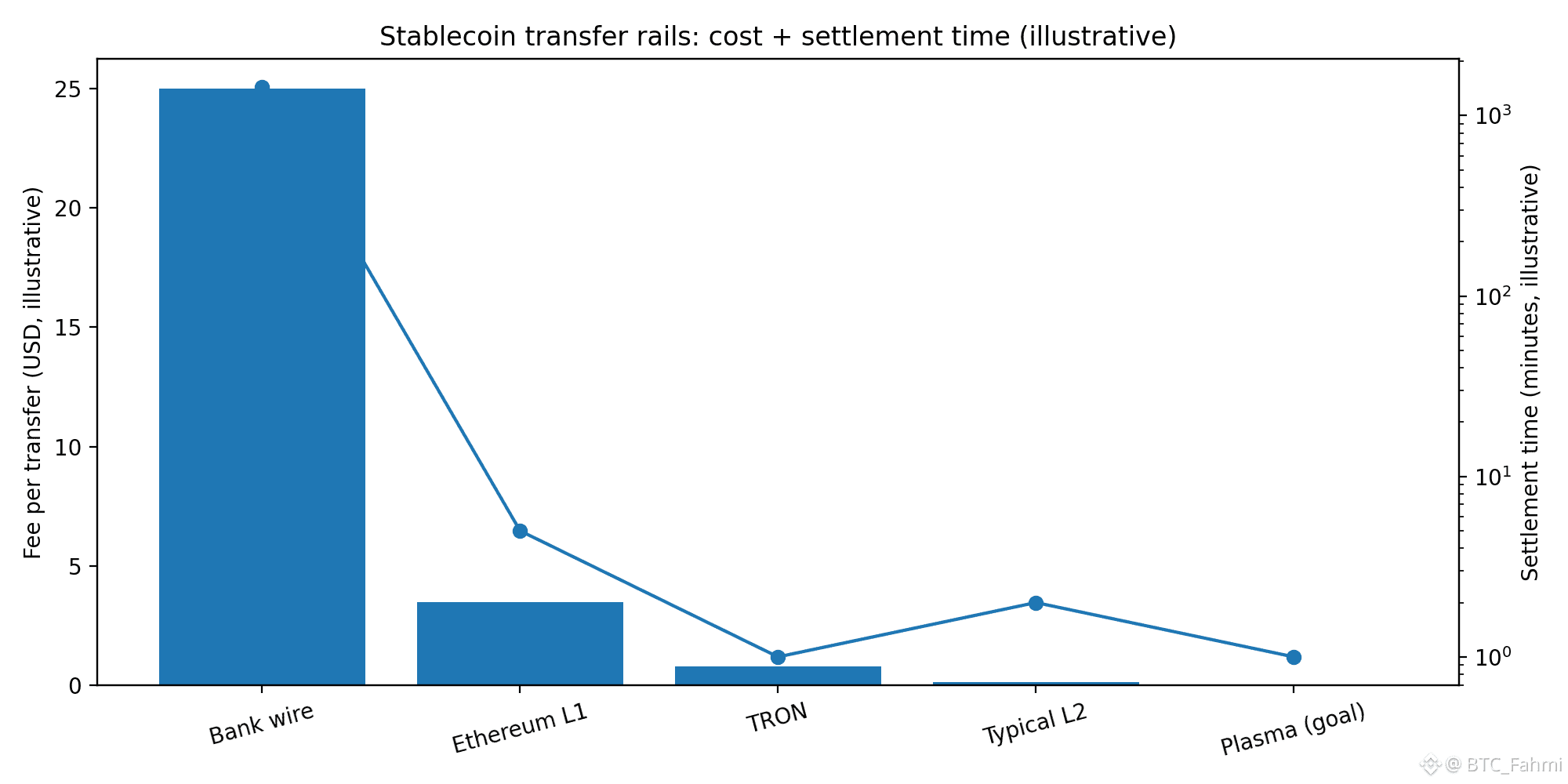
A real-world example makes this clearer. Imagine a small export business in Bangladesh paying a supplier in Turkey using stablecoins because it’s faster than bank wires. Today, they might use Ethereum or Tron or another common chain. The business owner doesn’t care about decentralization debates they care about getting the payment delivered cheaply, quickly, and consistently. If fees jump suddenly or the network delays settlement, that’s not “tech risk.” That’s business risk. Late inventory means lost revenue. In that world, Plasma’s value isn’t theoretical. If it can provide stablecoin rails with predictable behavior, it’s directly competing with traditional cross-border payment infrastructure.
For traders, the impact is just as practical. Stablecoins are the lifeblood of trading, but capital efficiency suffers when moving funds is slow or costly. Plasma’s approach hints at a future where stablecoin transfers become fast enough and cheap enough that traders can reposition liquidity more aggressively without bleeding fees. That doesn’t just improve convenience it changes strategy. It creates an environment where on-chain settlement can actually keep up with decision making speed.
There’s also a broader trend supporting Plasma’s existence: the market is shifting from “crypto as assets” to “crypto as rails.” The easiest way to see this is stablecoin growth itself. Stablecoins have quietly become the most adopted crypto product in the world because they solve a real problem: dollar movement across borders. And as more governments, fintechs, and institutions pay attention, the infrastructure layer becomes more important than the token narratives.
Plasma, at its best, is an infrastructure bet. It’s a bet that the future of crypto is not only trading volatility, but also moving stable value at scale. That’s a more mature thesis than most people are used to in this space and it’s why it’s worth understanding.
Of course, none of this guarantees success. Plasma still has to execute. It has to attract integrations, liquidity partners, wallets, and payment flows. It has to prove that its design choices hold up under real load, not just testnets and marketing. But the direction is coherent, and that alone makes it different in a market filled with chains that don’t know what they’re for.
The simplest way to summarize Plasma is this it’s trying to take on-chain money movement from an unstable, trader only experience and turn it into real financial infrastructure. Not louder. Not flashier. Just more usable, more reliable, and more aligned with how money actually moves in the world. And if Plasma succeeds at that, it won’t just redefine one niche it could quietly reshape the most important part of crypto: the ability to move value like it’s truly the internet of money.

