


The dashboards were calm long enough that nobody checked why the Dusk's disclosure scope box was still blank.
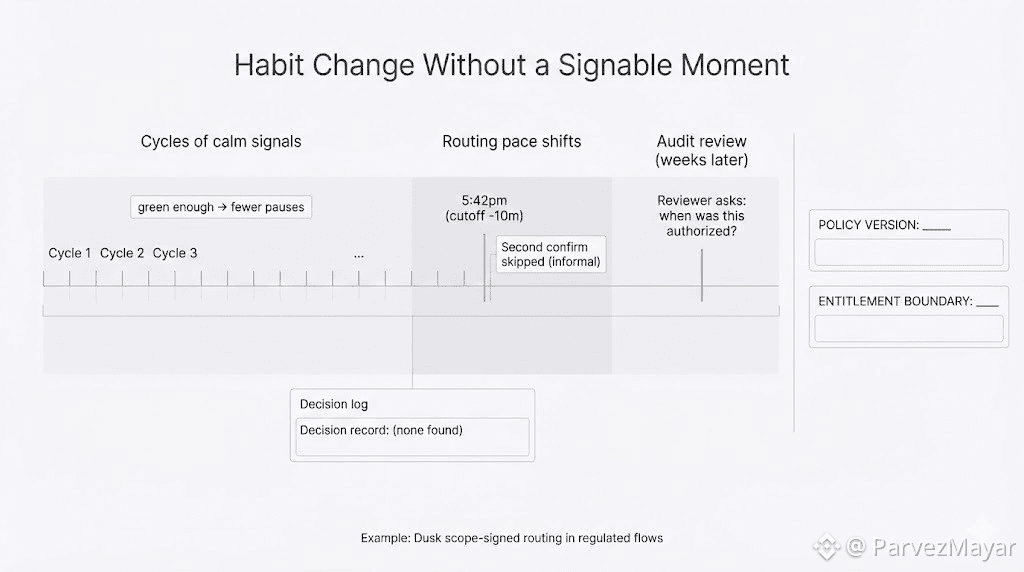
Attestations kept arriving on schedule. Final blocks sealed without drama. Nothing jittered. Nothing lagged. The kind of quiet that usually earns trust by default. After a few cycles... the ops lead stopped waiting for the second confirmation and routed earlier. Not announced. Just a habit change. One fewer pause in the runbook. The "second-confirm' box stayed unchecked and nobody reopened the ticket though.
It happened at 5:42pm once, ten minutes before cutoff.
Green enough. Ship it.
On Dusk, the ticket does not just ask "did it finalize". It asks who is entitled to see the proof under the current disclosure scope... and whether the scope owner signed that routing. That box was blank.
So when surface signals behave, people start borrowing certainty from them because it is the only certainty that's safe to forward. The line between "validated' and 'usable' blurs. The runbook did not change. The behavior did in reality.
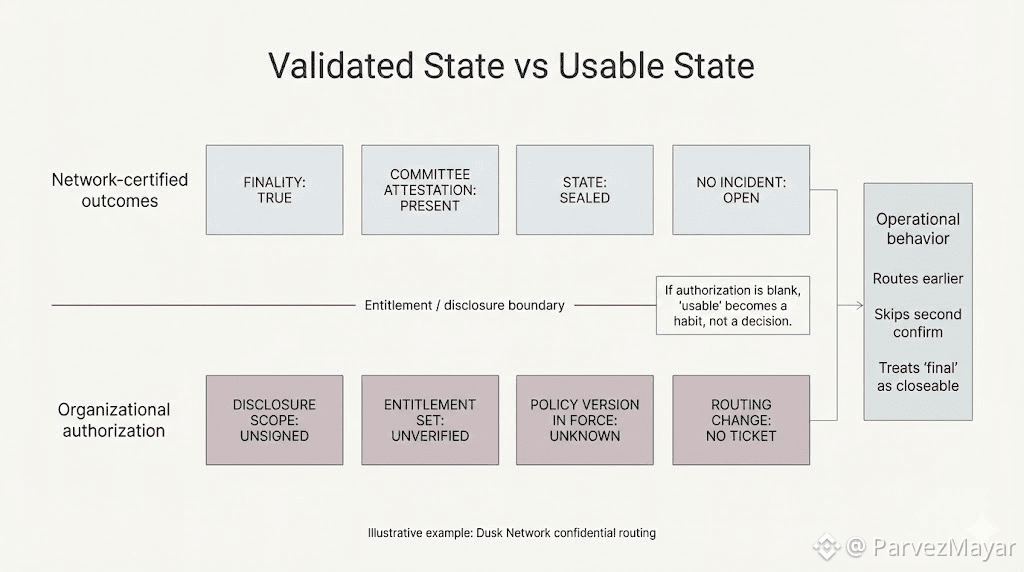
The credentials at Dusk checked at execution were correct. That was not the question. The question nobody asked was whether those checks were meant to justify what happened next... timing, sizing, reuse.
A reviewer flags it weeks later, not as a failure, but as a mismatch. The routing looks different. Cutoffs shifted and exposure closes faster. There's no ticket authorizing it. No note explaining why the pace changed. Just a trail of decisions pointing back to the same calm surface.... and a blank line where the classifier should be, which policy version was treated as in force when the route changed and who signed off that the entitlement set was sufficient for the new pace.
When asked when the call was made, there is not a moment to point to.
Finality landed. "Final" shows up on-chain. The release checklist still had a blank. The internal question stayed open... was the organization allowed to treat this as closeable without widening disclosure scope to pull in more eyes. On Dusk, widening scope is not a free debug step. It's precedent. And the person who can authorize it is never the person who wants to use it to explain a habit.
So nothing gets unwound.
The ops lead keeps moving at the new pace because reversing looks like admitting error without evidence. Risk does not object because nothing violates limits as written. Audit parks the thread and waits.... assuming there was a decision upstream they just haven't seen yet.
There wasn't.
The system stayed correct the whole time. The signals never lied. They were just partial.
Weeks later, the question lands heavy and late: when did we decide this was okay?
No alarm answers. No metric blinks. The confidence is already baked into the flow... and pulling it back would require a justification that fits inside the current disclosure scope on Dusk.
So it stays like this.
Policy version: ____
Entitlement boundary: ____
