
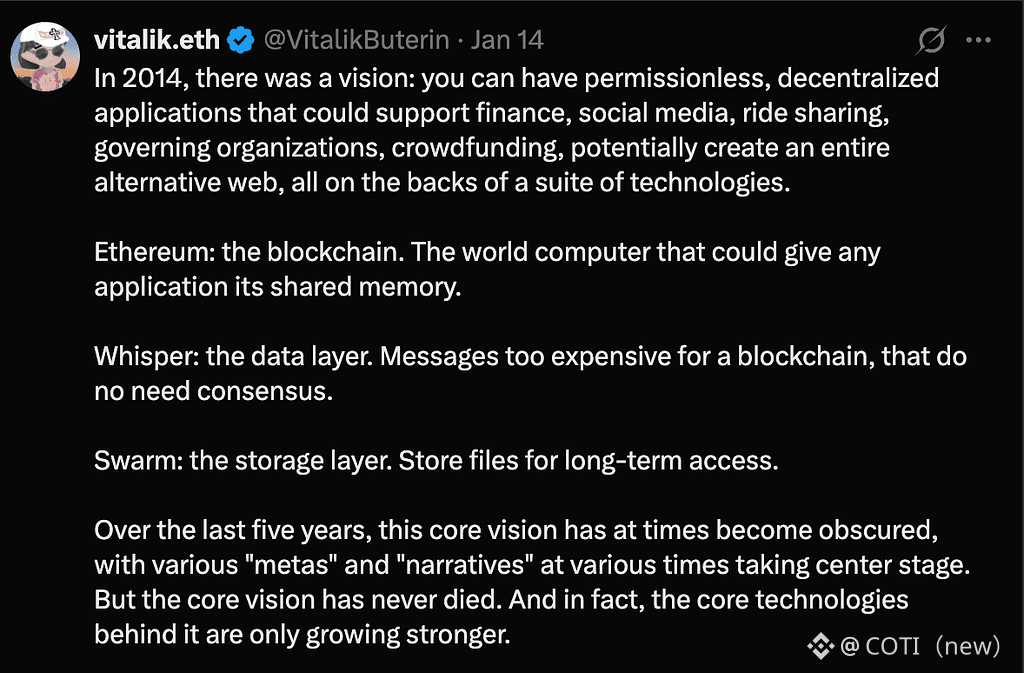
Last week, Ethereum co-founder Vitalik Buterin renewed his commitment to the vision of a decentralized internet, a vision originally articulated in 2014, when the idea of a permissionless, decentralized stack capable of supporting everything from finance to social media was first laid out.
Vitalik describes a world where decentralized applications reshape the internet’s architecture. There are layers for computation, data transfer, and storage all working together.
Today, many of those components have matured, and the broader Web3 ecosystem is entering a phase where the original ideals are finally within reach.
In 2024, the team here at COTI began exploring the challenges and opportunities of building a decentralized internet. The idea goes hand in hand with our core mission for Web3 privacy which is an essential piece of infrastructure for a self-sovereign internet to thrive.
As Shahaf Bar-Geffen noted in 2024, “Without privacy, Web3 is doomed to be a kind of castle in the sky that sounds great in theory, but in practice simply doesn’t work.”
This insight has shaped COTI’s roadmap ever since.
The prerequisites for Vitalik’s Web3 vision are now in place. Ethereum’s transformation to proof-of-stake, coupled with L2 scaling and off-chain messaging (e.g., Waku) and decentralized storage, has built strong foundations. But a complete decentralized internet must go further, especially in delivering privacy that is practical, scalable, and usable.
Closing the Gap Between Vision and Reality
A truly decentralized web must be supported by complete, production-grade tooling, that is fast, frictionless, capable of handling real-world complexity, and able to operate without relying on centralized intermediaries.
This means three things must work together:
Computation that can execute complex logic at scale
Privacy that protects sensitive data without sacrificing performance
Storage that is efficient, persistent, and economically viable
Until now, no protocol has been able to deliver all three simultaneously.
Today, COTI’s work shows that this is no longer the case and public blockchain is now ready to scale.
Where public blockchains are transparent by design, COTI provides opt-in confidentiality that doesn’t compromise auditability or trustlessness. This enables enterprises to use decentralized systems for sensitive operations, from payroll to asset management.
COTI’s privacy primitives are not standalone add-ons. They are protocol-level infrastructure, built into the blockchain itself, making them fundamental building blocks for the next generation of decentralized applications. And where ZK is limited in scalability, COTI’s privacy solution can support the complexities of DeFi and RWAs.
Let’s dig in.
High-Performance Private Computation with Helium
With the Helium Mainnet Upgrade, COTI delivers a privacy-first foundation designed for production use. Helium expands COTI’s ability to support confidential computation at scale, without introducing friction for users or developers.
Helium enables native 128-bit and 256-bit arithmetic on COTI, something that other protocols, including ZK, lack. This means that COTI can computing larger numbers which allows for the complex financial and enterprise logic needed in use cases like DeFi and RWAs.
Together, these advances position COTI as one of the fastest, lightest, and most cost-effective privacy layers in Web3, making private computation practical rather than theoretical.
Multi-Party Privacy Computation With COTI
Privacy in Web3 is not just about hiding values. It is about enabling secure joint computation, allowing multiple parties to execute logic together without revealing their inputs.
COTI’s implementation of Garbled Circuits, a form of decentralized confidential computing, enables complex encrypted computation on-chain without trusted intermediaries. It supports multi-party logic, preserves auditability when required, and maintains EVM compatibility, minimizing friction for developers.
This moves Web3 beyond simple shielded transfers toward programmable, auditable privacy suitable for business, institutional, and everyday use cases.
COTI as a Storage Solution
A decentralized web also requires efficient, persistent storage. COTI is emerging as a cost-effective storage and compute layer, with early benchmarks indicating efficiency comparable to centralized cloud providers, while remaining decentralized by design.
By combining private computation, programmable confidentiality, and efficient storage within a single stack, COTI removes the final structural barriers to building real decentralized applications.
For the first time, developers can build systems that are decentralized, private, performant, and economically viable, without compromise. [LINK to demo]
Web3’s Missing Link is Now in Place
In 2026, the decentralization renaissance Vitalik describes is finally converging with infrastructure capable of delivering on that promise. COTI has been building toward this for years, not as a theoretical exercise, but with practical, usable tools that make privacy and confidential computation part of the Web3 mainstream stack.
We’re not just witnessing a decentralized internet; we’re building it.
About COTI
COTI is the programmable privacy layer for Web3. Powered by high-performance Garbled Circuits, COTI brings fast, low cost, flexible, and compliant privacy to any blockchain. With privacy that’s programmable by design, COTI enables the next generation of DeFi, payments, identity, governance, and AI.
For all of our updates and to join the conversation, be sure to check out our channels:
Website: https://coti.io/
X: https://twitter.com/COTInetwork
YouTube: https://www.youtube.com/channel/UCl-2YzhaPnouvBtotKuM4DA
Telegram: https://t.me/COTInetwork
Discord: https://discord.gg/9tq6CP6XrT
GitHub: https://github.com/coti-io

