

@Walrus 🦭/acc Protocol is not designed to attract attention through grand visions or aggressive marketing. Its purpose is far more practical. While most blockchains excel at processing transactions and tracking ownership, they struggle when it comes to handling real-world data. Large files such as images, videos, software assets, AI training datasets, and long-term application state do not fit comfortably into typical blockchain architectures. Keeping this data on-chain is costly and inefficient, yet outsourcing it to centralized cloud services contradicts the principles of decentralization. Walrus exists to address this exact problem. It is a decentralized infrastructure protocol built to manage large volumes of data while remaining closely aligned with blockchain security and logic.
At its core, Walrus enables applications to store and access sizable datasets without forcing blockchains to bear the full storage burden. Rather than treating data storage as an external add-on, Walrus treats it as a foundational component of decentralized systems. The protocol is structured so applications can depend on data being accessible, verifiable, and resistant to censorship, without trusting any single provider. The goal is not secrecy, but resilience—creating infrastructure that continues to function even as individual nodes fail or exit the network.
Walrus is developed on top of the Sui blockchain, a decision that strongly influences its design. In this setup, Sui functions as the coordination and verification layer rather than the physical storage location. The blockchain records which nodes are assigned specific data fragments, the duration of their storage commitments, and whether they are fulfilling their obligations. The actual data lives off-chain, distributed among a network of independent storage providers. This division allows Walrus to expand storage capacity without overloading the blockchain, while still preserving cryptographic links between the stored data and on-chain state.
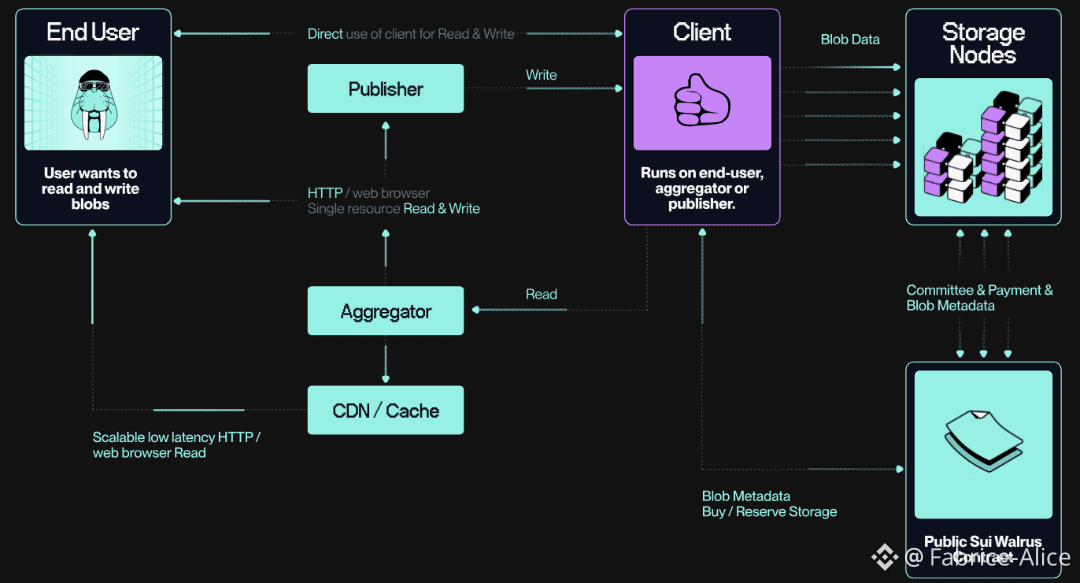
A central technical feature of Walrus is its use of erasure coding. Instead of duplicating entire files across multiple nodes, the protocol divides each file into smaller chunks and introduces mathematically calculated redundancy. These fragments are spread across different storage nodes, and as long as a sufficient subset remains accessible, the original file can be reconstructed. This method provides strong fault tolerance with far less storage overhead than simple replication. Conceptually, it mirrors the techniques used in enterprise data centers, but adapted for a decentralized environment where participants cannot be inherently trusted.
The storage network operates in defined time intervals known as epochs. During each epoch, a specific group of storage nodes is responsible for maintaining and serving assigned data fragments. Their performance is continuously evaluated, and economic incentives or penalties follow accordingly. This is where the WAL token plays a crucial role. WAL is not merely a medium of exchange; it underpins the protocol’s incentive structure. Users pay WAL to store data for a set period. Storage providers earn WAL by reliably hosting and serving that data. Token holders can also stake or delegate WAL to storage nodes, boosting those nodes’ standing while sharing in generated rewards. Nodes that fail to meet performance standards risk losing a portion of their staked value, directly tying economic outcomes to technical reliability.
The economic design of Walrus is intentionally straightforward. Those who require storage pay for it, and those payments are distributed over time to storage operators and staking participants who secure the network. Governance—such as adjusting protocol parameters or approving upgrades—is also linked to WAL ownership. This grounds the token’s value in real utility rather than purely speculative demand. As more data is stored and more applications rely on the protocol, usage-driven demand naturally increases.
Walrus’s role within the broader blockchain landscape is particularly notable. Its close integration with Sui allows developers to reference Walrus-hosted data directly from smart contracts. This means, for example, that an NFT can point to media stored across a decentralized network rather than a centralized server. Decentralized websites can load content from Walrus while relying on the blockchain for ownership or access control. AI applications can work with large, verifiable datasets that are resistant to tampering. In all these scenarios, Walrus functions as backend infrastructure—similar to cloud storage in traditional web applications, but without centralized ownership or control.
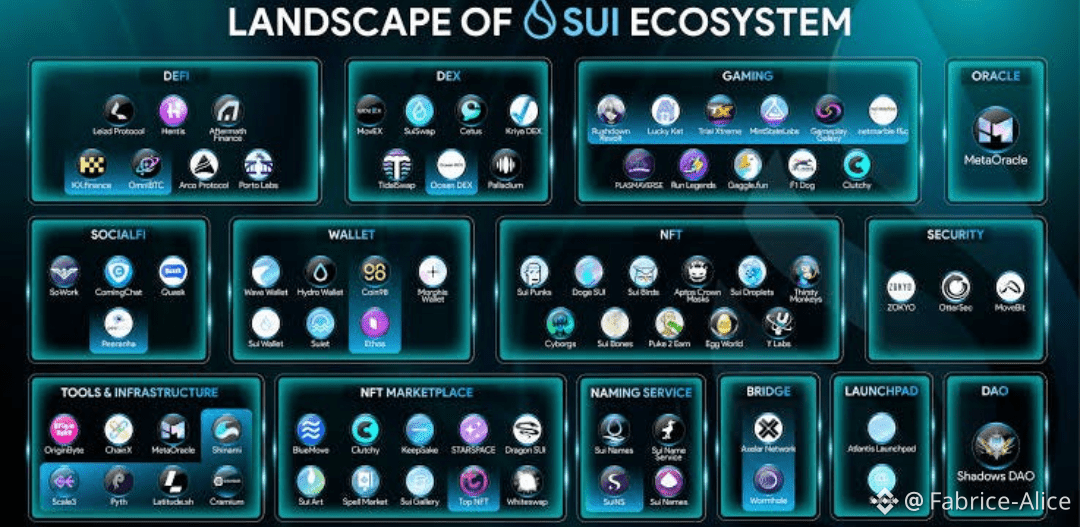
Adoption to date reflects this infrastructure-focused philosophy. Walrus has been incorporated into a growing number of projects within the Sui ecosystem, particularly those that require dependable media storage, persistent application data, or decentralized hosting. These use cases may not be flashy, but they are fundamental. Infrastructure is often invisible when it works properly, only drawing attention when it fails. Walrus appears to be aiming for that quiet reliability.
Development progress suggests an emphasis on steady delivery rather than hype-driven growth. The protocol has transitioned from testing into mainnet deployment, expanded its network of storage nodes, and improved tooling for developers. Backing from prominent investors has supported long-term development, but the true measure of success will be sustained reliability and real-world usage. Trust in storage systems is built gradually, through consistent performance over time.
Challenges remain. The decentralized storage sector is crowded, and Walrus must continue to distinguish itself both technically and economically. Balancing affordable storage costs with sufficient incentives for node operators is complex. Operational risks are also inherent—distributed systems are difficult to manage, and maintaining high availability across many independent participants is never trivial. Adoption is another variable. While tight coupling with Sui provides a strong foundation, it also means broader growth may depend on future integrations beyond that ecosystem.
Looking ahead, Walrus is clearly positioning itself as a core layer for data-heavy decentralized applications. As blockchains evolve beyond simple value transfers into areas such as media, identity, artificial intelligence, and fully featured applications, the demand for reliable decentralized storage will increase. If Walrus continues to emphasize reliability, efficiency, and developer accessibility, it may become one of those protocols that users rarely notice—but depend on every day. Over time, that kind of quiet indispensability is often the hallmark of well-built infrastructure.
