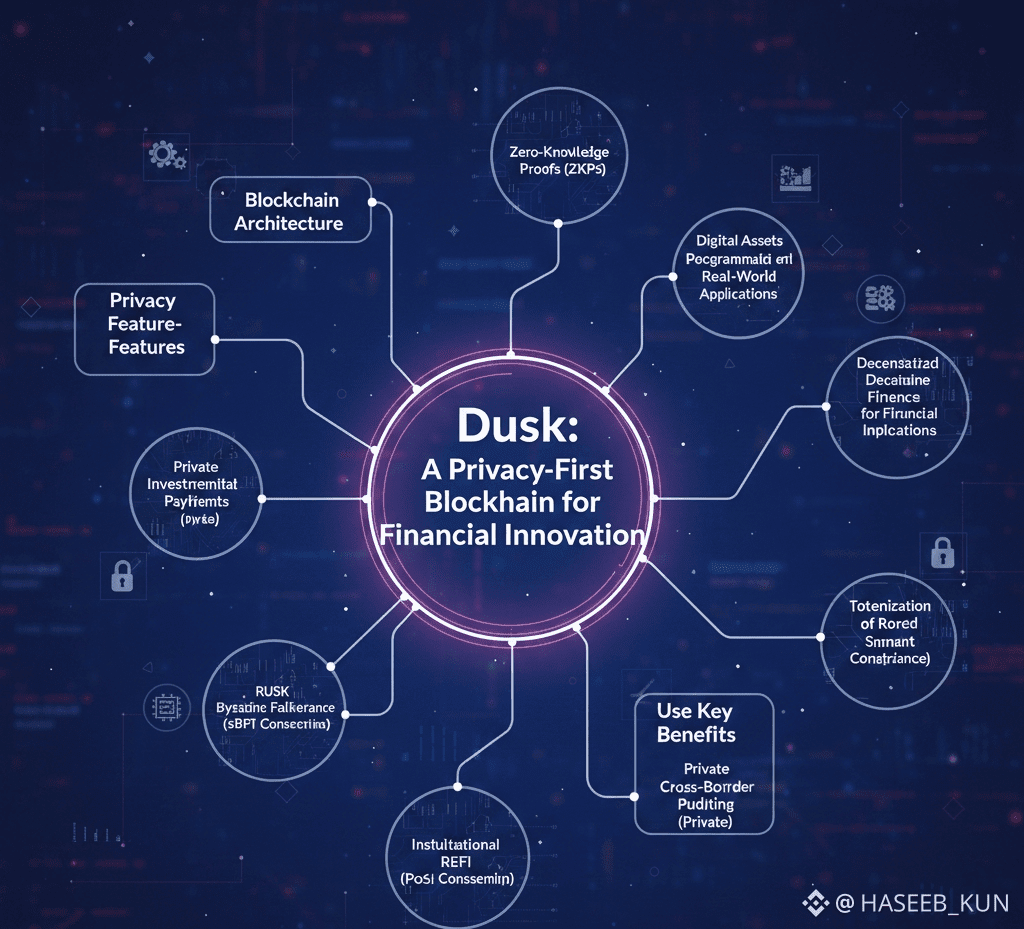
The financial world stands at a crossroads. On one side, we have traditional finance—opaque, heavily intermediated, and accessible only to the privileged few. On the other, the promise of blockchain technology beckons with radical transparency and democratization. Yet here's the paradox: while blockchains offer unprecedented openness, they've inadvertently created a surveillance economy where every transaction, every wallet balance, and every financial move becomes permanently etched into public ledgers for anyone to scrutinize.
Enter Dusk Network, a blockchain that dares to ask a provocative question: What if we didn't have to choose between transparency and privacy? What if compliance and confidentiality could coexist? What if institutions could embrace decentralized finance without exposing their entire financial playbook to competitors?
This isn't just another blockchain project making incremental improvements. Dusk represents a fundamental reimagining of what blockchain infrastructure can achieve when privacy isn't an afterthought but the very foundation upon which everything else is built.
The Privacy Paradox in Modern Blockchain
Let me paint you a picture. Imagine you're a wealth management firm exploring tokenized securities. You've heard the pitch about blockchain's efficiency—instant settlement, reduced intermediaries, programmable compliance. It sounds revolutionary. But then reality hits: every trade your firm executes would be visible on-chain. Your competitors could analyze your positions, track your strategies, and front-run your moves. Your clients' holdings would be exposed. Regulatory arbitrage becomes impossible because everyone sees everything.
Suddenly, that revolutionary technology looks more like a liability than an asset.
This is the unspoken crisis plaguing institutional blockchain adoption. Bitcoin and Ethereum pioneered incredible innovations, but their radical transparency creates untenable situations for real-world financial applications. When every wallet address becomes a window into someone's entire financial history, we haven't just failed to improve on traditional finance—we've arguably made things worse.
Traditional banks, for all their flaws, at least maintain client confidentiality. They don't broadcast your account balance to the world. They don't let strangers trace every purchase you've ever made. Yet this is exactly what happens on most public blockchains today.
The cryptocurrency community initially celebrated this transparency as a feature, not a bug. And for certain use cases—particularly those requiring public auditability—it absolutely is. But we've learned the hard way that one-size-fits-all transparency doesn't work for the complex, nuanced world of regulated finance.
The Birth of a Privacy-First Vision
Dusk Network emerged from a simple but profound realization: for blockchain to achieve mainstream institutional adoption, it must provide confidentiality without sacrificing compliance. The project was conceived by founders who understood both the transformative potential of distributed ledger technology and the non-negotiable requirements of regulated financial markets.
Their vision wasn't to create yet another cryptocurrency focused on speculative trading. Instead, they set their sights on something far more ambitious—building the infrastructure that could bring trillions of dollars in real-world assets onto blockchain rails while satisfying the stringent privacy and regulatory requirements that institutional finance demands.
Think about what this really means. We're talking about tokenizing corporate bonds, real estate, private equity, and complex financial instruments. We're talking about enabling confidential business transactions between competitors who need to interact economically without revealing strategic information. We're talking about creating a financial system that's simultaneously more efficient, more accessible, and more private than what exists today.
The Dusk team recognized that achieving this goal required innovations across multiple dimensions—cryptography, consensus mechanisms, programming languages, and regulatory compliance frameworks. They couldn't simply fork an existing blockchain and add privacy features as an afterthought. They needed to architect something fundamentally new from the ground up.
## Core Values: The Pillars of Dusk's Philosophy
Every meaningful project operates from a set of core values that guide decisions and shape evolution. For Dusk, these values aren't marketing slogans—they're technical and philosophical commitments baked into the protocol itself.
Privacy as a Fundamental Right
At Dusk's core lies a conviction that financial privacy is not a luxury for criminals but a fundamental right for all participants in the economy. This doesn't mean facilitating illicit activity—quite the opposite. It means recognizing that businesses and individuals have legitimate reasons to keep their financial affairs confidential.
Consider a pharmaceutical company negotiating a merger. They need to conduct due diligence, transfer funds, and structure deals—all while keeping negotiations confidential from competitors and the public. In traditional finance, this confidentiality is standard. In blockchain, it's been nearly impossible.
Dusk's approach to privacy recognizes these real-world needs. The network implements sophisticated cryptographic techniques that allow transactions to remain confidential by default, revealing details only to parties who need to know—the sender, the receiver, and potentially regulatory authorities when required by law.
This selective disclosure model represents a middle path between the surveillance economy of transparent blockchains and the opacity that can enable wrongdoing. It's privacy with accountability, confidentiality with compliance.
Permissionless Innovation
Despite its focus on regulated financial applications, Dusk remains fundamentally permissionless. Anyone can build on the network, deploy applications, or participate in consensus without asking for permission from a central authority.
This might seem contradictory at first. How can a permissionless network serve highly regulated industries? The answer lies in separating infrastructure from applications. Dusk provides privacy-preserving infrastructure that's open to all, while individual applications built on top can implement whatever compliance frameworks their use cases require.
Think of it like the internet itself. The TCP/IP protocol doesn't know or care whether you're accessing a banking website or a blog. It simply routes packets. The application layer—the banks, the authentication systems, the compliance tools—handles industry-specific requirements. Dusk applies this same architectural principle to blockchain finance.
This permissionless foundation serves crucial purposes. It prevents censorship, enables innovation without bureaucratic gatekeeping, and ensures that Dusk itself doesn't become a centralized chokepoint. Anyone who believes they can build better financial applications has the freedom to try.
Regulatory Compliance by Design
Here's where Dusk truly differentiates itself from privacy-focused cryptocurrencies that position themselves as tools for regulatory evasion. Dusk embraces compliance not as a constraint but as a feature that expands blockchain's addressable market.
The network implements confidential security contracts—smart contracts specifically designed for tokenizing regulated securities while maintaining regulatory compliance. These contracts can enforce transfer restrictions, implement know-your-customer requirements, and provide selective disclosure to regulators—all while keeping transaction details confidential from the general public.
This approach represents a sophisticated understanding of how regulation actually works. Regulators don't necessarily need or want complete public transparency of every transaction. What they need is the ability to audit when necessary, to enforce rules, and to prevent systemic risks. Dusk provides these capabilities in ways that traditional blockchains cannot.
The confidential security framework allows issuers to maintain control over who can hold their tokens, implement lock-up periods, enforce geographic restrictions, and comply with securities regulations—all through programmable smart contracts rather than intermediaries. It's the automation and efficiency of blockchain with the compliance framework of traditional securities.
The Technical Foundation: Building Privacy That Scales
Understanding Dusk's mission requires appreciating the technical innovations that make it possible. Privacy on blockchain isn't a simple problem. It requires breakthroughs in cryptography, careful engineering of consensus mechanisms, and novel approaches to smart contract execution.
Zero-Knowledge Cryptography: Privacy Without Secrets
At the heart of Dusk's privacy model lies zero-knowledge cryptography—a technology that sounds like science fiction but has become cryptographic reality. Zero-knowledge proofs allow one party to prove they know something without revealing what they know.
In the context of blockchain transactions, this means you can prove you have sufficient funds to make a payment without revealing your account balance. You can prove you're authorized to trade a security without revealing your identity to the entire network. You can verify compliance with regulations without exposing confidential business information.
Dusk implements a specific variant called zero-knowledge succinct non-interactive arguments of knowledge, or zk-SNARKs. These cryptographic proofs are remarkably compact—regardless of the complexity of what's being proven, the proof itself remains small and quick to verify. This efficiency is crucial for a blockchain that needs to process thousands of transactions while maintaining privacy.
But Dusk doesn't stop with standard zk-SNARKs. The network implements Plonk, an advanced zero-knowledge protocol that offers universal trusted setup, meaning the cryptographic parameters can be reused across different applications without requiring new setup ceremonies. This dramatically reduces the friction of deploying privacy-preserving applications.
Phoenix: Reimagining Confidential Transactions
Transaction models matter enormously in blockchain design. Bitcoin uses an unspent transaction output model, while Ethereum uses an account-based model. Each has tradeoffs, and neither was designed with privacy as a primary concern.
Dusk developed Phoenix—a novel transaction model specifically architected for privacy-preserving payments. Phoenix allows users to have multiple notes (similar to UTXOs but with privacy enhancements) that can be spent confidentially. Transaction amounts, sender identities, and receiver identities all remain hidden from public view.
What makes Phoenix particularly elegant is how it handles the double-spend problem—the fundamental challenge that Bitcoin solved but traditional privacy solutions have struggled with. Phoenix notes contain hidden serial numbers that become revealed only when spent, allowing the network to detect double-spending attempts without revealing transaction details.
This model also enables features like confidential smart contracts where the contract's state remains hidden from public view. Assets can move between transparent and confidential spaces as needed, giving users flexibility in how much privacy they require for different transactions.
Segregated Byzantine Agreement: Fast Finality Meets Decentralization
Consensus mechanisms determine how blockchain networks agree on transaction ordering and validity. Traditional proof-of-work systems like Bitcoin offer strong security but poor performance. Many newer systems sacrifice decentralization for speed.
Dusk implements Segregated Byzantine Agreement, a consensus protocol specifically designed to balance security, performance, and decentralization while accommodating privacy-preserving transactions. The protocol separates block generation from block validation, allowing specialized roles that optimize network performance.
Block generators are selected through a stake-based lottery system, ensuring fair participation while preventing predictable attack vectors. Block validators then check proposed blocks using Byzantine fault-tolerant agreement mechanisms that can reach consensus even if some validators are malicious or offline.
What's particularly innovative is how SBA handles privacy. Traditional Byzantine fault tolerance requires validators to see transaction details to verify them. SBA validators can verify zero-knowledge proofs without seeing underlying transaction data, maintaining privacy throughout the consensus process.
The result is a network that achieves block finality in seconds rather than minutes or hours, making it suitable for real-world financial applications where transaction certainty matters. You can't run securities markets where participants must wait an hour to know if their trade settled.
Real-World Applications: Where Privacy Meets Utility
Technical sophistication means nothing without practical applications. Dusk's architecture enables use cases that have been impossible or impractical on other blockchain platforms.
Tokenized Securities: Bringing Wall Street On-Chain
The securities industry represents one of the most obvious yet challenging applications for blockchain technology. Tokenizing stocks, bonds, and alternative assets could eliminate intermediaries, enable fractional ownership, provide instant settlement, and open markets to global participants.
But here's the catch: securities markets have complex regulatory requirements. Issuers must control who can purchase their tokens. Different securities have different transfer restrictions. Regulators need audit trails. None of this works with transparent blockchains where anyone can see and potentially interact with any token.
Dusk's confidential security contracts solve these problems elegantly. An issuer can create a tokenized bond that automatically enforces accredited investor requirements, implements lock-up periods, pays coupons on schedule, and provides redemption at maturity—all while keeping holder identities and transaction amounts confidential from competitors and the general public.
Imagine a real estate investment trust tokenized on Dusk. Investors could buy fractions of commercial properties through confidential tokens. Quarterly distributions would be paid automatically through smart contracts. Ownership could be verified without revealing exact holdings. Secondary market trading could occur 24/7 with instant settlement. And all of this would remain compliant with securities regulations through programmable rules enforced by the protocol itself.
This isn't hypothetical. Dusk has already demonstrated these capabilities with various partners, showing that regulated securities can exist on public blockchains when privacy and compliance are properly architected.
Decentralized Finance with Confidentiality
DeFi promised to revolutionize finance by removing intermediaries and creating open, composable financial primitives. The movement delivered remarkable innovations—automated market makers, lending protocols, synthetic assets, and more. But DeFi's transparency creates problems that limit institutional adoption.
Liquidity providers in automated market makers face sandwich attacks where bots exploit knowledge of pending transactions. Lending protocols expose borrower positions, enabling targeted liquidations. Trading strategies become public knowledge. Large institutions simply cannot operate in this environment.
Dusk enables confidential DeFi where protocols function transparently in their logic but privately in their data. An automated market maker on Dusk could obscure trade sizes and user identities while maintaining the algorithmic pricing that makes AMMs work. Lending protocols could offer loans without revealing exact collateral amounts or borrower identities.
This confidential DeFi isn't about hiding illegal activity—it's about creating functional financial markets where participants aren't constantly front-run and exploited. It's about enabling institutions to participate without exposing their entire playbook to competitors and adversaries.
Enterprise Applications: Blockchain for Business
Beyond DeFi and securities, Dusk's privacy features enable enterprise applications that require confidentiality in business operations.
Consider supply chain finance. Companies need to track goods, verify authenticity, and coordinate payments across complex networks of suppliers and buyers. Blockchain offers obvious benefits for these workflows, but companies won't use systems that expose pricing negotiations, supplier relationships, and inventory levels to competitors.
Dusk allows supply chain participants to share only what's necessary with specific counterparties while keeping commercial details confidential. A manufacturer can prove to a buyer that goods were sourced from an approved supplier without revealing cost structures. Financial institutions can provide trade financing based on verified shipment status without seeing the entire supply chain.
Similarly, healthcare applications—perhaps the most privacy-sensitive sector—could leverage Dusk for medical data sharing, insurance claims processing, and pharmaceutical supply chain integrity. Patient records could be verified and shared with appropriate parties without broadcasting medical histories to public blockchains.
The Dusk Ecosystem: Infrastructure for a Privacy-Preserving Future
No blockchain succeeds in isolation. Ecosystem development—the applications, tools, and community that build around core infrastructure—determines whether a technological vision becomes reality.
Developer Tools and Documentation
Dusk provides comprehensive developer resources designed to lower the barrier to building privacy-preserving applications. The network supports smart contracts written in Rust through its Piecrust virtual machine, giving developers access to a mature programming language with strong safety guarantees.
Unlike some privacy-focused blockchains that require exotic programming models or specialized cryptographic knowledge, Dusk strives to make privacy accessible to mainstream developers. The framework abstracts complex zero-knowledge proofs into higher-level APIs that developers can use without becoming cryptographers.
Documentation covers everything from basic smart contract development to advanced topics like confidential security creation and zero-knowledge proof optimization. Developer testnets allow experimentation without financial risk. Open-source examples demonstrate best practices for common patterns.
This focus on developer experience matters because ultimately, Dusk's success depends on the quality and diversity of applications built on the platform. Every barrier removed, every complexity abstracted, every tool improved—these incremental improvements compound into a more vibrant ecosystem.
Governance and Decentralization
Blockchain governance determines how networks evolve, who decides on protocol changes, and how resources are allocated for ecosystem development. Dusk implements on-chain governance where token holders can propose and vote on protocol upgrades.
This decentralized governance model ensures that Dusk evolves according to the interests of its community rather than a centralized foundation or company. As the network matures, governance becomes increasingly important for navigating tradeoffs between competing priorities—performance versus decentralization, privacy versus auditability, stability versus innovation.
The governance framework also manages the network treasury, funding protocol development, ecosystem grants, and public goods that benefit the entire community. This creates a self-sustaining system where the network can continue improving even as founding team involvement decreases.
Economic Model and Incentives
Blockchain networks require carefully designed economic models to align incentives between different participants—users, validators, developers, and investors. Dusk's tokenomics balance several objectives: securing the network through staking, rewarding validators fairly, funding ongoing development, and creating sustainable demand for the native token.
Validators stake DUSK tokens to participate in consensus, earning rewards for securing the network. Transaction fees compensate validators for their computational work while preventing spam. A portion of network rewards funds ongoing protocol development and ecosystem growth.
As adoption grows and more applications launch on Dusk, network activity should drive organic demand for DUSK tokens needed to pay transaction fees and interact with applications. This creates a positive feedback loop where increased utility drives value, which attracts more development, leading to more utility.
## Competitive Landscape: Dusk in Context
Understanding Dusk requires positioning it within the broader blockchain ecosystem. How does it compare to other platforms? What unique advantages does it offer?
Versus Public Transparent Blockchains
Traditional platforms offer transparency and simplicity but fail to address privacy needs that are non-negotiable for many financial applications. While these networks have achieved significant adoption and network effects, their transparency fundamentally limits addressable markets.
Dusk's privacy-first approach targets use cases that simply cannot work on transparent blockchains—regulated securities, confidential business transactions, sensitive data sharing. This isn't about being "better" in some absolute sense but rather addressing different requirements.
Versus Privacy-Focused Cryptocurrencies
Several cryptocurrencies focus on privacy but position themselves primarily as mediums of exchange rather than platforms for smart contracts and financial applications. Their privacy technologies, while impressive, weren't designed with regulatory compliance or complex financial instruments in mind.
Dusk differs by building privacy infrastructure specifically for programmable applications with compliance requirements. The confidential security framework, the integration of regulatory primitives, and the focus on institutional use cases represent a fundamentally different vision than privacy cryptocurrencies that prioritize censorship resistance above all else.
Versus Permissioned Enterprise Blockchains
Enterprise blockchain platforms offer privacy through permissioning—only authorized participants can see and validate transactions. While this solves privacy concerns, it sacrifices the permissionless innovation and censorship resistance that make public blockchains valuable.
Dusk provides the best of both worlds: permissionless infrastructure with application-layer privacy. Organizations can build private applications without seeking permission from network gatekeepers. The network itself remains open and censorship-resistant while individual applications implement whatever access controls they require.
Challenges and Considerations
No technological vision unfolds without obstacles. Understanding Dusk requires acknowledging the challenges it faces.
Regulatory Uncertainty
While Dusk embraces compliance, the regulatory landscape for blockchain and cryptocurrencies remains unsettled. Different jurisdictions have different rules, and those rules continue evolving. What's compliant today might not be tomorrow, and vice versa.
Dusk's architecture provides flexibility to adapt to changing regulations, but uncertainty inevitably slows institutional adoption. Organizations move cautiously in regulatory gray areas, waiting for clarity before committing resources. This patience is prudent but delays the network effects that come with widespread adoption.
Technical Complexity
Privacy-preserving cryptography requires significant computational resources compared to transparent transactions. Zero-knowledge proofs, while remarkably efficient considering what they achieve, still impose performance costs. This creates tradeoffs between privacy guarantees and transaction throughput.
Dusk's engineering team continually works on optimizations—better proof systems, more efficient circuits, hardware acceleration. But fundamental physics and mathematics limit how much optimization is possible. The network must balance privacy, performance, and decentralization—a challenging equilibrium.
Ecosystem Maturity
Dusk's developer ecosystem, while growing, remains smaller than established platforms. Fewer tools exist, documentation is less comprehensive than mature networks, and developers face a steeper learning curve implementing privacy-preserving applications.
Building an ecosystem takes time. Early adopters must be willing to work with less mature tooling in exchange for technical capabilities unavailable elsewhere. As the ecosystem develops, these barriers lower, but patience is required during the growth phase.
Competitive Dynamics
The blockchain space moves quickly. Other projects are working on privacy solutions, regulatory compliance frameworks, and financial applications. Some have more funding, larger teams, or better marketing. While Dusk's technical approach is sound, success requires execution across multiple dimensions—technology, business development, community building, and ecosystem growth.
Competition isn't necessarily harmful; it validates the importance of privacy-preserving financial infrastructure and creates pressure to innovate. But Dusk must differentiate itself and demonstrate clear advantages to attract developers and users who face numerous platform choices.
The Road Ahead: Dusk's Future Vision
Where does Dusk go from here? What milestones must the project achieve to realize its vision?
Mainnet Maturity and Production Deployments
The network continues evolving from experimental infrastructure toward production-ready platform. This maturation involves rigorous security auditing, performance optimization, and real-world testing under demanding conditions.
As the mainnet stabilizes, the first production applications will launch—tokenized securities, confidential DeFi protocols, enterprise integrations. These early deployments provide crucial validation that the technology works not just in whitepapers but in messy reality with real users and real money.
Each successful deployment builds credibility and attracts additional interest. Demonstration effects matter enormously in technology adoption. Seeing is believing, and seeing privacy-preserving financial applications actually work will convince skeptics more effectively than any marketing.
Institutional Partnerships and Integration
Mainstream adoption requires partnerships with established financial institutions, securities issuers, and regulated entities. These organizations move slowly and require extensive due diligence, but their participation brings legitimacy and scale.
Dusk has already begun cultivating these relationships, demonstrating technology to potential partners and adapting the platform to meet institutional requirements. As regulations clarify and technical maturity increases, these partnerships should accelerate, bringing real-world assets and traditional financial participants onto the network.
Interoperability and Cross-Chain Integration
No blockchain exists in isolation. The future likely involves multiple specialized chains serving different purposes, with assets and data moving between them. Dusk is developing cross-chain bridges and interoperability solutions that allow confidential assets to interact with other networks while maintaining privacy guarantees.
This interoperability expands Dusk's addressable market. A tokenized security issued on Dusk could serve as collateral in a lending protocol on another chain. Confidential stablecoins on Dusk could be used in payments across multiple networks. The more integrated Dusk becomes with the broader ecosystem, the more valuable its unique privacy capabilities become.
Technological Innovation
Cryptography and blockchain technology continue advancing rapidly. Dusk's technical team remains at the forefront of these developments, researching next-generation proof systems, more efficient consensus mechanisms, and enhanced privacy techniques.
Future upgrades might include post-quantum cryptography to protect against future quantum computers, recursive proof composition for even more efficient verification, or novel privacy-preserving smart contract models. The protocol must evolve continuously to maintain technical leadership.
Conclusion: Privacy as Foundation, Not Feature
Dusk Network represents more than technical innovation—it embodies a vision for how blockchain technology can serve the real economy without sacrificing the privacy that businesses and individuals require. In a space that often chooses between radical transparency and permissioned opacity, Dusk charts a third path: permissionless infrastructure with confidential applications.
The network's success won't be measured primarily in token price or market capitalization but in whether it enables applications that couldn't exist otherwise. Can securities worth billions be tokenized and traded on Dusk? Can confidential DeFi protocols attract institutional liquidity? Can enterprises adopt blockchain without exposing commercial secrets? These are the questions that matter.
We stand early in blockchain's evolution. The technology has proven its potential through cryptocurrencies and decentralized applications, but the hard work of achieving mainstream adoption in regulated finance remains ahead. Dusk's privacy-first approach addresses fundamental barriers that have prevented institutional blockchain adoption.
The journey from vision to reality is long and challenging. Technical problems must be solved, ecosystems must be built, partnerships must be forged, and regulations must be navigated. But the destination—a financial system that combines blockchain's efficiency and accessibility with the privacy that real-world applications require—justifies the effort.
For developers, Dusk offers infrastructure to build applications previously impossible. For institutions, it provides a path to blockchain adoption without unacceptable privacy tradeoffs. For users, it promises financial applications that respect confidentiality while maintaining integrity.
Privacy in finance isn't about hiding wrongdoing—it's about protecting competitive advantages, respecting individual dignity, and enabling business relationships that require confidentiality. Dusk recognizes these legitimate needs and builds technology to serve them.
As blockchain matures from experimental technology to critical infrastructure, projects like Dusk that address real-world requirements rather than pursuing ideological purity will define the industry's future. The question isn't whether financial institutions will adopt blockchain but which blockchains will meet their requirements.
Dusk positions itself as the answer for applications where privacy isn't optional. Time will tell whether this vision resonates with developers, institutions, and users. But the technical foundation has been laid, the use cases identified, and the ecosystem beginning to form. The infrastructure for privacy-preserving financial innovation exists. Now comes the work of building on it.