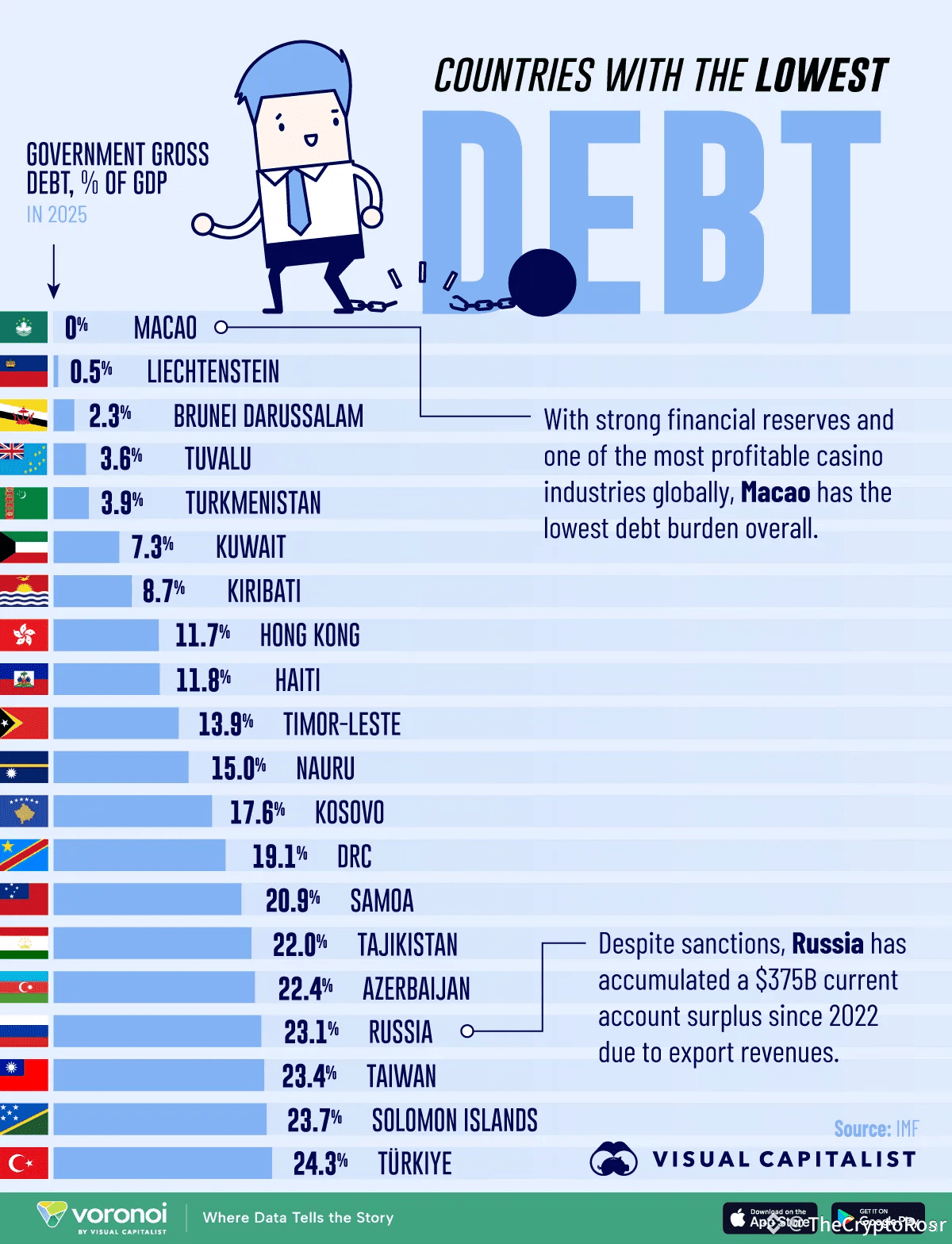
🌍 Ranked: The Countries With the Lowest Debt-to-GDP in 2025
#BinanceBlockchainWeek #WriteToEarnUpgrade $BTC
In a world drowning in debt—where global government debt hovers near 94.7% of GDP in 2025—a few standout nations are proving that fiscal discipline is not only possible but also powerful. These countries, spread across Asia, Europe, and the Middle East, are demonstrating how stable governance, smart economic choices, and sometimes sheer scale can keep national borrowing to a minimum.
Let’s take a colorful journey across the globe to see who’s winning the low-debt game this year.
🌏 Asia Leads the Pack—Quietly and Confidently
Asia shines brightly in 2025, claiming 9 of the top 20 spots for the lowest debt-to-GDP ratios worldwide.
What makes this impressive?
Many of these countries are smaller, fast-developing economies that have intentionally kept their borrowing shallow. Their growth models often prioritize controlled spending, stable foreign reserves, and cautious borrowing.
While the global giants wrestle with hefty deficits, these nations maintain a lighter financial footprint—almost like traveling with a backpack instead of a suitcase.
🇱🇮 Liechtenstein: Europe’s Debt-Free Superstar
If there were a gold medal for financial discipline, Liechtenstein would take it home effortlessly.
With a jaw-dropping 0.5% debt-to-GDP ratio, Liechtenstein stands as Europe’s least burdened nation—almost operating as if national debt is a myth.
This microscopic yet wealthy country benefits from:
A powerful financial services sector
High-income citizens
Strong government reserves
Low welfare burden due to small population
It’s the closest thing to a “debtless economy” on the map.
🇰🇼 Kuwait: Middle East’s Financial Guardian
Among Middle Eastern countries, Kuwait stands out as the region’s most financially secure nation. Blessed with ample oil revenues and a relatively small population, Kuwait’s leadership has historically leaned toward conservative fiscal policy.
As energy markets rebalance in 2025, Kuwait’s careful budgeting and sovereign wealth funds help keep debt low and stability high.
📊 Why Low Debt Matters More in 2025
High debt ratios typically signal risks—higher interest payments, increased vulnerability, and less room for economic maneuvering.
Countries with low debt enjoy:
More flexibility during crises
Stronger credit ratings
Lower borrowing costs
Healthier long-term economic stability
In a world full of uncertainties—war, climate change, shifting trade routes—these financial advantages matter more than ever.
🔍 The Bigger Picture
According to the IMF’s latest World Economic Outlook, these low-debt nations are not only rare—they’re becoming increasingly important case studies for economic resilience.
While major economies struggle with swelling budget deficits and rising interest rates, these lean economies show that careful governance, diversified revenue streams, and long-term planning can keep debt in check.
🧭 Final Thoughts
Amid rising global debt, it’s refreshing to see that some countries are charting a different course—lean, strategic, and surprisingly stable.
Whether it’s Asia’s compact economies, Europe’s disciplined microstate, or Kuwait’s oil-backed caution, each nation offers a unique lesson in managing money wisely.
In 2025, the world may be burdened by debt—but these countries are proving that the future isn’t financially doomed after all.