
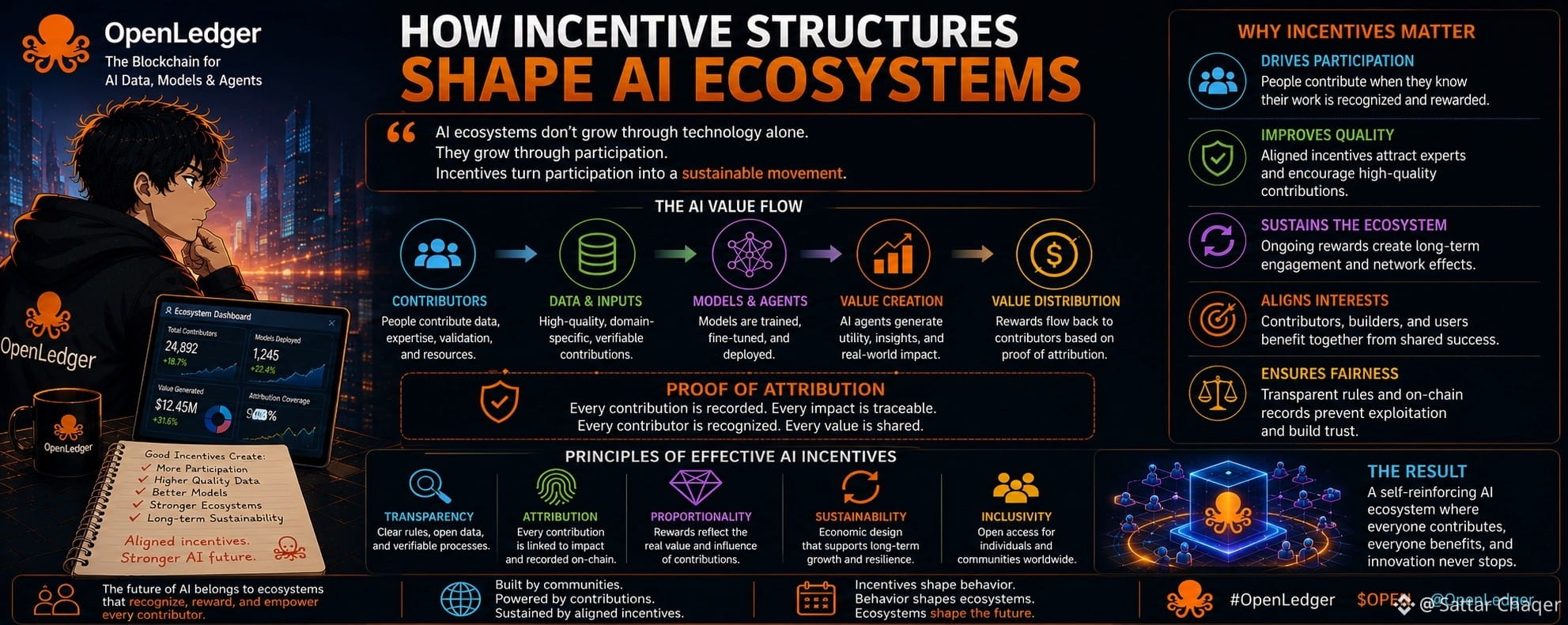


I keep noticing that when people talk about AI they usually focus on intelligence itself. Better models. Better reasoning. Better outputs. But the more I’ve been reading through the OpenLedger whitepaper the more I keep coming back to a different question what motivates people to keep contributing to these systems in the first place?
Because AI ecosystems do not grow through technology alone.
They grow through participation.
Every dataset every correction every evaluation every domain specific insight comes from someone choosing to contribute value to the network. The challenge is that participation does not happen automatically. It emerges when incentives encourage people to remain involved over time.
That is why incentive structures matter so much.
In many traditional systems contributors create value without maintaining a meaningful connection to future outcomes. Data gets collected models get trained platforms scale but the people helping improve those systems often disappear from the economic picture.
The system functions.
But participation becomes increasingly disconnected from reward.
Over time that creates structural problems.
High quality contributors become harder to attract.
Specialized expertise becomes more difficult to sustain.
Long term ecosystem growth depends on goodwill rather than alignment.
And eventually participation begins to weaken.
The OpenLedger whitepaper approaches this challenge from a different direction. Instead of treating contribution as a one time event the infrastructure attempts to preserve ongoing links between contributors datasets models and downstream value creation through Proof of Attribution.
That changes the role incentives play inside AI systems.
Rather than existing as an afterthought incentives become part of the architecture itself.
The reason this matters is simple incentives shape behavior.
If contributors are recognized they are more likely to contribute.
If participation remains visible trust increases.
If rewards remain connected to value creation ecosystems become more sustainable.
These effects compound over time.
The whitepaper repeatedly emphasizes specialized intelligence and domain specific data as critical parts of future AI development. But specialized intelligence depends on specialized contributors. Healthcare experts financial analysts researchers and domain specialists all provide forms of knowledge that cannot easily be replaced through scale alone.
Those contributors need reasons to participate.
That is where incentive alignment becomes more important than raw technology.
The strongest AI ecosystem is not necessarily the one with the largest model.
It may be the one that creates the strongest participation loop.
A system where contributors see value.
Where attribution remains visible.
Where rewards reflect impact.
And where participation continues because the ecosystem itself remains economically aligned.
This is one of the reasons I find OpenLedger’s infrastructure approach interesting. The project is not only asking how AI becomes smarter. It is also asking how AI ecosystems remain healthy as they grow.
Those are different questions.
One focuses on intelligence.
The other focuses on sustainability.
I keep coming back to a simple observation technology can attract attention but incentives determine whether ecosystems survive.
And in the long run the systems that align participation with value creation may be the systems that endure.