


In the vast world of digital assets, privacy-focused cryptocurrencies occupy a unique and often controversial space. They offer solutions to the inherent transparency issues of public ledgers like Bitcoin, where every transaction is traceable. Zcash (ZEC) is one of the pioneers in this field, bringing groundbreaking cryptographic principles to the forefront of blockchain discussions.
For those proficient in blockchain technology, Zcash is not just another altcoin; it is a testament to the power of zero-knowledge proofs. However, its development history has been marked by significant volatility, technological evolution, and fierce competition. This article will delve into Zcash's price history, exploring the factors that influence its market valuation, and comparing its technology and market position with its main competitors—Monero (XMR) and Dash.
The origins of Zcash: Achieving privacy through advanced cryptography
Technical overview
Zcash is recognized as the first viable project to implement **zero-knowledge proofs** on a public blockchain. It is based on Bitcoin's UTXO model and first introduced zk-SNARKs (zero-knowledge succinct non-interactive arguments of knowledge) technology—this cryptographic structure allows the verifier to confirm the validity of a transaction without disclosing its contents.
In traditional blockchains like Bitcoin, all transaction details (including sender, receiver, and amount) are fully public, achieving transparency but lacking privacy. Zcash's zk-SNARK system replaces information transparency with mathematical correctness proofs. Each privacy transaction generates a cryptographic proof to validate the transaction's legitimacy while concealing all related details. The network only verifies the correctness of the proofs without knowing 'who paid whom.'
Technically, Zcash supports two types of addresses:
Transparent address (t-address): Similar to Bitcoin, transaction data is public.
Private address (z-address): Utilizes zk-SNARK technology to hide transaction information.
Users can freely transfer between two types of addresses, enabling selective privacy. This dual-address model strikes a balance between privacy and compliance: by viewing the key (View Key), users can open part of their transaction data when regulatory or auditing needs arise.
Zcash has undergone significant protocol upgrades in recent years, such as Halo 2 and Orchard (NU5), which completely eliminate the early zk-SNARK's reliance on 'trusted setups.' The new recursive proof architecture enhances system scalability and lays the groundwork for cross-chain privacy interoperability and light client verification, supporting future Web3 privacy infrastructure and private DeFi modules.
Economic model
Zcash adopts the same total supply cap of 21 million coins as Bitcoin and halves its block reward every four years. However, its distribution mechanism differs to ensure ongoing funding for development. Early versions established a founders’ reward, allocating 20% of mining rewards to early developers, investors, and Electric Coin Company (ECC). After improvements through community governance, this mechanism evolved into a development fund that continues to allocate 20% of block rewards to ECC, the Zcash Foundation, and community-funded projects.
This mechanism ensures the project's research-oriented innovation can sustainably operate, allowing zk-SNARK technology development, mobile SDK maintenance, and governance operations without relying on external donations. As of 2025, Zcash's block reward is 3.125 ZEC per block, creating a long-term incentive balance among miners, developers, and the community.
In economic function, ZEC serves a dual role as both a medium of exchange and a token with privacy features. Unlike Bitcoin, which primarily relies on scarcity and adoption to drive value, ZEC's long-term value is more contingent upon the elasticity of privacy demand—specifically, the actual intensity of users' and institutions' need for transaction confidentiality.
On-chain data shows that from 2020 to 2025, the adoption rate of privacy transactions has consistently risen and positively correlated with ZEC's price performance. This indicates that the market is shifting from 'privacy is a minority preference' to 'privacy is a core value,' giving Zcash stronger resilience and lasting competitiveness in an environment of increasing regulatory scrutiny and blockchain monitoring.
Decoding Zcash (ZEC) price history: A story of highs and lows
ZEC's price history is a compelling case study of the dynamics of the cryptocurrency market, influenced by early hype, technological milestones, broader market cycles, and ongoing inflation concerns.
Explosive launch and subsequent pullback (2016-2017)
The launch of Zcash was one of the most anticipated events in crypto history. The hype surrounding its zk-SNARK technology was massive. This led to extreme supply-demand imbalances in the initial hours of trading. Due to a slow-starting mining mechanism, very few coins were available, and initial prices on some exchanges soared to ridiculous levels, briefly trading at thousands of dollars each.
This initial peak was unsustainable and purely speculative. As more ZEC entered circulation, prices sharply retraced, falling below $50 by early 2017. This period established a pattern of high volatility, which would define ZEC in the subsequent years. In the first half of 2017, as the market began to understand the fundamentals beyond the initial hype, ZEC traded within a range and built a base.
The bull and bear markets of 2017-2018
Like most crypto markets, ZEC experienced a parabolic rise in late 2017 and early 2018. It surged from under $300 to nearly $900 in January 2018. This spike was driven by overall market euphoria and a growing interest in privacy-centric assets.
However, the subsequent bear market was brutal for ZEC, arguably more severe than for many other top assets. Throughout 2018 and 2019, prices collapsed, eventually falling below pre-bull market levels. Several factors contributed to this long-term slump:
Founders' reward inflation: Zcash launched with a 'founders' reward' that allocated 20% of the mining rewards to ECC, the Zcash Foundation, and other early stakeholders during its first four years. While intended to fund development, this created persistent sell pressure in the market as recipients liquidated ZEC to cover operational costs. This ongoing supply inflation severely suppressed prices.
Low adoption rate of shielded transactions: Despite its strong privacy features, most transactions on the Zcash network are still transparent. The computational intensity required to create shielded transactions makes them slower and more expensive, leading most users to default to using t-addresses. This has drawn criticism for Zcash's failure to realize its primary use case.
Regulatory fears: Privacy coins have long been overshadowed by the potential for regulatory crackdowns. Exchanges in some jurisdictions have begun delisting ZEC and other privacy coins, fearing repercussions from financial regulators. This has reduced liquidity and investor confidence.
Halving and performance post-2020
In November 2020, Zcash experienced its first halving, reducing the block reward from 12.5 ZEC to 6.25 ZEC. This event also marked the end of the original founders' reward. It was replaced by a new development fund that receives 20% of the block rewards but at a new, lower rate. This significantly reduced the inflation and sell pressure that had plagued the coin for four years.
Halving, along with the bull market of 2021, helped ZEC regain some ground. The price rebounded from a low of about $50 at the end of 2020 to over $300 in May 2021. This period also witnessed significant technological advancements. ECC focused on improving the usability of shielded transactions and ultimately launched the Halo Arc update, which included a unified address system and set shielded transactions as default in supported wallets.
Despite these improvements, ZEC still struggles to keep pace with Bitcoin and other major altcoins in the coming years. Since its peak in 2021, it has entered a long-term downward trend, facing ongoing market skepticism and competition. However, in 2025, Zcash made headlines with an astonishing 400% rebound, marking a resurgence of interest and optimism in privacy-focused cryptocurrencies. This dramatic surge may reflect a shift in attitudes towards blockchain privacy, significant advancements in Zcash technology, or speculation around new use cases and adoption. The rebound in 2025 serves as a strong reminder that when conditions are right, ZEC has tremendous potential and volatility to capture the imagination of crypto investors.
Key factors affecting ZEC value
Understanding ZEC's price requires looking beyond typical market cycles. Several unique factors are at play.
Adoption of shielded transactions: Zcash's value proposition is directly related to its privacy features. The percentage of fully shielded transactions is a key indicator of network health. An increase in z-address adoption will validate its core use case and may positively impact investor sentiment. The recent shift to default shielding is a crucial step in this direction.
Regulatory environment: Zcash and its peers are highly sensitive to regulatory news. Any hints of widespread bans or forced delistings from major economies could trigger a sharp price drop. In contrast, frameworks that adapt to privacy-enhancing technologies (PETs) could be a major catalyst. ECC has proactively engaged with regulators to explain how Zcash's 'View Key' achieves compliant privacy, but concerns remain.
Development and innovation: The Electric Coin Company’s continued ability to push the boundaries of zero-knowledge cryptography is crucial. Transitioning from zk-SNARKs to more advanced Halo proof systems (which do not require a trusted setup) is an important milestone. Future upgrades that improve performance, reduce computational costs, and enhance privacy will be key to maintaining relevance.
Inflation and token economics: Zcash follows the same supply schedule as Bitcoin, with a total supply cap of 21 million coins, halving every four years. The new development fund structure is less inflationary than the original founders’ reward, but the market remains sensitive to any sell pressure from funded entities.
Competitive landscape: Zcash does not operate in a vacuum. Its performance is closely related to that of other privacy coins, especially Monero.
Comparative analysis: Zcash vs. privacy coin competitors
To fully grasp Zcash's position, we must compare it with its main competitors: Monero (XMR) and, to a lesser extent, Dash.
Zcash (ZEC) vs. Monero (XMR)
Monero is widely regarded as the king of privacy coins, and the comparison between ZEC and XMR is one of the classic debates in the crypto space. They provide privacy through fundamentally different cryptographic methods.
Technology:
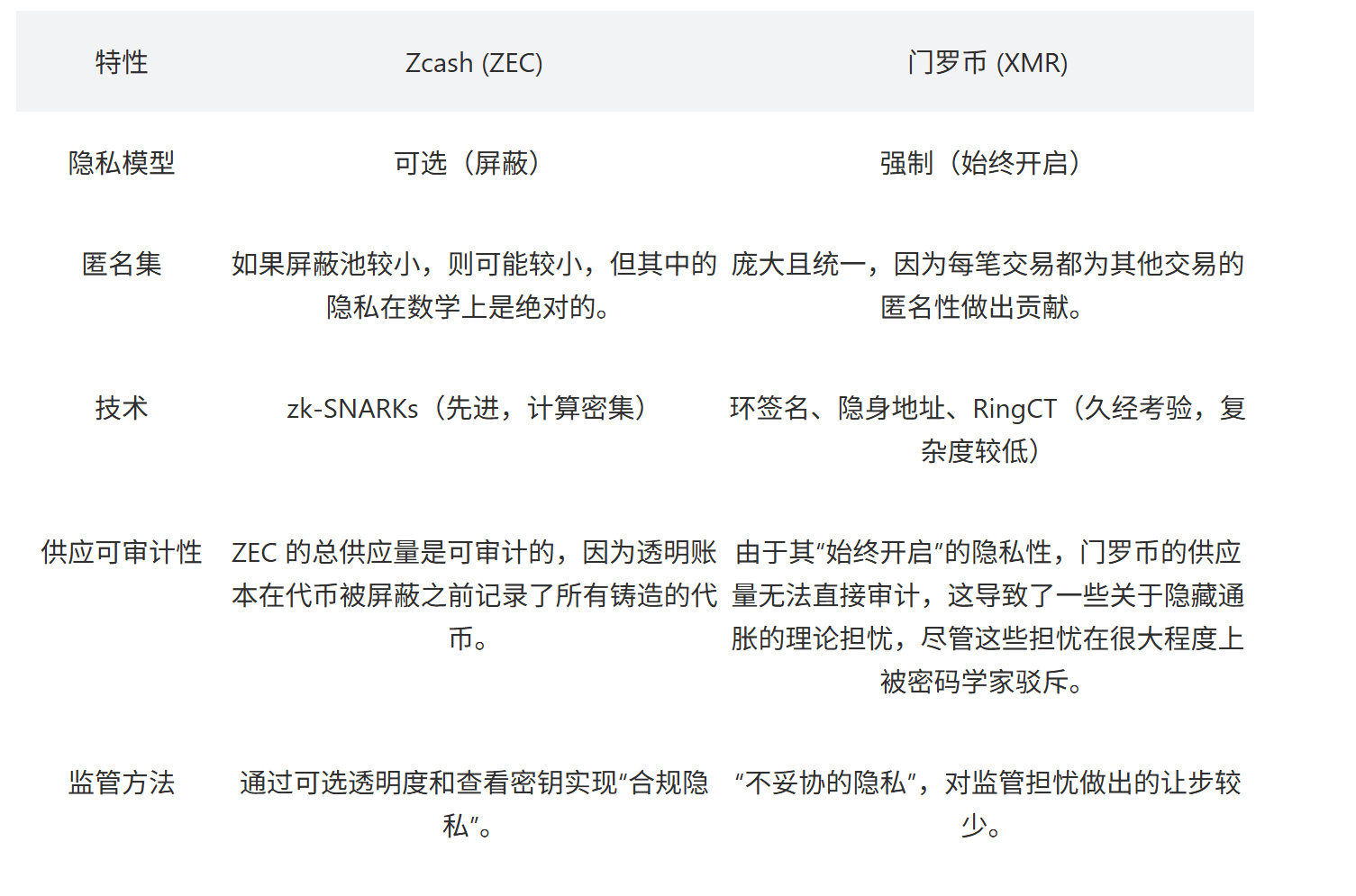
Zcash (ZEC): Uses zk-SNARKs to achieve optional, high-intensity privacy. Transactions can either be fully transparent (t-to-t) or completely private (z-to-z). For shielded transactions, privacy is absolute, but not enforced across the entire network.
Monero (XMR): Uses a multilayered approach that is mandatory for all transactions. It combines ring signatures (hiding the sender), stealth addresses (hiding the receiver), and RingCT (hiding the amount). This creates a large anonymous set for each transaction, making it difficult to trace the source.
Major differences and trade-offs:
Market performance and adoption:
Historically, Monero has maintained a more stable market cap and has seen broader adoption in dark web markets—a controversial but genuine real-world stress test for privacy. This is primarily because its privacy is enforced by default, leaving no room for user error.
Zcash's optional privacy is both a strength and a weakness. It makes the coin easier for exchanges and regulators to accept, but it also fragments its anonymous set and leads to low adoption rates for shielded transactions over the years. While recent upgrades aim to address this issue, Monero has a significant lead in establishing itself as the default choice for untraceable transactions.
Zcash (ZEC) vs. Dash
Dash is another contemporary product of Zcash but employs a much lighter privacy approach and is generally not viewed by privacy purists as equivalent to ZEC or XMR.
Technology:
Dash (Dash): Features an optional privacy function called 'PrivateSend.' It uses a mixing technique (CoinJoin) through a masternode network. Multiple users' inputs are combined into a single transaction and then redistributed, obfuscating the original transaction flow.
Zcash: As previously mentioned, uses cryptographic proofs (zk-SNARKs) to completely shield transaction data.
Main differences:
Dash's PrivateSend provides privacy that is probabilistic rather than cryptographic. It relies on trust in the non-collusion of the masternode network and sufficient participants in the mixing rounds to provide meaningful cover. It is noticeably weaker than the cryptographic guarantees provided by Zcash's shielded transactions.
While Dash was an early innovator in privacy and governance, the market has largely come to view it more as a payment-focused cryptocurrency with optional mixing features. In contrast, Zcash fundamentally serves as a privacy protocol. Therefore, Zcash competes more directly with Monero for the crown of 'true privacy,' while Dash has carved out a different niche.
Trade ZEC on XT.COM: Spot and futures markets
If you want to take advantage of Zcash's market volatility, consider trading ZEC directly on XT.COM. The exchange offers flexible options for every trader:
ZEC spot trading: With high liquidity, instant buy and sell ZEC/USDT trading pairs. Spot trading of ZEC/USDT on XT.COM.
ZEC perpetual contracts: Go long or short on ZEC, capturing opportunities in both bull and bear markets. Trade ZEC/USDT perpetual contracts on XT.COM.
Whether you are an experienced investor or a newcomer to the crypto market, XT.COM provides secure, efficient, and user-friendly tools to participate in Zcash trading.
The future of Zcash: Challenges and opportunities
Zcash stands at a crossroads. The technology behind it is more powerful and user-friendly than ever before. The shift to a default shielded paradigm through the Halo Arc update is a significant step toward realizing its original vision. The ECC development team continues to be at the forefront of zero-knowledge research and plans to further enhance scalability and performance.
However, significant challenges remain.
Overcoming market perception: Zcash needs to shed its reputation for poor performance. This can only be achieved through a sustained increase in the adoption rate of shielded transactions, which will demonstrate its utility and attract new investment.
Navigating the regulatory maze: The global regulatory landscape for privacy coins remains the biggest external threat. ECC's active participation and 'compliant privacy' strategy may be its best defense, but the outcome is far from certain.
Winning the privacy war: In a world where Monero's mandatory privacy has become the standard for many, Zcash must convince users that its robust but optional model is the superior long-term solution, providing both impenetrable privacy and flexible transparency.
Zcash's ultimate bull case hinges on a future where financial privacy is not just a niche demand but a mainstream necessity. If individuals and institutions begin seeking ways to shield their financial activities on public blockchains, Zcash's complex, auditable, and regulatory-friendly technology may make it the preferred solution. Its journey is a testament to the slow and arduous process of building and deploying revolutionary technology. Whether this technology will translate into long-term market success remains one of the most compelling open questions in the cryptocurrency space.
About XT.COM
Founded in 2018, XT.COM is a leading global digital asset trading platform, now with over 12 million registered users, covering more than 200 countries and regions, with an ecological traffic of over 40 million. The XT.COM cryptocurrency trading platform supports over 1300 high-quality coins and over 1300 trading pairs, providing diverse trading services such as spot trading, leverage trading, and contract trading, and equipped with a secure and reliable RWA (real-world asset) trading market. We always adhere to the concept of 'exploring crypto, trusting trading,' and are committed to providing global users with a safe, efficient, and professional one-stop digital asset trading experience.