
In the ever-changing landscape of Web3 gaming, there’s always been a certain pattern: a game is introduced, players rush to farm, trade, and earn, and then the economic loop either breaks or drains out. We've seen it happen countless times. What starts as an exciting new system often turns into a robotic grind, one where efficiency trumps engagement and economies eventually collapse, drained by the very mechanisms that were supposed to make them thrive.
But here’s the thing about Pixels (PIXEL): it doesn’t fit that mold. When I first joined, I expected it to follow the usual trajectory — a game that promises more than it can deliver, eventually turning into a cycle of repetition. But Pixels surprised me. The farming loop, while simple, wasn’t immediately solved. It wasn’t a matter of scaling efficiency to win; there was something deeper happening underneath.
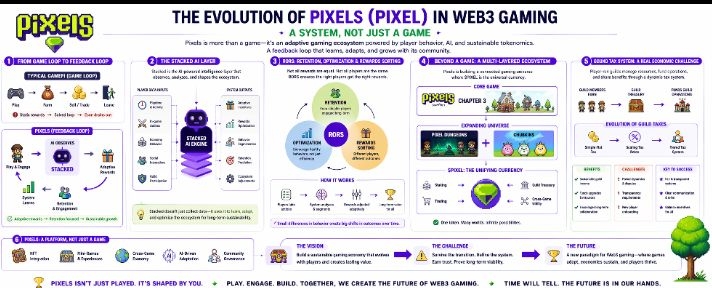
A Game Loop vs. A Feedback Loop
What I realized is that Pixels isn’t just running a game loop, it’s running a feedback loop. And right at the heart of this system is Stacked, the AI-driven layer that observes player behavior. It doesn’t just collect data—it uses that data to shape future incentives and rewards. You’re not just farming for rewards; you’re interacting with a dynamic system that adapts to you and the broader player base. This is where the distinction between Pixels and typical GameFi projects becomes clear.
In most systems, rewards are static. You farm, you sell, and you leave. That’s the pattern. It’s predictable. But Pixels flips this. It adapts to player behavior. The system learns what works, what keeps players engaged, and tweaks the rewards to keep them coming back. The key here is retention. Pixels doesn’t just want players to play and leave. It wants them to stay, to engage deeply, and to build something sustainable. And this approach, although subtle, is what sets it apart.
The Role of RORS and Adaptive Systems
The concept of RORS (Retention, Optimization, and Rewards Sorting) makes more sense in this context. Not all rewards are equal because not all player behaviors are equal. The system is smart enough to distinguish between players who are engaging with the game in a meaningful way and those who are simply extracting rewards. Even though two players may generate the same output, their long-term outcomes will be very different. This sorting happens invisibly, but over time, it compounds.
It reminds me of the dynamics we see in real-world economies. It’s not about restricting people, it’s about positioning them differently based on their actions. Small differences in behavior create big shifts in outcomes, and it happens gradually, almost imperceptibly. Pixels isn’t trying to stop optimization—it’s trying to shape it into something more sustainable.
Pixels Beyond the Game: A Multi-Layered Ecosystem
One of the most exciting aspects of Pixels is how it extends beyond a single game. While Pixels Chapter 3 remains the centerpiece, it’s clear that this is no longer just about one game. With projects like Pixel Dungeons and Chubkins, Pixels is positioning itself as a gaming ecosystem, not just a standalone game. The integration of s a cross-game currency is the game-changing move here. It’s about creating an interconnected economy where the token isn’t just a reward within one game, but a currency that transcends individual projects.
This creates a more complex, yet more compelling vision. It’s no longer about isolated gaming experiences. It’s about building a sustainable economy that’s shaped by player behavior across multiple platforms. And while that introduces complexity, it also opens up a world of possibilities. The goal isn’t just to attract players—it’s to keep them engaged over time and to create a feedback loop that continuously improves the system.
The Evolution of Guild Taxes: A Real Economic Challenge
One of the most interesting features of Pixels is the guild tax system. When I first heard about it, I had the same knee-jerk reaction many players did: taxes in a farming game? But after spending more time with it, I began to see the brilliance behind it. Guilds in Pixels are player-run organizations that pool resources and manage in-game assets. The tax system ensures that guilds have a reliable income stream, allowing them to fund shared resources, upgrades, and operations.
At first, guild taxes were a simple cut from member earnings. But as guilds grew, the tax rates increased, and with that came real tension. The guilds’ tax systems started replicating real-world economic dynamics—leaders had power over earnings, and members had to decide whether the benefits outweighed the costs of participation. Guild tax disputes started to feel less like a game disagreement and more like a labor negotiation.
Some guilds moved towards tiered tax systems, where the tax rate varied based on player role and contribution. This created a more equitable system, but it also added a layer of complexity. New players had to understand how the tax system worked before they could make informed decisions about joining. Transparency became critical, and it’s something that needs to be addressed for this system to succeed long-term.
Pixels: A Platform, Not Just a Game
What makes Pixels stand out is its long-term vision. It’s not just a game. It’s a platform. The integration of NFTs, the expansion into mini-games, and the push towards creating a cross-game economy are all signals that Pixels is trying to build something far more substantial than a typical Web3 game. But as any successful platform knows, the real challenge lies in balancing growth with utility.
Pixels is starting to move away from pure speculation and is focusing on creating real utility. The ken, once a reward currency, is now a coordination layer that enables seamless interaction across different parts of the ecosystem. Whether it’s used for staking, progression, or guild activities, it’s designed to keep players coming back, because without that retention, none of this works.
The Challenge: Can Pixels Hold the Line?
The truth is, Pixels is still in a transition phase. It’s evolving into something much more ambitious, but it’s not quite there yet. While it has the potential to build a new type of gaming economy, it has to survive long enough for that vision to materialize. Early systems like this always face challenges—data is noisy, early adoption is slow, and even the best designs can feel ineffective at first.
But here’s the key: it’s learning. Pixels is adapting in real-time, tweaking rewards, improving engagement, and building a more sustainable loop. The more players interact with the system, the more it learns, and the better it becomes. It’s not a game anymore. It’s an experiment in building a new kind of economy. And if it succeeds, it could redefine how we think about Web3 gaming.
For now, Pixels is sitting in that middle ground—neither a failure nor a huge success—but one thing is clear: it’s doing something different. It’s trying to create a game economy that doesn’t just live off hype but evolves based on player behavior. And that’s a much more sustainable approach.
Conclusion: Time Will Tell
The truth is, no one can predict where Pixels will go from here. It’s an evolving system, and its future depends on how well it can scale and adapt. But if the current trajectory holds, Pixels has the potential to become a true platform one that offers lasting value for players and creates a gaming economy that’s not just about short-term rewards, but long-term engagement.
In the end, it’s all about time and user behavior. If Pixels can navigate the complexities of scaling while keeping its players engaged, it could change the entire landscape of Web3 gaming. But until then, it remains a fascinating experiment, with the potential to revolutionize the way we think about game economies.