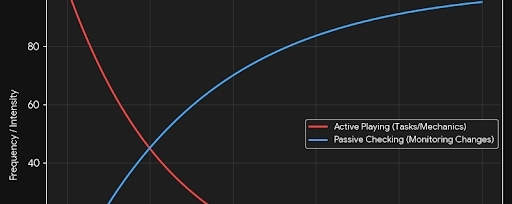

That shift is subtle, almost easy to miss. At first, the engagement seemed to come from the mechanics themselves 😜 farming, collecting, interacting. But the more time I spend inside the system, the more I feel like the pull isn't coming from what I do, but from what might have changed since the last time I looked. That's a different kind of motivation. It's quieter, and harder to step back from.
The interface plays a role in this. It's clean enough that I don't think about it much, which is probably the point. But that simplicity hides a layered structure underneath. Transactions, state changes, ownership mechanics none of it is constantly visible, yet all of it quietly defines everything I interact with. I keep wondering whether that invisibility is a strength or a risk. When players don't fully see the system beneath the surface, are they engaging with it meaningfully, or just reacting to whatever feels intuitive in the moment?
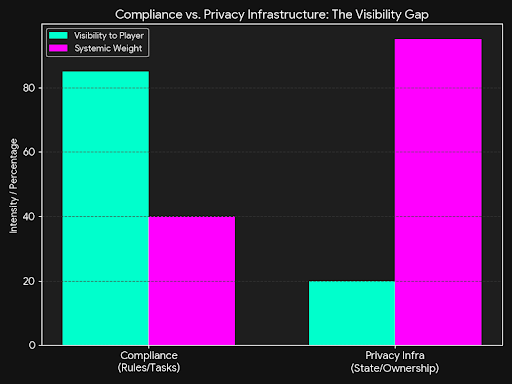
That question gets harder to dismiss the longer I stay.
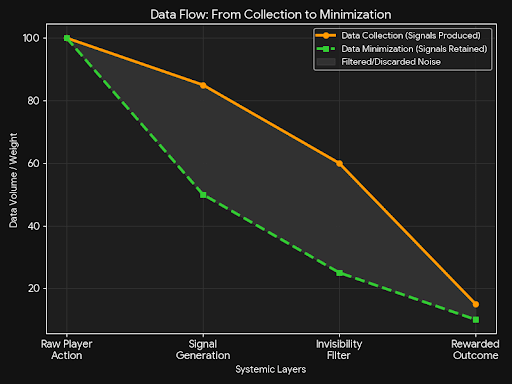
Because beneath the farm, beneath the Task Board resets and the Coins cycling through loops, something else is happening. Not all actions carry equal weight. Not everything I do becomes a candidate for reward. Some behavior never surfaces as a Task at all. Some Coins circulate indefinitely without ever converting into something that crosses outward. And the more I pay attention to that pattern, the more the farm starts to feel less like the system itself and more like the place where signals get produced filtered before they become visible, reduced through layers I can't directly observe.
That changes how progress feels. It's not that nothing works. It's that what works has already been selected for, quietly, before I even see my options.
Scale makes this harder to ignore. I try to imagine what happens when the number of players grows beyond a certain point — not just technically, but behaviorally. More players means more interactions, but it also means more pressure on whatever sits beneath the surface, deciding what can be rewarded without breaking the balance behind it. Systems that feel stable at smaller scales often shift when participation increases. I'm not sure Pixels anticipates that shift in advance, or simply adapts to it as it arrives. Both are possible. Only one feels reassuring.
The visual design contributes to how settled everything seems. The art style is consistent, almost calming, and that makes the environment easier to read. But I also wonder if that coherence masks underlying complexity. When everything looks stable, it's tempting to assume the system itself is equally stable. I'm not convinced that assumption always holds, especially as the layers beneath the surface keep adjusting to what they can afford.
Customization adds a dimension I didn't initially weigh carefully. Being able to shape space feels like ownership, and for a while it reads that way. But choices start to converge over time. Players optimize layouts, align toward similar strategies, and gradually reduce variation in ways that feel voluntary but aren't entirely free. That doesn't eliminate creativity. It does suggest that freedom operates within constraints that aren't always announced.
The social layer runs quietly behind all of this. Visiting other players' spaces, observing their setups, measuring progress not just against mechanics but against visible patterns of activity around me. None of that comparison is explicitly designed into the experience, yet it emerges anyway. And once it does, it starts shaping how I interpret my own position inside the system — not just what I've built, but whether it's enough.
What keeps pulling my attention, though, is how engagement is actually sustained here. It doesn't rely on intensity. There's no constant urgency driving me forward, no escalating stakes demanding immediate action. Instead, it builds through repetition, familiarity, and the quiet expectation that something will be slightly different the next time I log in. That approach feels more durable than excitement-based design, but it also raises a question I can't quite resolve: can familiarity hold attention over extended time, or does it slowly transform into routine without anyone noticing the difference?
Technically, everything depends on infrastructure working without interruption. If interactions slow or fail, the sense of continuity fractures quickly. Stability is expected, not noticed until it isn't, and then it becomes the defining feature of the experience. That's a fragile kind of foundation to build daily habits on, even when it holds.
Outside the system, behavior is less predictable. Players step away, lose interest, return on irregular schedules. If Pixels depends on steady participation to maintain its internal balance, then those uneven patterns might quietly reshape how the world feels over time not through any single absence, but through the accumulated weight of inconsistent presence.
So I'm left with this: Pixels feels stable because it's continuously active, not because it's fixed. The farm keeps running. The loops keep cycling. The system keeps learning what it can afford to surface and what it needs to keep contained.
And I keep logging in.
Not always because I have something to do. Sometimes just to see what changed. To check whether the version of the game waiting for me today is the same one I left behind yesterday.
I'm not sure when checking became the point. But somewhere along the way, it did.
@Pixels #pixel $PIXEL $RAVE $EDU