
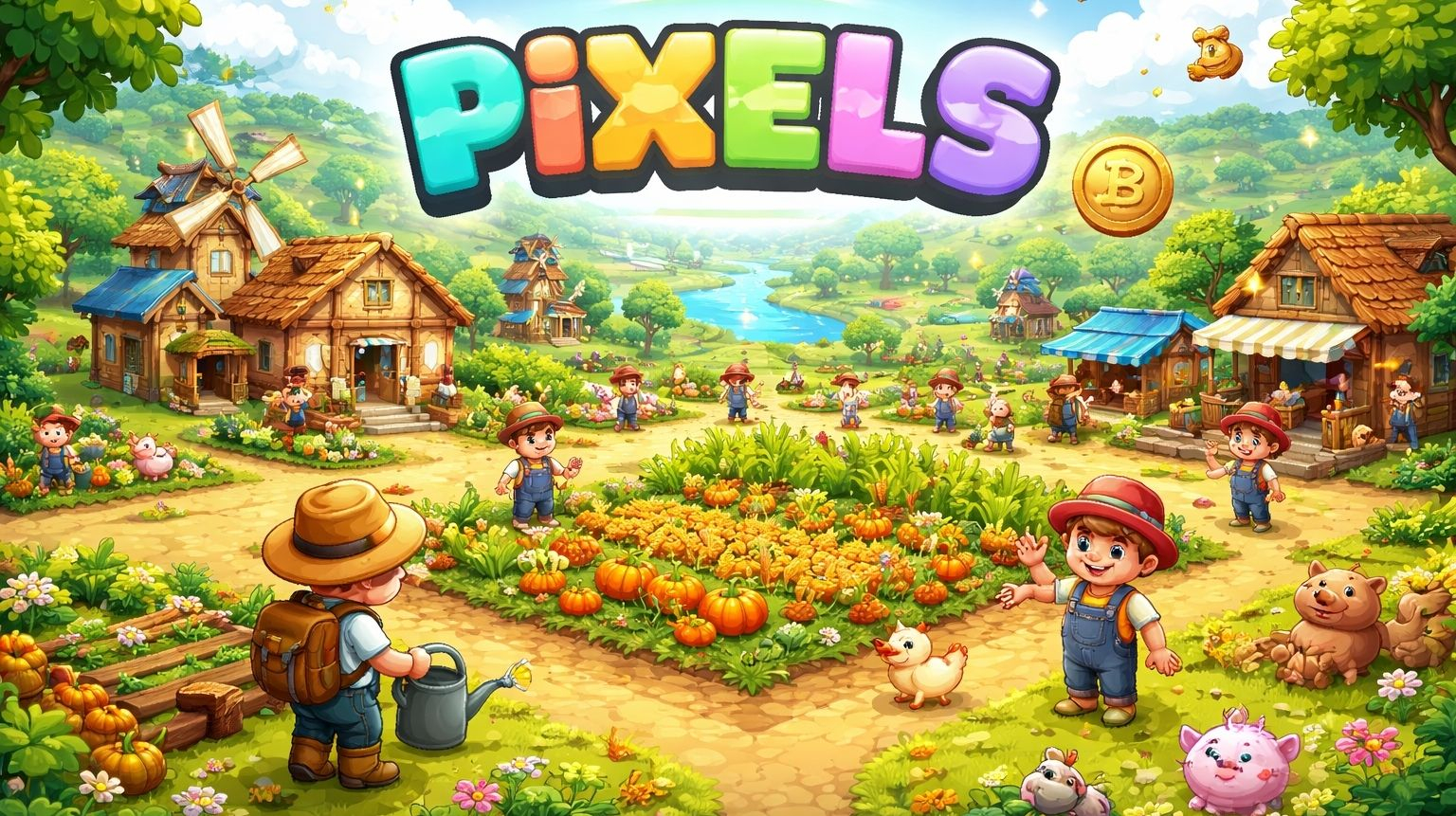
There’s a certain kind of experience that doesn’t need loud marketing or complicated systems to pull people in—it just feels right from the moment you start. That’s the kind of quiet strength Pixels carries. It doesn’t try to overwhelm you with technical details or force you into a fast-paced grind. Instead, it opens the door to a soft, pixelated world where everything moves at your pace, and somehow, that simplicity becomes its biggest advantage.
At first glance, Pixels feels like a familiar farming and exploration game. You plant crops, move around freely, discover new areas, and interact with other players who are building their own spaces alongside you. But as you spend more time in it, you begin to notice something different. This isn’t just about passing time or completing tasks. There’s a deeper layer where your effort starts to hold value, where your presence inside the game actually means something beyond the screen.
Built on the Ronin Network, Pixels blends traditional casual gaming with Web3 in a way that feels natural rather than forced. You don’t need to understand blockchain to enjoy it. There’s no pressure to figure everything out instantly. You simply start playing, and gradually the system reveals itself. That smooth onboarding is rare in Web3 gaming, where many projects struggle to balance accessibility with innovation. Pixels manages to do both without making it feel complicated.
The world itself is open and flexible. There’s no strict path you have to follow, no rigid structure telling you what to do next. You can focus on farming if that’s what you enjoy, or spend time exploring, gathering resources, and experimenting with different activities. This freedom creates a sense of personal connection with the game. It doesn’t feel like you’re playing someone else’s story—it feels like you’re creating your own.
What truly sets Pixels apart is how it treats the player. Instead of being just another user, you become part of a living system. The PIXEL token plays a key role in this, acting as both a reward and a tool within the ecosystem. As you engage with the game—whether through farming, trading, or contributing in other ways—you earn value that can be used within the same world. It creates a loop that feels balanced and fair, where time spent doesn’t feel wasted.
But beyond tokens and mechanics, there’s a human element that makes Pixels stand out. The social side of the game is not just an extra feature—it’s part of the core experience. You see other players moving around, building their own spaces, interacting, trading, and sharing the same environment. It gives the game a sense of life that many digital worlds fail to capture. You’re not isolated; you’re part of something active and evolving.
This sense of community is one of the strongest indicators of the project’s potential. Pixels hasn’t relied only on hype to grow. Instead, it has built a user base that genuinely enjoys being there. People return not just because they expect rewards, but because they feel connected to the environment and the players within it. That kind of organic engagement is difficult to create, and even harder to maintain, yet Pixels seems to be doing it steadily.
As the Web3 gaming space continues to develop, Pixels feels like a project that understands the long game. It’s not chasing trends or trying to be overly ambitious too quickly. The foundation it has built—simple gameplay, real ownership, and strong community interaction—gives it room to grow in a stable and meaningful way. With the support of the Ronin Network, there’s clear potential for expansion, whether through new features, deeper economies, or more advanced social systems.
For players, the appeal is clear. It’s easy to enter, comfortable to stay in, and rewarding over time. You don’t need to invest heavily or compete aggressively to feel progress. The game respects your pace and rewards consistency, which makes it accessible to a wide range of users, from casual players to those exploring Web3 for the first time.
There’s also something refreshing about how Pixels approaches ownership. In most traditional games, everything you build stays locked within that system. Here, your actions carry weight. The time you spend isn’t just entertainment—it becomes part of an ecosystem where your contributions matter. That subtle shift changes how the game feels, turning even small actions into something more meaningful.
In a space where many projects are still trying to find the right balance between fun and financial incentive, Pixels seems to have found a natural middle ground. It doesn’t sacrifice enjoyment for earning potential, nor does it ignore the importance of value creation. Instead, it blends both in a way that feels smooth and organic.
And that’s ultimately what makes Pixels special. It doesn’t try to prove itself loudly. It doesn’t rely on complexity to stand out. It simply offers a space where players can relax, create, connect, and gradually realize that they are part of something bigger than just a game.