
i remember the first time i read Sign Protocol closely. it was on a night when the market had dropped nearly 10 percent in 48 hours, and almost every conversation around me had shrunk to price alone. i paused at Sign Protocol because the project was not trying to sell another fresh narrative. it was pressing on a much older gap in crypto, which is that the system can record every transaction, yet still recognize user identity in a shallow and incomplete way.
what stands out here is that the project does not treat onchain identity as a profile for display. it treats it as a set of structured attestations. that distinction matters. a wallet can show 150 transactions, 12 nfts, 5 votes, and 2 testnet participations, but all of that trace data is still cheap if an application cannot tell who validated it, under what criteria, and how it can be checked again. Sign Protocol goes directly into that missing layer by turning traces into evidence that can be read and reused.
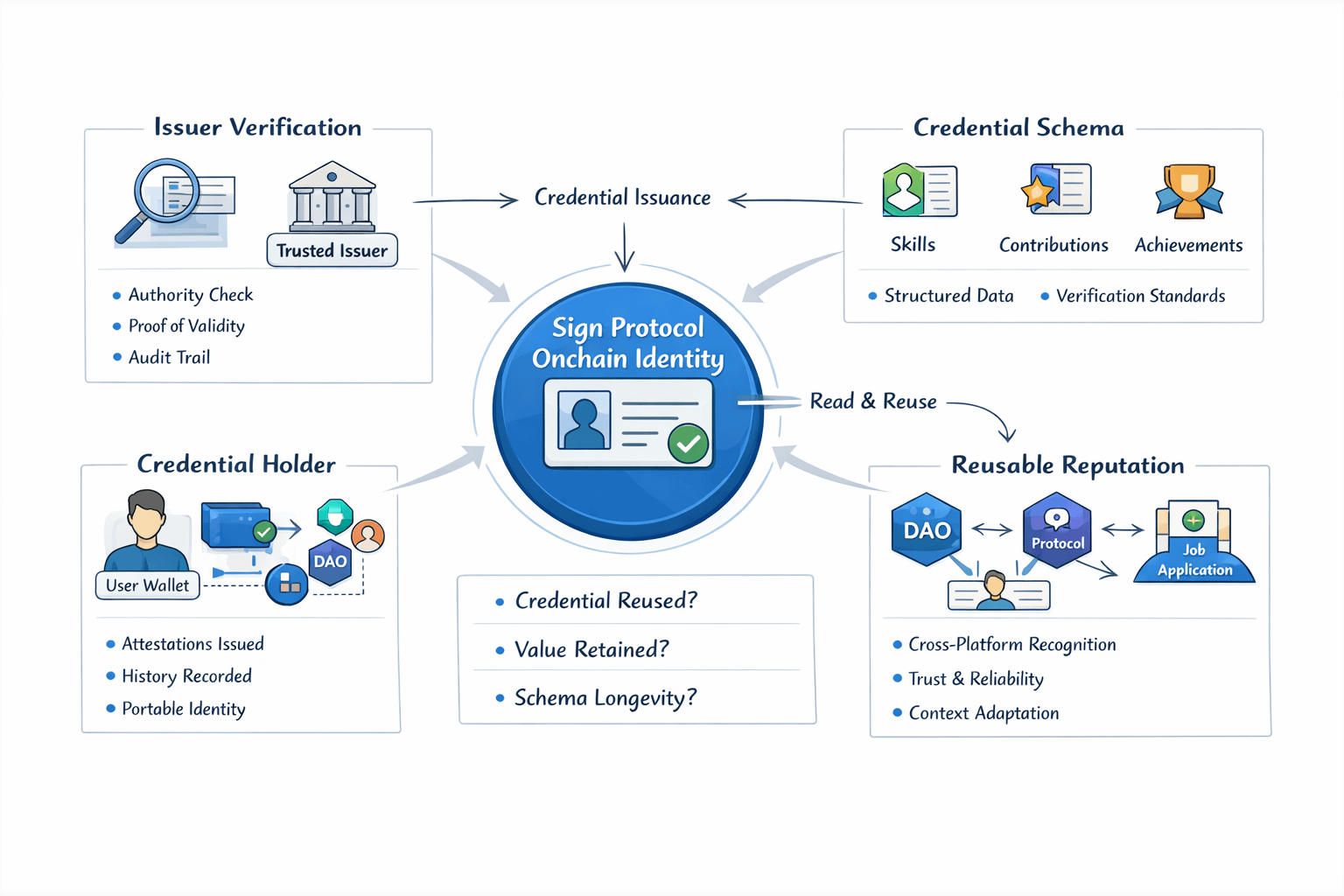
i think many people misread the project at exactly this point. they see credentials and immediately think of badges or airdrops. but stopping there is too shallow. the real issue is turning a fragmented action into a unit of data that can be reused in actual decisions. a strong credential usually needs 4 parts, the recipient, the issuer, the content schema, and the verification state. remove 1 part and trust drops sharply. remove 2 parts and what remains is barely more than a prettier label attached to wallet activity.
the second anchor is the ability to carry reputation across different environments without starting again from 0. this is where i think Sign Protocol becomes worth watching over the long term. a contributor with 18 months of documentation work, 9 rounds of review, 2 identified logic flaws, and 1 cycle of community call coordination usually cannot compress that history into a few lines on a profile. but if those contributions are issued as properly structured credentials, a dao or a protocol can read them again without manually checking every scattered proof.
the gap between wallet data and credentials is large here. wallet data only shows that an address did something. a credential shows who validated what that action means. for example, 1 wallet taking part in 30 governance transactions does not automatically say much about the quality of its contribution. but 1 credential stating that the same person coordinated 6 discussions, wrote 4 proposals that passed, and maintained a community response rate above 70 percent over 90 days says something entirely different. this, perhaps, is the part that makes Sign Protocol more important than many people assume.
to be honest, this is also where the problem becomes genuinely difficult. Sign Protocol does not only need infrastructure to record attestations. it also has to solve 2 stubborn questions, the quality of the credential issuer and the relevance of the credential in each context. an attestation that matters in community a may mean almost nothing in community b. a person who completes 25 bounty tasks is not automatically suited to manage a treasury. if the system only stacks points without distinguishing the type of contribution and the purpose of use, onchain identity will slide very quickly from verification into mechanical scoring.
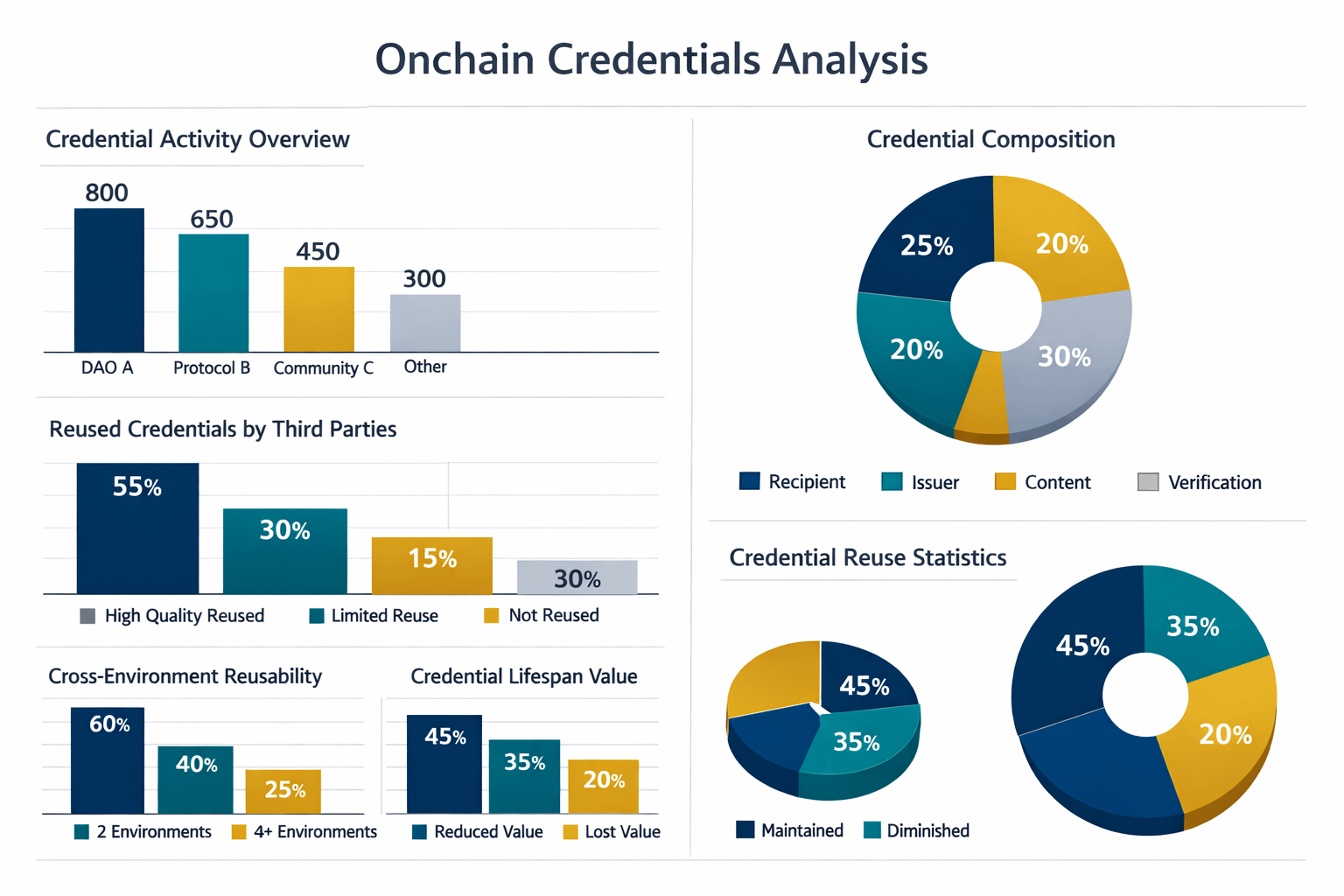
that is why i do not evaluate this project through surface metrics like how many partners it announces in 1 quarter or how many credentials are issued in 30 days. those numbers show distribution speed, not attestation quality. the more useful questions are 3 very specific ones. how many credentials are actually reused by third parties. what share of credentials loses practical value when moved into another application. and whether 1 schema can survive across 2, 3, or 5 environments while preserving the same meaning.
after going through enough cycles, i think the most valuable thing about Sign Protocol is that it is pulling onchain identity out of the zone of vague description and forcing it closer to the logic of evidence. that is not a loud move, but it is a fundamental one. when a system starts remembering the right person, the right action, the right context, and the right source of validation, the quality of coordination changes. builders no longer have to retell their history 10 times. communities no longer need to judge each other by followers or volume. could this be the real reason Sign Protocol deserves a much closer look.