
I’ve been following Midnight Network since its early days, and what stands out most is how intentionally it’s built around protecting data without losing what makes blockchains useful.
Instead of aiming for full anonymity Midnight focuses on data protection. That means you stay in control of what’s private and what’s shared, while the network still verifies everything.
It runs as a partner chain to Cardano, using its proof-of-stake security while handling privacy-heavy operations itself.
At a high level, Midnight uses a dual-state model. One part is public, based on UTXO, handling things like settlement and verification. The other is private, account-based, where sensitive data and logic stay hidden. This split lets the network stay transparent where needed, without exposing everything.
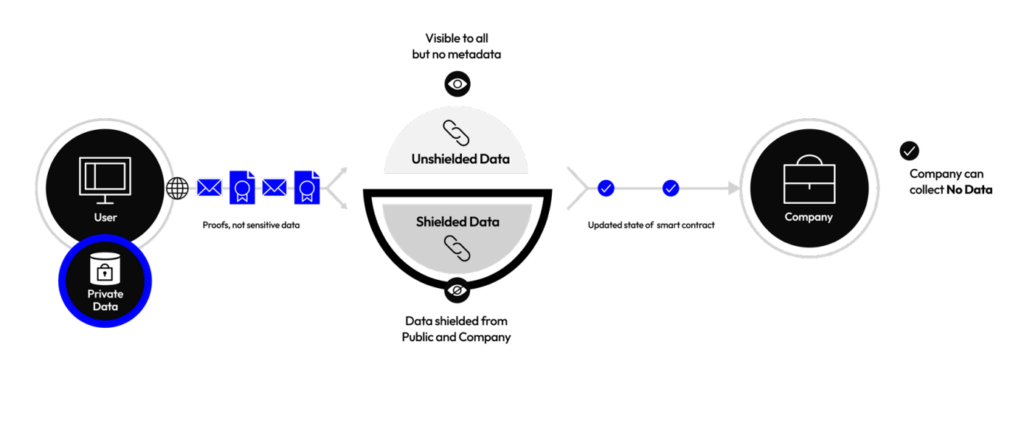
The key piece connecting this is the Kachina protocol. Instead of running all computations on-chain, private logic runs off-chain. You execute the task locally, generate a zero-knowledge proof, and submit that proof to the chain. Validators check the proof, not your data. So the network knows the rules were followed but never sees the details.
This is powered by zk-SNARKs, which let the system confirm things like valid transactions or correct state changes without revealing inputs. On top of that Midnight supports selective disclosure, so you can reveal specific information only when needed like for compliance or audits.
Smart contracts follow the same idea. Developers use Compact, a TypeScript-like language, to build apps where sensitive inputs stay private. Functions (called witnesses) run off-chain, generate proofs, and send only the result back on-chain. The contract enforces outcomes without ever seeing the raw data.
Another important piece is how proofs are handled. They’re generated locally (or via delegated services), which keeps the network lightweight and scalable. Fees for these private actions are paid using DUST, a resource generated from holding NIGHT, so you don’t constantly spend your main tokens.
Under the hood, components like Minotaur (consensus) and Nightstream (communication) keep everything coordinated, while Cardano provides a secure base layer.
This setup works well for apps that deal with sensitive data. You can build private DeFi that proves collateral without exposing wallets, identity apps that verify attributes without revealing personal details, or business tools that stay compliant without leaking internal data.
What I like about this design is the balance. It avoids full transparency, which exposes too much, and full secrecy, which limits usability. Instead, it makes privacy something developers can control at a granular level.
For anyone building or using apps where data matters, Midnight’s approach feels practical. It keeps the system verifiable and decentralized while letting your data stay yours.
@MidnightNetwork #night $NIGHT
