
Vanar has always struck me as a project that cares more about structure than spotlight. When I look at VANAR Chain, I do not see a token story first. I see infrastructure trying to solve something very basic that crypto still struggles with: making blockchain feel normal to use.
Most chains focus on speed, throughput, or cost. Vanar seems more focused on experience. Not the flashy kind. The kind where the user does not need to think about the chain at all. That difference matters more than people admit.
When I read through their materials and followed updates from @Vanarchain , I noticed a consistent theme. The chain is designed to sit quietly in the background. It tries to remove friction rather than advertise complexity. That is harder than launching another Layer 1 with impressive numbers on paper.
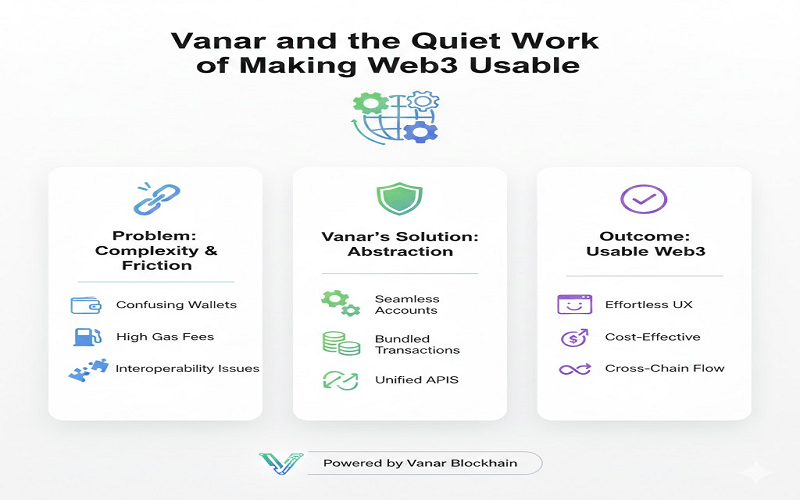
Think of it like plumbing in a building. Nobody praises the pipes when water flows smoothly. But when something breaks, everyone notices. Blockchain infrastructure is similar. If users are thinking about gas fees, bridges, wallets, or failed transactions, something is not working the way it should.
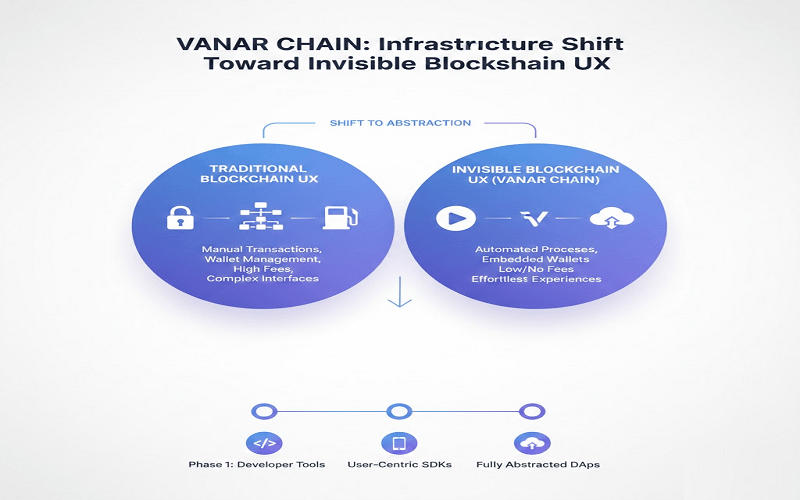
VANAR Chain seems built around that idea. It leans into embedded wallets and smoother onboarding. The goal appears to be reducing the number of steps between interest and actual usage. For developers, that translates into tools that abstract away the heavy blockchain logic. For users, it means fewer moments where they feel lost.
The token, $VANRY, plays its role inside that system. It is not positioned as a speculative centerpiece. It is more like a utility layer that keeps the machine moving. Fees, ecosystem incentives, access mechanics. Basic but necessary parts of any working network.
On Binance, activity around $VANRY has been steady rather than explosive. It moves with the broader market sentiment, especially when infrastructure narratives rotate back into focus. Right now, price action feels measured. Not overheated, not abandoned. That middle ground often reflects a project still building rather than chasing noise.
If someone were approaching it purely from a trading perspective, a conservative framework might look like this:
Entry Point: Near visible support zones after pullbacks rather than during sharp spikes
Take Profit: At previous resistance levels where liquidity has historically slowed momentum
Stop Loss: Slightly below structural support to manage downside if sentiment shifts
No certainty. Just structure and discipline.
What stands out to me is how Vanar positions itself in gaming and digital ownership without making loud claims. The website at https://tinyurl.com/vanar-creatorpad outlines tools that aim to make asset creation and deployment simpler. Not revolutionary in tone. Practical in intent.
In a market where many projects still struggle with real user retention, focusing on user experience is not glamorous but necessary. Adoption does not come from complex tokenomics. It comes from products that people can use without reading a manual.
There are risks, of course. Infrastructure plays are slow burns. They require developer adoption, consistent updates, and strong ecosystem support. If developer traction stalls, the chain risks becoming technically sound but underused. Competition is also intense. Every major network claims to improve onboarding and scalability. Vanar will need to prove that its approach is not just cleaner on paper but better in practice.
Still, I appreciate that the conversation around #Vanar and #vanar often centers on usability rather than hype. That tone feels more sustainable. It suggests a project aware that the next phase of blockchain growth depends less on speculation and more on invisibility.
In the end, the strongest infrastructure is the kind you barely notice.
