

Vanar is the kind of project you don’t “get” from a chart, a meme, or a slick thread. You get it the first time you try to build something real and you realize the enemy isn’t speed—it’s surprise. The moment your product depends on a network that behaves differently on Tuesday than it did on Monday, you’re not building anymore. You’re babysitting.
Most crypto conversations are addicted to the loud metrics. TPS. Finality. “Near-zero fees.” It’s the same dopamine loop every cycle: someone posts a number, everyone claps, nobody asks what happens when real users show up and do real-user things at scale. Builders ask that question because they’re the ones who eat the consequences.
Here’s what the hype crowd doesn’t feel in their bones: “cheap” is not a feature if it can’t be relied on. Cheap today is a coin toss dressed as marketing. Cheap when the network is quiet is basically meaningless. The only cheap that matters is the cheap you can plan around—the cheap you can promise your users without crossing your fingers.
That’s where Vanar feels like it was designed by people who’ve watched products break. Not because it shouts “we’re builders” louder than everyone else, but because it treats predictability like the point of the whole thing. The whitepaper doesn’t bury the problem: it calls out unpredictable transaction pricing as a structural barrier for high-volume apps and frames fixed, dollar-value fees as a core design goal.
And Vanar does something most chains avoid because it forces accountability: it puts a number on it. A baseline target equivalent to $0.0005 for common actions like transfers, swaps, minting, staking, bridging—“at any given time.” Not “lowest fees in the market.” Not “almost free.” A target that’s meant to stay stable even when the token price moves, with an outlined mechanism for keeping fees consistent by adjusting based on market price and by transaction type.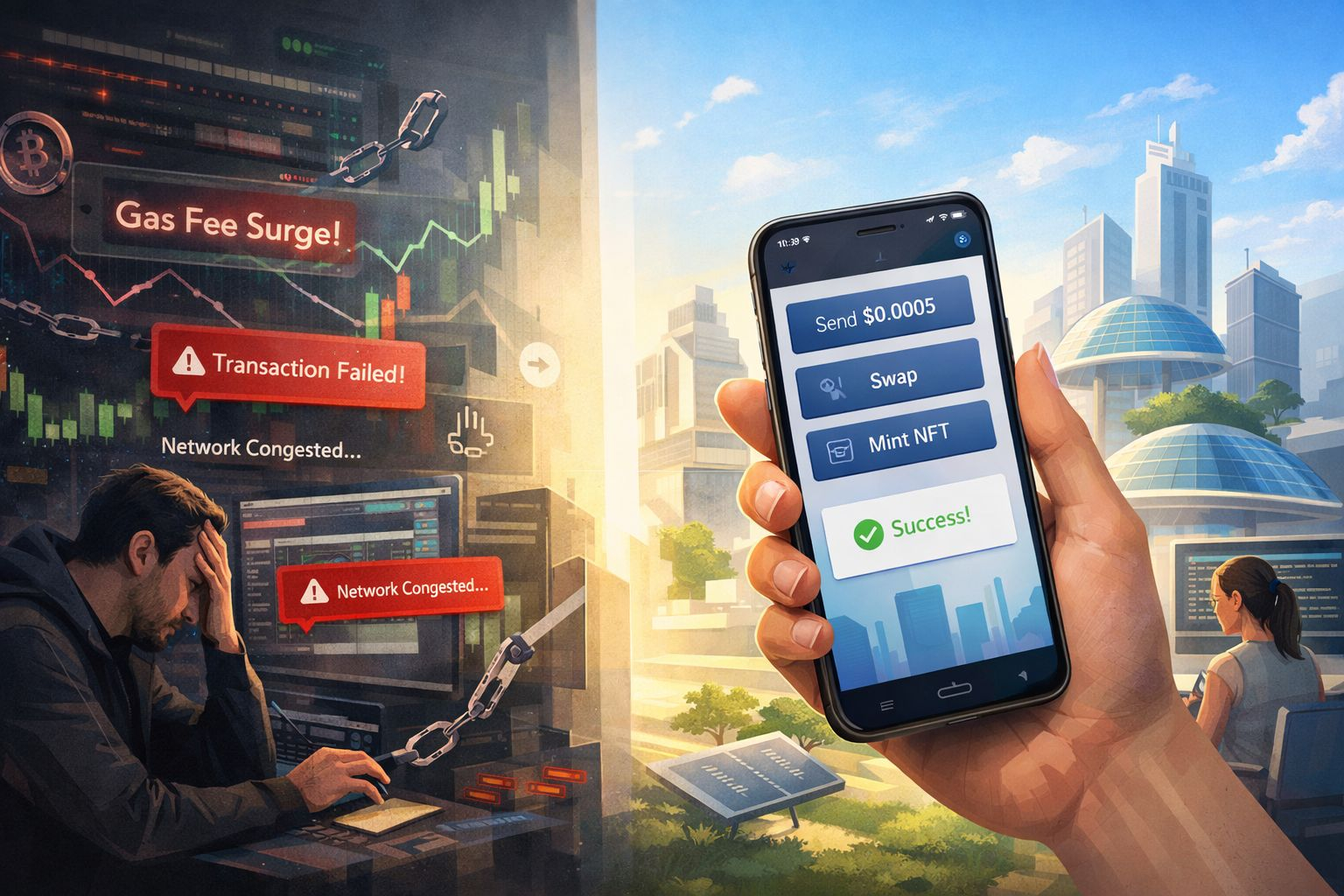
People who don’t build will skim that and think, cool, cheaper gas. People who build will read it and think, okay… that means I can actually design a product loop without holding my breath. That’s a completely different feeling. That’s the feeling of control.
Because the ugliest part of fee volatility isn’t the cost itself. It’s what it does to trust. Your app becomes unreliable in the one moment it needs to feel effortless. You spend weeks polishing onboarding, tightening copy, optimizing flows, paying for acquisition… and then the chain pops up at the exact moment of conversion and goes, “Surprise. The price changed.” The user doesn’t blame the mempool. They blame you. They don’t write an essay about network conditions. They just leave.
This is where the “fast” talk starts sounding childish. Fast doesn’t keep a product alive. Fast doesn’t save you when your funnel collapses at the worst point. Fast doesn’t fix the support tickets where someone feels robbed because they weren’t expecting the fee. Predictable does. Predictable is the difference between building a business and running an experiment.
If you want the most honest example, look at games. Everyone loves saying “gaming is the killer use case,” but most people saying it have never shipped a game economy that has to feel smooth for normal players. Games are a thousand tiny actions: craft, upgrade, trade, equip, merge, redeem. These are not “investment decisions.” They’re impulse taps. The user doesn’t want to think. The second a wallet prompt turns a small action into a little negotiation with gas, the spell breaks. Players don’t do gas math. They don’t wait. They don’t care why it happened. They just feel friction, and friction is death.
A chain that’s trying to make games work at scale has to care less about being the fastest in a benchmark and more about being boringly consistent. Vanar’s fixation on stable, low, dollar-equivalent fees is exactly the kind of boring that makes a game economy even possible on-chain without turning your UX into a constant apology.
There’s another thing that makes Vanar feel like it’s aiming at builders instead of spectators: it doesn’t try to “convert” you into a new religion technically. It leans into EVM compatibility and is blunt about what that means: “what works on Ethereum, works on Vanar,” including referencing Geth as an Ethereum client implementation. That’s not sexy. That’s mercy.
Because rewriting everything for a novel VM isn’t innovation when you’re under deadlines. It’s friction disguised as purity. Compatibility is a builder’s secret weapon because it preserves momentum. It lets teams ship without retraining their entire org, without rebuilding tooling, without introducing new classes of bugs for the privilege of being “early.”
Then there’s the part most projects quietly get weird about: token structure. Vanar’s whitepaper positions VANRY as the token tied to network operations (gas and related functions), and describes staking/governance participation through delegated staking mechanics. It also explains the evolution from Virtua’s TVK to VANRY through a 1:1 swap and states a maximum supply cap of 2.4B.
But the detail that makes you stop and reread, because it’s the kind of thing projects usually keep vague, is the explicit claim that no team tokens will be allocated in the additional supply allocation described. That doesn’t magically delete risk—nothing does—but it’s a signal. It’s a project choosing constraints, not escape routes. Builders notice constraints, because builders have been burned by “trust us” more times than they can count.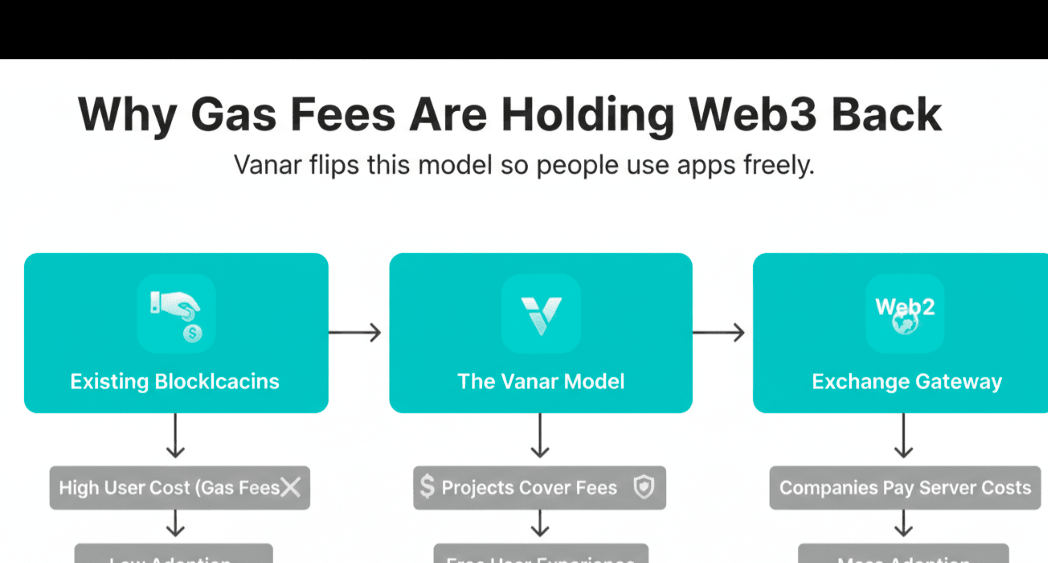
Now, if you want to talk about “real adoption” without lying to yourself, it rarely arrives as viral crypto content. It arrives as boring partnerships and distribution pipelines. Vanar’s partner material points to Viva Games Studios, described as having 700M+ downloads and associations with big brands like Hasbro and Disney. That’s not a guarantee of anything, but it’s a better signal than influencer excitement because it hints at something concrete: teams with catalogs and users even being willing to entertain the stack.
And yes, Vanar’s current positioning leans into the “AI infrastructure” era—calling itself an AI infrastructure stack and emphasizing intelligent apps that “learn, adapt, and improve.” The space is noisy with that language, so skepticism is healthy. But again, the question that matters is boring: does the project keep reducing builder risk? If the foundations are predictable—fees that don’t whip around, compatibility that doesn’t demand reinvention—then “AI” stops being a buzzword and starts being a category of workloads that can’t tolerate chaos.
A third-party overview even frames Vanar around long-term usability and deterministic-feeling transaction costs, which aligns with that “less bragging, more operations” theme. And that’s the thread you can pull all the way through the project without snapping it: Vanar doesn’t read like it was designed to win attention. It reads like it was designed to survive maintenance.
That’s what “built for builders” actually means, and it’s rarely romantic. It’s the chain doing the unglamorous work of making costs predictable, making deployment familiar, and making the system stable enough that you can focus on your product instead of your plumbing.
Fast is cheap talk because “fast” is easy to claim and easy to demo in a controlled environment. Predictable is rare because predictable forces you to commit to an experience that holds up when real people arrive and behave like real people—impatient, casual, allergic to friction, and uninterested in your technical excuses.
Vanar might not be the loudest story in the room, and that’s kind of the point. If it succeeds, the first people to notice won’t be the ones dunking on timelines. It’ll be teams shipping without flinching, because their users stopped hitting that wall where “web3” suddenly shows up and ruins the moment.
And honestly, that’s the only kind of win that matters. Not the kind you can screenshot. The kind you can build a life on.
