
Fogo is easiest to understand once you stop thinking of it as just another Solana fork and instead look at how it approaches execution from a market structure perspective. After spending time reviewing its architecture and how it positions itself in the Solana Virtual Machine landscape, it feels less like a general-purpose Layer 1 and more like a system deliberately shaped for trading-heavy environments.
At its core, Fogo runs on the Solana Virtual Machine. That immediately gives it developer compatibility with existing SVM tooling and programs. Builders familiar with Solana do not need to relearn everything. Smart contracts written for the SVM environment can be adapted without rewriting the entire logic stack. That matters, because ecosystem friction is usually what slows down adoption, not performance benchmarks.
Where Fogo separates itself is not in branding but in design priorities. Most Layer 1 chains claim high throughput, but they still treat trading applications as just one category among many. Fogo appears to invert that logic. It treats trading infrastructure as foundational. That changes how execution and state updates are handled.
Think of a blockchain like a highway system. On most networks, DeFi apps, NFT projects, and simple token transfers all share the same lanes. During high traffic periods, congestion builds and latency increases. Fogo tries to build dedicated high-speed lanes specifically optimized for market activity. Its architecture anticipates constant order flow rather than occasional bursts of activity.
The integration of order book-style mechanics into the chain’s design is central to this. Instead of pushing everything off-chain or relying heavily on external matching systems, Fogo’s structure acknowledges that price discovery requires predictable and low-latency execution. The chain is shaped around that assumption. That gives it a trading-native character that feels closer to traditional exchange infrastructure than to a typical multipurpose blockchain.
Performance consistency is another point that stands out. High throughput numbers are easy to advertise. Sustaining execution quality under stress is harder. Fogo borrows ideas similar to the Firedancer-style client approach, focusing on efficient validator execution and optimized networking layers. This is less about flashy TPS figures and more about maintaining stable confirmation times when volumes rise.
This approach reflects something the broader market has been discussing quietly. As on-chain trading volumes fluctuate and liquidity fragments across ecosystems, execution reliability becomes more important than raw scalability claims. Traders care about whether transactions settle cleanly, not just how many theoretical transactions a network can process per second.
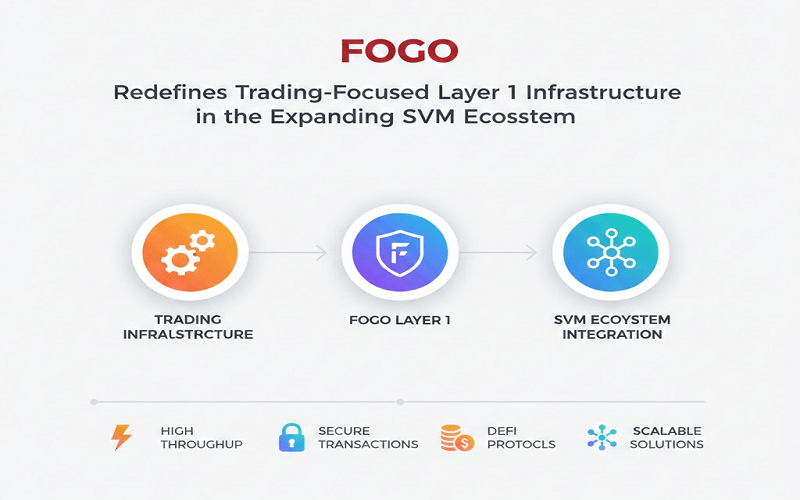
The project account @Fogo Official has consistently emphasized this trading-native philosophy rather than broad, undefined ecosystem expansion. That positioning feels deliberate. It narrows the scope but strengthens the identity.
From a token perspective, $FOGO is naturally tied to validator incentives and network participation. Like other SVM-based chains, the token model supports staking and security. What matters more in practice is whether network activity sustains demand beyond speculative cycles. A chain optimized for order flow must maintain real liquidity to justify its architecture.
There are also realistic constraints. Competition within the SVM ecosystem is intense. Several chains now use similar execution models and compete for the same developer pool. Validator decentralization can become a challenge when performance optimization leads to higher hardware requirements. If the barrier to running a node rises, decentralization may narrow over time. That tension is not unique to Fogo, but it is relevant.
Ecosystem maturity is another factor. High-performance infrastructure only matters if applications actually deploy and attract users. Without sustained dApp activity, even the most refined execution layer feels underutilized.
In current market conditions, infrastructure-focused projects are being evaluated more critically. Traders are less interested in abstract roadmaps and more focused on measurable network activity and liquidity depth. That context shapes how #Fogo is being discussed. The narrative is less about promises and more about structural alignment with trading use cases.
For those looking at $FOGO from a short-term trading perspective, cautious range-based planning makes sense rather than directional assumptions:
Entry Point: Near strong support zones where volume historically consolidates
Take Profit: Prior local resistance levels with visible liquidity clusters
Stop Loss: Slightly below structural support to manage downside exposure
No projections. Just disciplined positioning.
The hashtag #fogo circulates steadily across trading communities, often alongside discussions about execution speed and SVM competition. The tone around it is analytical rather than euphoric. That feels appropriate for infrastructure plays.
Fogo’s central idea is simple. Build a chain that treats market execution as a first principle, not an afterthought. Whether that focus translates into lasting network gravity depends less on performance claims and more on whether traders consistently choose to transact there.
Infrastructure only matters if people actually drive on the road.

