

Fogo isn’t trying to be “another fast chain.” It’s making a much more specific bet: that if you compress block times to ~40 milliseconds and keep finality tight, you can create a trading experience that feels meaningfully better—so much better that traders, market makers, and liquidators start preferring it. If that preference turns into sticky liquidity, the token benefits. If it doesn’t, Fogo risks becoming a technically impressive chain with thin economic gravity. Right now, the data says the speed is real—but the liquidity flywheel is still in its early turns.
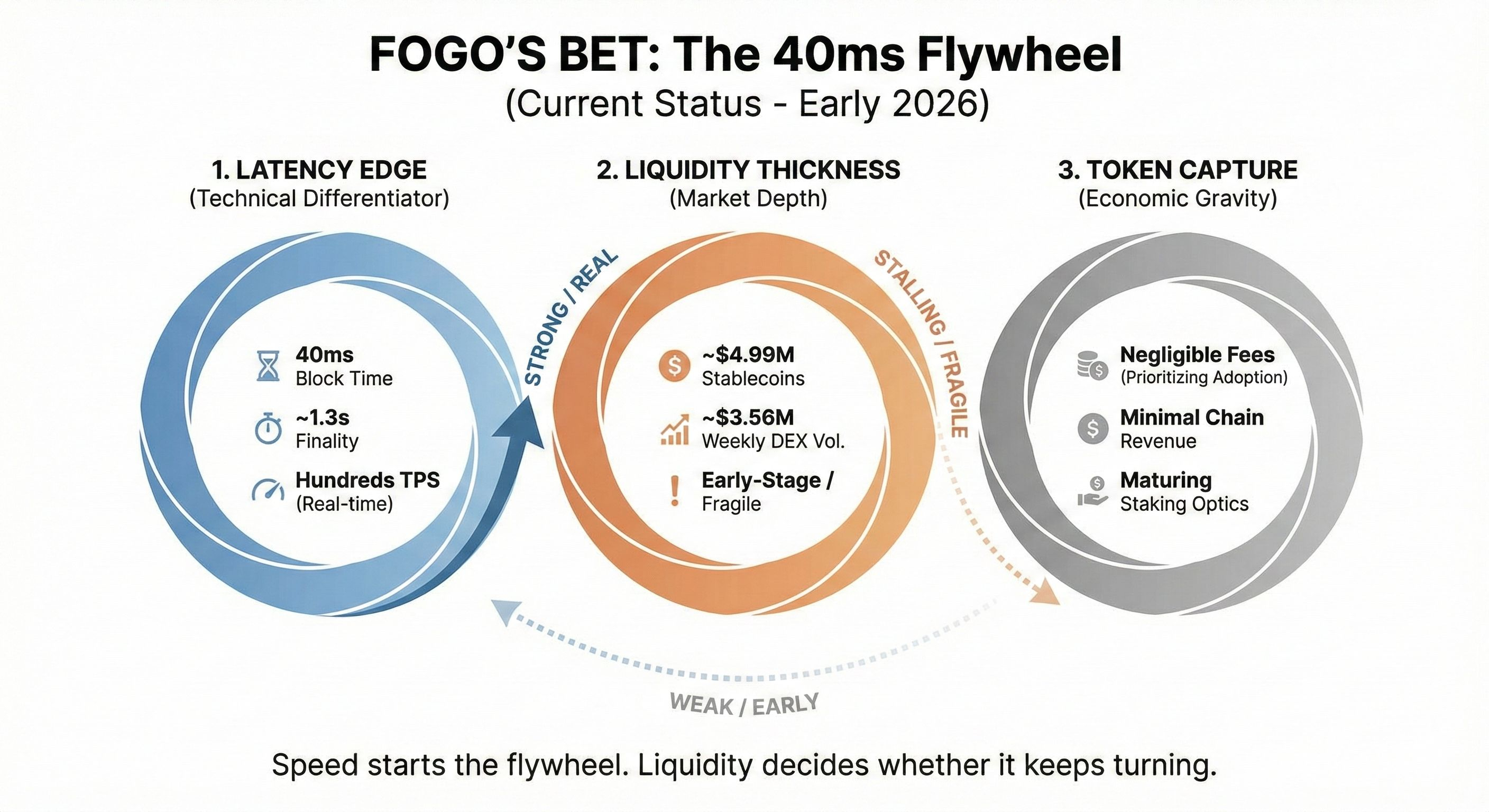
When Fogo’s public mainnet went live in January 2026 alongside live applications and exchange listings, the story shifted from “look at our testnet benchmarks” to “show me the numbers.” That shift matters. In crypto, claims are cheap; production metrics are not. Fogo reports ~40ms block time and around ~1.3s finality, with real-time throughput in the hundreds of transactions per second. That’s fast enough that, in theory, order placement, liquidations, and arbitrage should feel tighter and more competitive.
But speed is only half the equation. A trading chain doesn’t win because it can process transactions quickly—it wins because there’s enough money sloshing around that spreads tighten, depth thickens, and people come back the next day.
Here’s where the numbers get more sobering.
Stablecoins on Fogo sit around ~$4.99M, with DEX volume roughly ~$353K over 24 hours and ~$3.56M over 7 days in the cited view. That’s early-stage liquidity. It’s not nothing—but it’s not yet the profile of a serious trading venue. You can’t build a derivatives ecosystem or high-frequency arbitrage playground without deep, reliable dollar liquidity.
On the fee side, the average transaction cost is effectively microscopic, and reported chain revenue in the referenced snapshot is minimal. That’s intentional: Fogo is clearly prioritizing adoption over monetization. The risk is that if monetization never matures—if fees remain negligible even as usage grows—the token struggles to anchor its value to anything beyond expectation.
Tokenomics add another layer of nuance. Public trackers list total supply at 10B, with about 3.775B unlocked (~37.75%). Allocations to Core Contributors (~34%) and Foundation (~30.38%) are significant, and the next disclosed unlock event is dated September 26, 2026 (Advisors). None of this is inherently negative. But cliff-heavy unlock schedules create pressure windows. If growth metrics are strong into those windows, unlocks get absorbed. If they’re not, price often becomes a function of calendar math rather than network adoption.
Security optics matter too. One public dashboard view shows a small validator set and a low Nakamoto-style measure relative to mature L1s. Whether or not that evolves quickly, perception influences behavior. Market makers and larger players care about liveness, governance stability, and credible decentralization. Thin validator dispersion can be a psychological hurdle before it becomes a technical one.
To make sense of all this, I use what I call the Latency-to-Liquidity Flywheel.
Step one: Latency Edge. Fogo clearly scores high here. 40ms blocks and fast finality are not marketing fluff; they are real technical differentiators.
Step two: Liquidity Thickness. This is where the flywheel either catches or stalls. With under $5M in stablecoins and low single-digit millions in weekly DEX volume, liquidity is present but fragile.
Step three: Token Capture. If the chain generates meaningful economic activity, fees, MEV, staking demand, or priority markets eventually create value pressure for the token. Today, fee capture is negligible and staking/decentralization optics are still maturing.
Right now, the flywheel is spinning—but gently.
The most interesting comparison isn’t with random alt-L1s. It’s with Solana. Solana’s advantage has never been just speed—it’s liquidity density and developer gravity. Public dashboards show vastly larger validator counts and stronger decentralization metrics. And discussions around Solana’s own latency improvements (e.g., Alpenglow proposals targeting lower finality times) suggest the performance gap may narrow over time.
If that happens, Fogo’s differentiation must evolve from “we’re faster” to “we built the better trading microstructure.” That could mean maker incentive programs, deeper integration between liquid staking and collateral use, or priority fee markets that encourage competitive blockspace dynamics. In other words, structure—not just speed.
So what would success actually look like?
You’d expect stablecoin liquidity to move from ~$5M into the tens of millions and stay there. You’d expect weekly DEX volumes to climb into sustained multi–tens-of-millions territory. You’d expect validator dispersion metrics to improve meaningfully. And ideally, you’d start to see fee dynamics shift from “virtually free” to “competitive for priority,” indicating real economic demand for blockspace.
If those metrics trend positively ahead of the September 2026 unlock window, the token narrative changes. It becomes less about speculation on speed and more about ownership in an emerging venue.
Now, the honest risks.
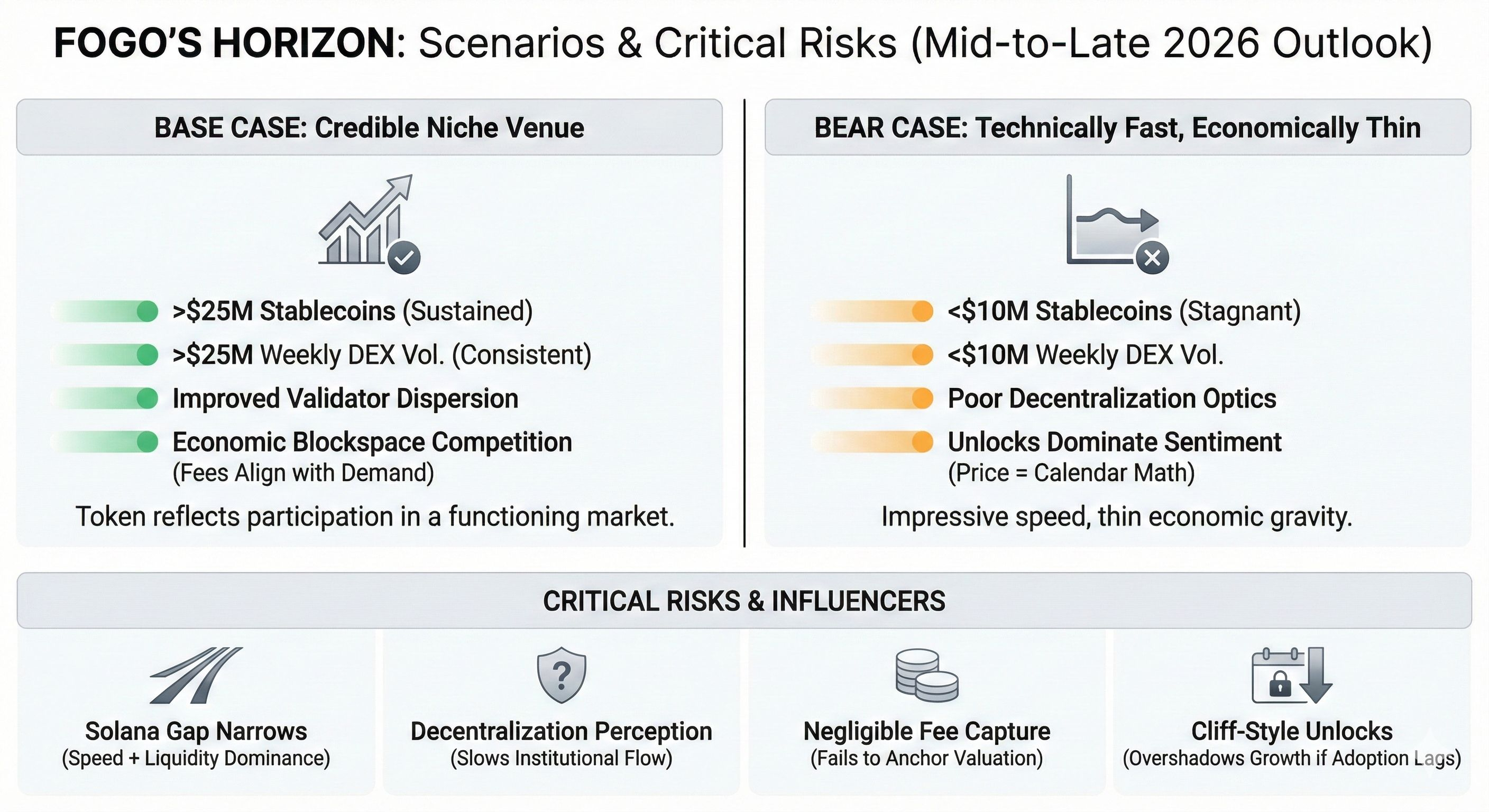
First, Solana can compress the latency gap while retaining its liquidity dominance. If that happens before Fogo builds meaningful depth, Fogo’s wedge narrows dramatically.
Second, decentralization optics could slow institutional liquidity.
Third, current fee capture is too small to anchor valuation in fundamentals.
Fourth, cliff-style unlocks can overshadow growth if adoption doesn’t accelerate into those windows.
Base case: by mid-to-late 2026, stablecoins exceed $25M and weekly DEX volume pushes beyond $25M with consistency; validator dispersion improves; and blockspace starts showing signs of economic competition. In that scenario, Fogo becomes a credible niche trading venue, and the token begins reflecting participation in a functioning market.
Bear case: stablecoins remain under $10M, weekly volume stagnates below $10M, decentralization optics don’t materially improve, and unlock windows dominate sentiment. In that world, Fogo is remembered as impressively fast—but economically thin.
The story of Fogo isn’t about milliseconds in isolation. It’s about whether milliseconds can compound into money, and whether money can compound into permanence. Speed starts the flywheel. Liquidity decides whether it keeps turning.
