
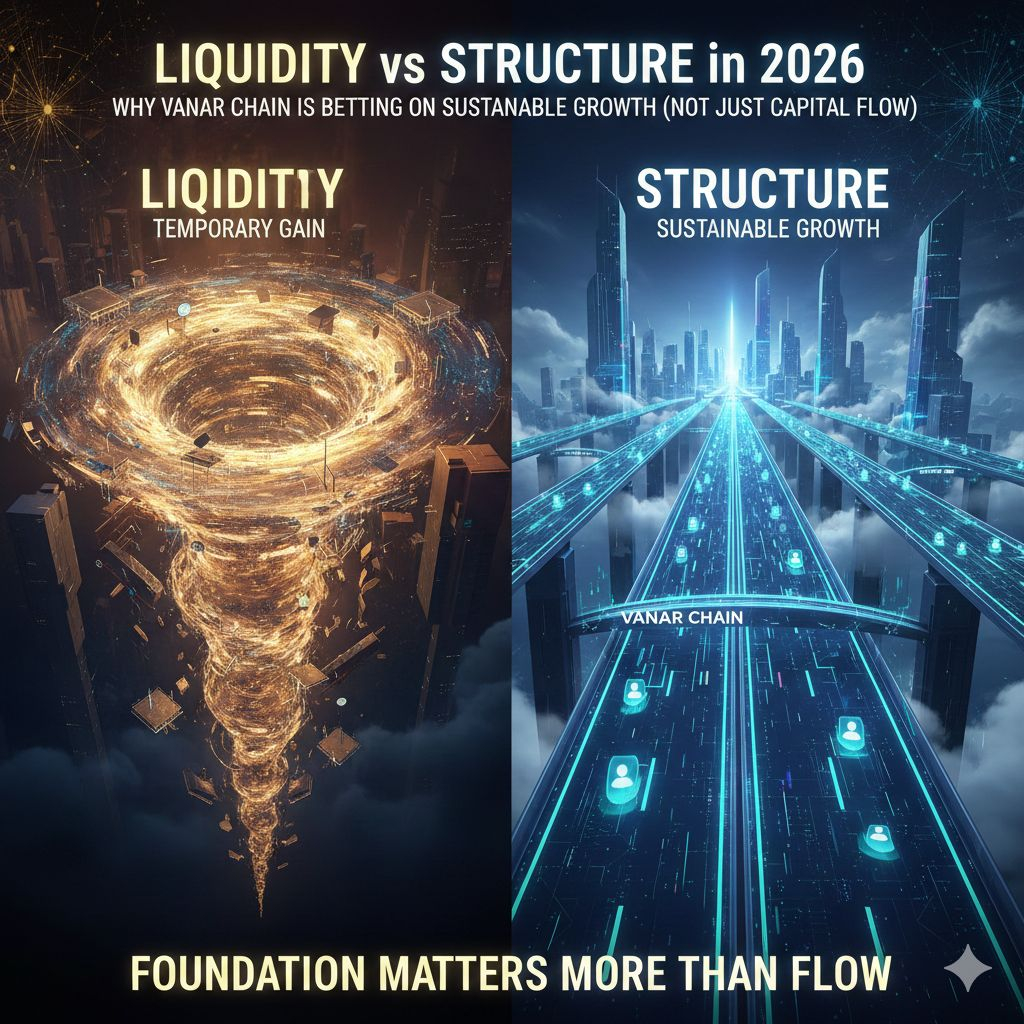
By 2026, liquidity will still move markets. But structure will decide survivors.
Crypto history shows a familiar pattern.
When liquidity enters, prices react fast. Momentum builds. Sentiment improves.
But liquidity alone does not create intrinsic value.
It simply amplifies whatever already exists good or bad.
Projects with weak foundations become volatile.
Projects with strong structure compound quietly.
That’s why the real question for long-term participants isn’t “Where is liquidity going?”
It’s “Which networks are building durable economic systems beneath the noise?”
This article explores that question through Vanar Chain framing its development within the AI + Blockchain narrative of 2026.
The What & Why: What Is Vanar Chain Really Building?
At its core, Vanar Chain is a Layer-1 blockchain designed for high-performance consumer applications especially gaming, immersive media, and AI-powered experiences.
Its goal is simple but ambitious:
Enable Web2-level user experiences on Web3 infrastructure.
Here’s a simple analogy.
Think of Vanar like a high-speed logistics highway.
Traditional blockchains are narrow roads: every action needs manual approval (wallet signatures), congestion is common, and users feel friction.
Vanar aims to become a multi-lane expressway, where applications can pre-authorize limited actions (via session logic), content loads instantly, and users don’t feel like they’re “using crypto” at all.
Just like you don’t manually approve every tap on a contactless card.
This matters because mass adoption doesn’t happen through whitepapers.
It happens when technology fades into the background.
Educational Deep Dive: Four Structural Pillars Behind Vanar
Liquidity can mask weaknesses for months.
Structure exposes them over years.
Let’s break down four technical areas that determine whether Vanar is built for temporary cycles or long-term relevance.
1. Session-Based UX: Removing Wallet Fatigue
One of the biggest blockers to on-chain adoption is constant transaction signing.
Vanar introduces scoped session keys that allow apps to request temporary, permissioned access.
For example:
Trade only on one market
For a fixed time window
With capped size limits
Users stay in control, but interactions feel instant.
This is critical for:
Games
AI-driven apps
Real-time marketplaces
Because no mainstream user wants to approve 30 wallet popups per session.
This design pushes blockchain UX closer to centralized exchange speed without surrendering custody.
2. High-Throughput Architecture for Real-Time Apps
AI and immersive applications require consistent performance, not just theoretical TPS.
Vanar focuses on:
Low-latency block finality
Predictable transaction costs
Infrastructure optimized for media-heavy workloads
This matters in 2026 because AI agents, on-chain games, and interactive environments all generate continuous transaction demand, not sporadic transfers.
Structural growth comes from usage density, not hype cycles.
3. Developer Ecosystem as an Economic Engine
Liquidity arrives from traders.
Value accrues from builders.
Vanar’s strategy emphasizes:
SDKs for game studios and AI developers
Simplified deployment pipelines
Tooling designed for Web2 teams entering Web3
Why is this important?
Because every active developer creates:
New contracts
New users
New transaction flows
Over time, this compounds into organic network demand something liquidity cannot fake.
4. Token Utility Integration: Making Functional
A token without embedded utility becomes a speculation vehicle.
Vanar is gradually integrating $VANRY into:
Network operations
Application-level incentives
Ecosystem participation mechanics
The objective is simple:
As network usage grows, token relevance grows with it.
That’s structural alignment.
Market Integration: Vanar in the 2026 AI + Blockchain Narrative
2026 is shaping up as the year where AI meets on-chain infrastructure at scale.
AI agents now:
Execute trades
Manage in-game economies
Coordinate decentralized services
But these systems require:
Fast settlement
Predictable costs
User abstraction layers
This is where Vanar positions itself as an execution layer for AI-native applications.
Within the broader ecosystem of Binance, this matters.
Binance increasingly supports projects that demonstrate:
Real usage
Developer traction
Cross-vertical relevance (AI, gaming, consumer apps)
Vanar’s alignment with AI + immersive tech gives it exposure to multiple growth vectors not just one narrative.
That diversification is part of structural resilience.
Actionable Insight: How to Follow Vanar on Binance (No Financial Advice)
If you’re researching Vanar from an educational perspective, here’s how to stay informed:
Open Binance (App or Web).
Search for $VANRY in the Markets section.
Add it to your watchlist for quick access.
Use Binance Pro charts to study:
Volume trends
Liquidity depth
Historical volatility
You can also follow ecosystem announcements directly through Binance Square and project updates.
This isn’t about trading signals.
It’s about understanding how market behavior reflects network progress.
Liquidity vs Structure: The 2026 Divide
Let’s return to the original thesis.
Liquidity accelerates movement.
Structure determines direction.
Projects relying solely on liquidity cycles will continue to experience violent swings.
Projects built on structural growth will show slower starts but stronger survivability.
For Vanar, the long-term equation looks like this:
More developers → more applications
More applications → more users
More users → real economic activity
Real activity → meaningful token utility
Liquidity then becomes a catalyst not a crutch.
Or as the saying goes:
Foundation matters more than flow.
When liquidity disappears, all that remains is structure.
By 2026, the gap between speculative ecosystems and functional networks will be impossible to ignore.
Vanar Chain is betting on:
Developer density
User-centric design
AI-compatible infrastructure
Token integration tied to real usage
Not just temporary capital rotations.
Whether that strategy succeeds depends on execution but the architectural intent is clear.
Engagement Loop (CTA)
Do you think Vanar’s focus on UX, developers, and AI-ready infrastructure represents the next standard for Layer-1 blockchains or will liquidity cycles continue to dominate crypto narratives?
Let’s discuss below.
