The most valuable part of Fogo isn't the 40ms block times or the 1.3second finality. Those numbers grab attention in 2026's crowded SVM race, but they're symptoms, not the thesis. What matters is the base layer engineering that was built assuming high stress environments liquidation cascades, MEV spikes, memecoin floods aren't edge cases. They're the default.
Fogo runs full SVM compatibility, so Solana programs, Anchor tools, and SPL standards drop in with near-zero friction. Builders port code using familiar Rust workflows. The real differentiation sits lower: Frankendancer (Firedancer + Agave hybrid) tiles pinned to cores for zero copy, low jitter execution; kernel bypass networking; and zoned, multi local consensus where validators rotate geographically, minimizing cross continent latency. Quorums form over tight fiber paths rather than global scatter. Physics gets respected, not ignored.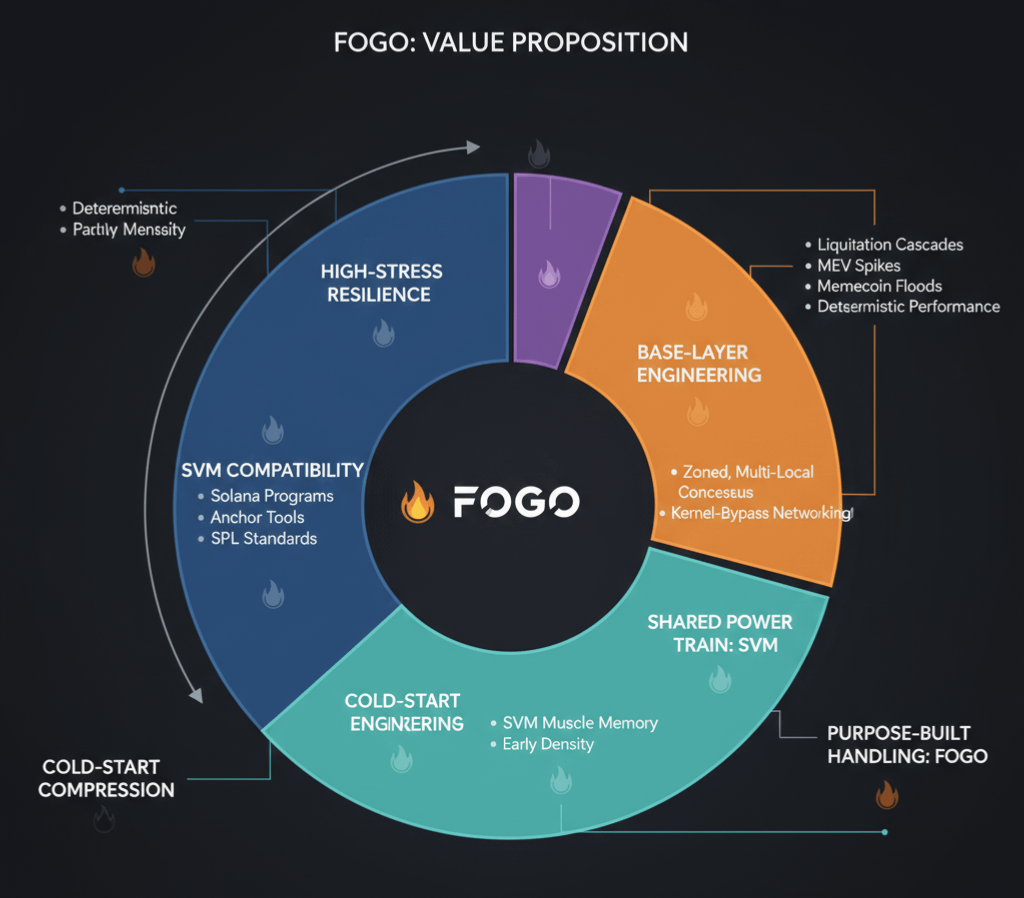
This chassis delivers deterministic performance when the network redlines. Perp books stay tight because finality isn't probabilistic under bursty load. Liquidations execute in real time, not after the cascade. It's SVM, but the base layer was tuned for trading racetracks, not general purpose chains.
The cold start loop haunts every L1: no apps without users, no users without liquidity, no liquidity without apps. Fogo compresses it via SVM muscle memory. Thousands of Solana devs already grok parallel execution quirks. They ship first Raydium forks, perp engines, lending primitives without relearning runtimes. Early density forms faster than the usual six-month slog.
What transfers: code, habits, tooling instincts. Solana's high performance culture optimize latency, mitigate MEV as table stakes ports intact. What doesn't: liquidity pools, market-maker trust, social proof. Those build slowly through uptime, stress survival, and fair launches. Mainnet went live January 15, 2026, with Binance sale, airdrop, and exchange listings. Early protocols landed, but real stickiness awaits real volume.
Second order effects compound here. Dense DeFi primitives mean tighter spreads from colocated execution. Deeper books reduce hedging risk. More apps pull capital, pulling more apps. It's Solana's flywheel, but accelerated by a chassis designed for density from genesis.
"It's just another SVM L1" is the easy critique. Eclipse, Monad, others share the engine. Fogo's edge is the chassis: zoned consensus and Frankendancer mandate prioritize stress resilience over generic TPS. It's not a street car with a swap it's a formula car built around the V8.
Simple model: SVM is the high rev engine. Fogo is the aero-tuned chassis with active suspension that stays planted in corners. Shared powertrain, purpose-built handling.
A month post-launch, the vibe is grounded. No endless hype cycles. Steady protocol onboarding, consistent block production, token around $0.023 (market cap mid eight figures, down from ATH but holding). It's infrastructure finding rhythm, not narrative chasing.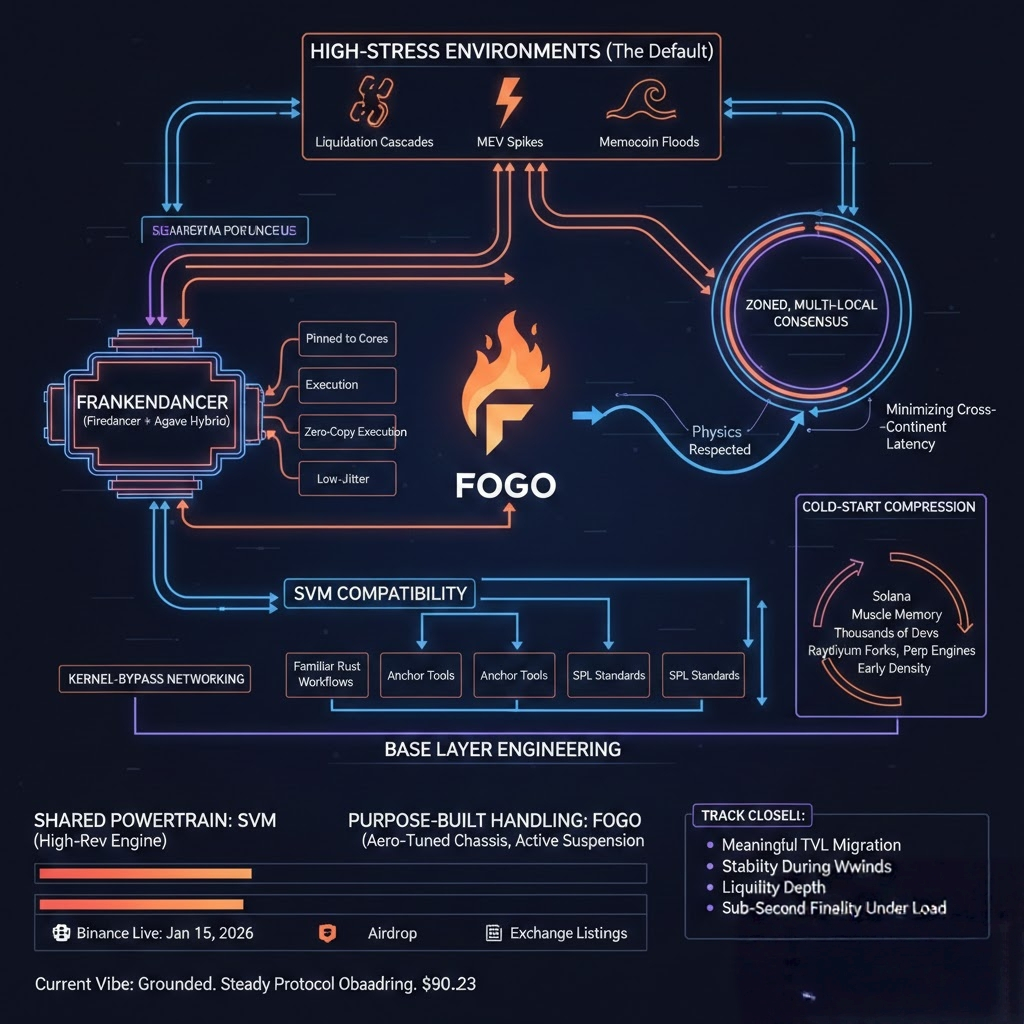
If watching Fogo closely, track: meaningful TVL migration from Solana natives; stability during real perp unwinds or viral spikes; liquidity depth and spread tightness; on chain metrics showing subsecond finality holds under load. Those prove the stress bet pays off.
Fogo doesn't promise everything. It promises not to buckle when pressure mounts. In SVM's maturing wars, that's the quiet, durable advantage.