
Fogo is easiest to understand if you stop thinking about it as just another Layer 1 and instead look at it as an execution system built specifically for markets. It runs on the Solana Virtual Machine, but it does not simply replicate what other SVM chains are doing. The central idea behind Fogo is tighter execution for trading environments, not general-purpose flexibility.
Most blockchains try to support everything at once. DeFi, NFTs, gaming, identity, social protocols. That breadth is powerful, but it often leads to congestion and unpredictable performance. Fogo takes a narrower view. It assumes that on-chain markets, especially order book–based trading, deserve infrastructure that is shaped around their needs.
Think of blockchains as highway systems. A general-purpose chain builds wide roads for all kinds of vehicles, but traffic varies wildly. At peak hours, delays are common. Fogo is more like a dedicated express lane built for high-frequency traffic. It is not trying to carry everything. It is trying to keep one kind of flow smooth and consistent.
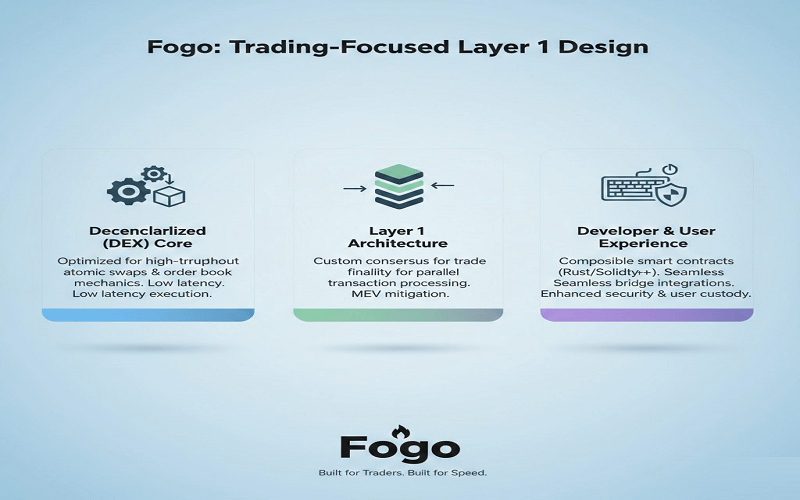
Because Fogo uses the Solana Virtual Machine, developers familiar with Solana tooling can migrate or deploy with relatively low friction. That compatibility matters. It reduces the cost of experimentation and lowers the barrier for teams who already understand SVM-based architecture. Instead of forcing developers into a new environment, Fogo leans into an existing one and refines the execution layer around a specific use case.
A key difference is how Fogo treats market structure as a first-class element. Traditional smart contract chains treat order books as applications layered on top. On Fogo, the architecture reflects the needs of order matching and price discovery more directly. Built-in assumptions around order flow and sequencing influence validator behavior and execution logic. This changes how latency and throughput are optimized.
High-performance execution is central here. Fogo’s approach resembles a Firedancer-style client architecture in its emphasis on streamlined processing and efficient networking. The idea is not just raw speed, but consistent speed. Traders and market makers care less about occasional peak throughput and more about predictable finality and low jitter. When latency fluctuates, strategies break down. Fogo attempts to reduce that variability at the protocol level.
The project account, @Fogo Official , often frames this as a focus on execution quality rather than ecosystem breadth. That distinction matters. Many chains measure success by total applications or total value locked. Fogo’s narrative centers more on how well transactions are processed under stress conditions.
This design also shapes validator expectations. To maintain consistent performance, node infrastructure requirements can become more demanding. That creates a balancing act. On one hand, higher hardware standards can improve throughput and reduce bottlenecks. On the other hand, it can limit validator decentralization if only well-resourced operators can participate. For any high-performance Layer 1, including #Fogo , that tension remains an open question.
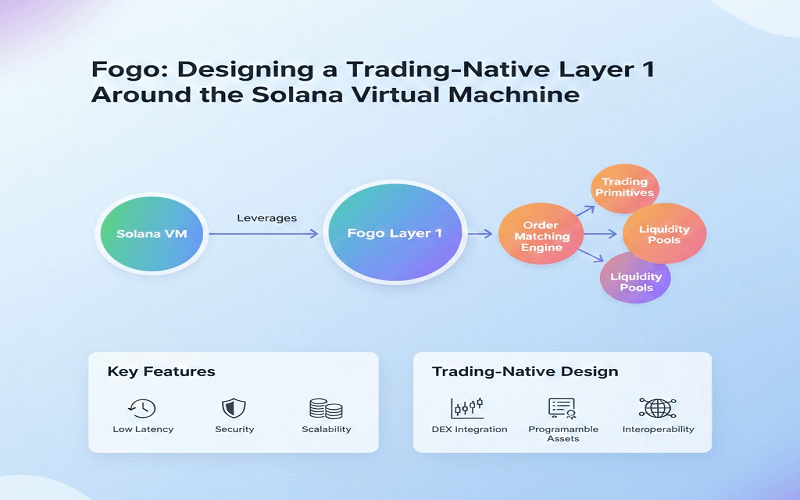
Competition is another factor. The SVM ecosystem is no longer small. Several chains leverage the same virtual machine, which means developer portability cuts both ways. If moving to Fogo is easy, moving away is also easy. Long-term retention will depend on whether execution stability and trading-native features offer tangible advantages over other SVM networks.
The token, $FOGO , plays the usual Layer 1 roles such as transaction fees, validator incentives, and governance alignment. Its value proposition depends less on abstract narratives and more on measurable network usage. If trading protocols choose Fogo because they see better execution outcomes, the token becomes tied to real activity. If not, it risks blending into a crowded field of SVM-based assets.
#fogo fits into a broader trend where blockchains specialize rather than compete on general capacity alone. Instead of asking, “How many apps can we host?” the question becomes, “Which workloads do we handle better than anyone else?” Fogo’s answer is clear: high-performance, order-driven markets.
Whether that specialization proves durable will depend on adoption, validator distribution, and sustained developer interest. The technical direction is coherent. It aligns infrastructure decisions with a specific market problem rather than chasing every possible use case.
In a space where many networks try to be everything at once, Fogo is testing what happens when you design for one thing and do it carefully.
