Most Layer-1 debates keep circling around the same number: speed.
Faster blocks. Higher TPS. Bigger headline metrics.
But if you’ve spent real time watching on-chain systems during volatility, you already know the uncomfortable truth — markets don’t usually break because the average block time is slow. They break because the worst moments are unpredictable.
That messy edge — the tail latency — is where confirmations suddenly drag, ordering gets noisy, and every serious protocol starts adding safety padding just to survive. Spreads widen. Buffers increase. Liquidations become more chaotic. And quietly, some of the most sensitive logic moves off-chain.
Fogo is interesting because it starts exactly there.
Instead of pretending the network is an abstract machine floating in perfect conditions, Fogo treats the real world as the constraint. Distance matters. Routing matters. Hardware differences matter. And if you want on-chain markets to behave like real venues, consistency matters more than flashy averages.
What Fogo Actually Is (In Plain Words)
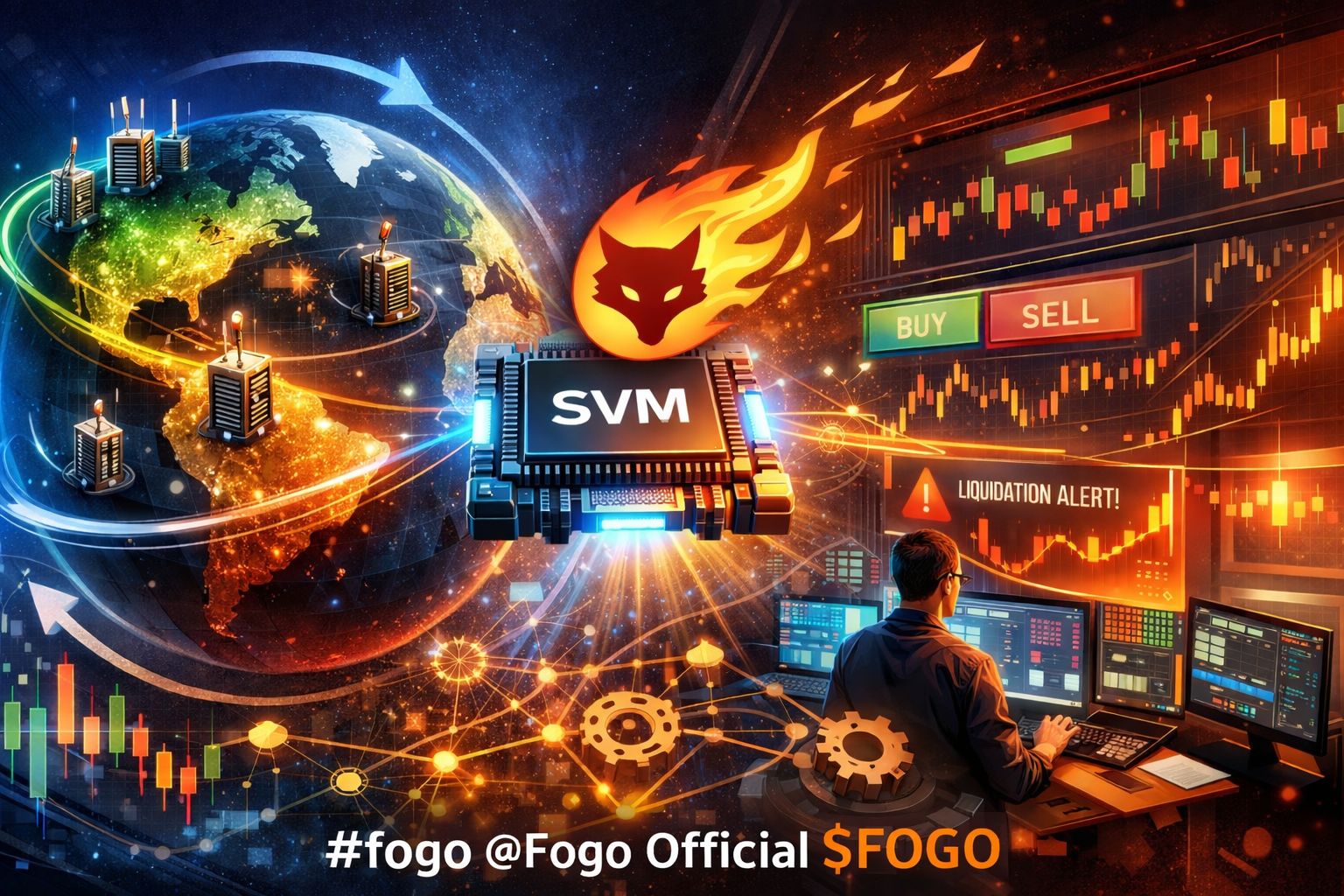
Fogo is an SVM-based Layer-1 that keeps the familiar Solana-style execution environment but tries to fix something deeper: how the network behaves when it is under real pressure.
The SVM choice is practical. It gives builders known tooling, known patterns, and a performance culture that already understands parallel execution. That lowers the barrier to entry.
But the real bet Fogo is making sits underneath the runtime.
The focus is on making execution timing more predictable, especially when the network is busy or geographically stretched.
The Real Problem Fogo Is Targeting
Not all DeFi is equally sensitive to timing.
Some applications can tolerate delays. Others absolutely cannot.
Anything that depends on ordering — order books, auctions, liquidations, keeper systems — becomes extremely sensitive to latency variance. When confirmations are inconsistent, protocols protect themselves by becoming more conservative.
You see it everywhere:
wider spreads
larger safety buffers
slower mechanisms
more off-chain assistance
Over time, that defensive design quietly limits how competitive on-chain systems can be.
Fogo’s thesis is simple but ambitious:
If you make timing predictable enough, builders can tighten their systems again.

The Zone Model — The Most Unusual Part
This is where Fogo really diverges from the typical Layer-1 playbook.
Instead of forcing every block to coordinate globally, Fogo groups validators into geographic zones and activates only one zone for consensus during a given epoch. Then it rotates which zone is active over time.
In simple terms, the network is trying to temporarily “tighten the circle” of validators that must coordinate for each block.
Why this helps
Global consensus is expensive in terms of latency. The farther apart validators are, the more variance creeps into the system. By compressing the active quorum into a physically closer group, Fogo aims to reduce jitter and make confirmation timing more consistent.
For latency-sensitive markets, that consistency is extremely valuable.
But the tradeoff is real
This design does not magically solve decentralization. It reshapes it.
During any given epoch, influence is naturally concentrated in the active zone. Rotation spreads that influence across time, but it also means decentralization becomes something you evaluate over a moving window, not a single snapshot.
That introduces real questions:
What if one zone is weaker than others?
What if stake starts clustering into a few preferred regions?
How healthy does each zone need to be before activation?
Fogo’s architecture forces these questions into the open instead of hiding behind raw validator counts.
Firedancer Direction — Quiet but Important
Another piece of the puzzle is Fogo’s focus on Firedancer-style performance paths.
This might sound technical, but the intuition is simple. A lot of the worst latency spikes in blockchain systems don’t come from transaction execution itself. They come from networking bottlenecks, packet handling, and leader-side processing delays.
If you can move data more efficiently and schedule work more cleanly, the entire system becomes less jittery.
It’s not glamorous engineering. But for trading systems, it’s exactly where reliability is won or lost.
Sessions — Small Feature, Bigger Strategy
At first glance, Fogo Sessions looks like a user-experience improvement.
But it connects directly to the broader thesis.
If on-chain markets are supposed to compete with fast venues, users cannot be stuck approving and signing every tiny action. Sessions introduce scoped permissions and smoother flows so applications can support repeated actions without constant friction.
In other words, Fogo isn’t just trying to speed up the chain. It is also trying to reduce the interaction overhead that slows real users down.
Why Fogo Matters
Fogo only really matters if you believe the next phase of on-chain finance will be decided by market quality, not just raw throughput.
If the thesis works, the benefits are meaningful:
more stable confirmation timing
tighter on-chain mechanisms
fewer defensive buffers
better user experience in active apps
infrastructure that behaves more like professional venues
That is a different ambition from being “another fast chain.” It is an attempt to make blockchains behave predictably enough for serious financial systems.
What Their Plan Appears to Be
Looking at the direction of the design, Fogo seems focused on a few clear priorities:
Prove that localized consensus can reduce harmful latency variance
Build validator infrastructure that behaves consistently under load
Lower UX friction so active applications can thrive
Attract builders who actually care about execution quality, not just deployment ease
It is a systems-first approach rather than a narrative-first one.
What to Watch Next
The real test for Fogo is not whether it can demonstrate speed in controlled environments. The real test is operational durability over time.
Key things to watch:
whether zone rotation stays healthy and balanced
whether stake distribution remains diverse across regions
whether validator quality stays consistently high
whether real applications begin tightening their parameters on Fogo
If those pieces come together, Fogo could carve out a very specific and valuable niche.
If they don’t, it may still remain an important experiment that taught the industry where the real bottlenecks live.
The Bottom Line
Fogo is not trying to win the usual Layer-1 marketing race.
It is making a more technical — and riskier — bet:
that the future of on-chain markets depends less on peak speed and more on predictable timing under real-world conditions.
SVM compatibility is the foundation.
Zone-based consensus is the core experiment.
Firedancer acceleration is the leverage.
Sessions smooth the user edge.
Now the only thing that matters is whether the system can hold up when the network — and the markets on top of it — start to get truly busy.