Low latency is one of the most overused phrases in blockchain marketing. It is often reduced to a number, milliseconds per block, seconds to finality, transactions per second under ideal conditions. But latency, in practice, is not a headline metric. It is an engineering constraint. And when I look at Fogo, what interests me is not the promise of speed, but the architectural discipline required to sustain it.
Fogo’s design does not attempt to reinvent the execution paradigm from scratch. It builds around the Solana Virtual Machine, preserving compatibility with an ecosystem that already understands parallelized execution and high-throughput transaction scheduling. That decision alone is strategic. Reinventing a virtual machine adds friction for developers. Refining an existing high-performance stack lowers the barrier to experimentation. In that sense, Fogo is not chasing novelty. It is optimizing familiarity.
The real architectural divergence appears in how the network approaches consensus and validator coordination. Multi local consensus, as framed in Fogo’s design, treats geography as an active variable rather than an incidental outcome. Traditional globally distributed validator sets maximize dispersion, which strengthens censorship resistance but introduces unavoidable communication delays. Fogo compresses that physical distance. Validators are organized in ways that reduce message propagation time, tightening coordination loops and stabilizing block production intervals.
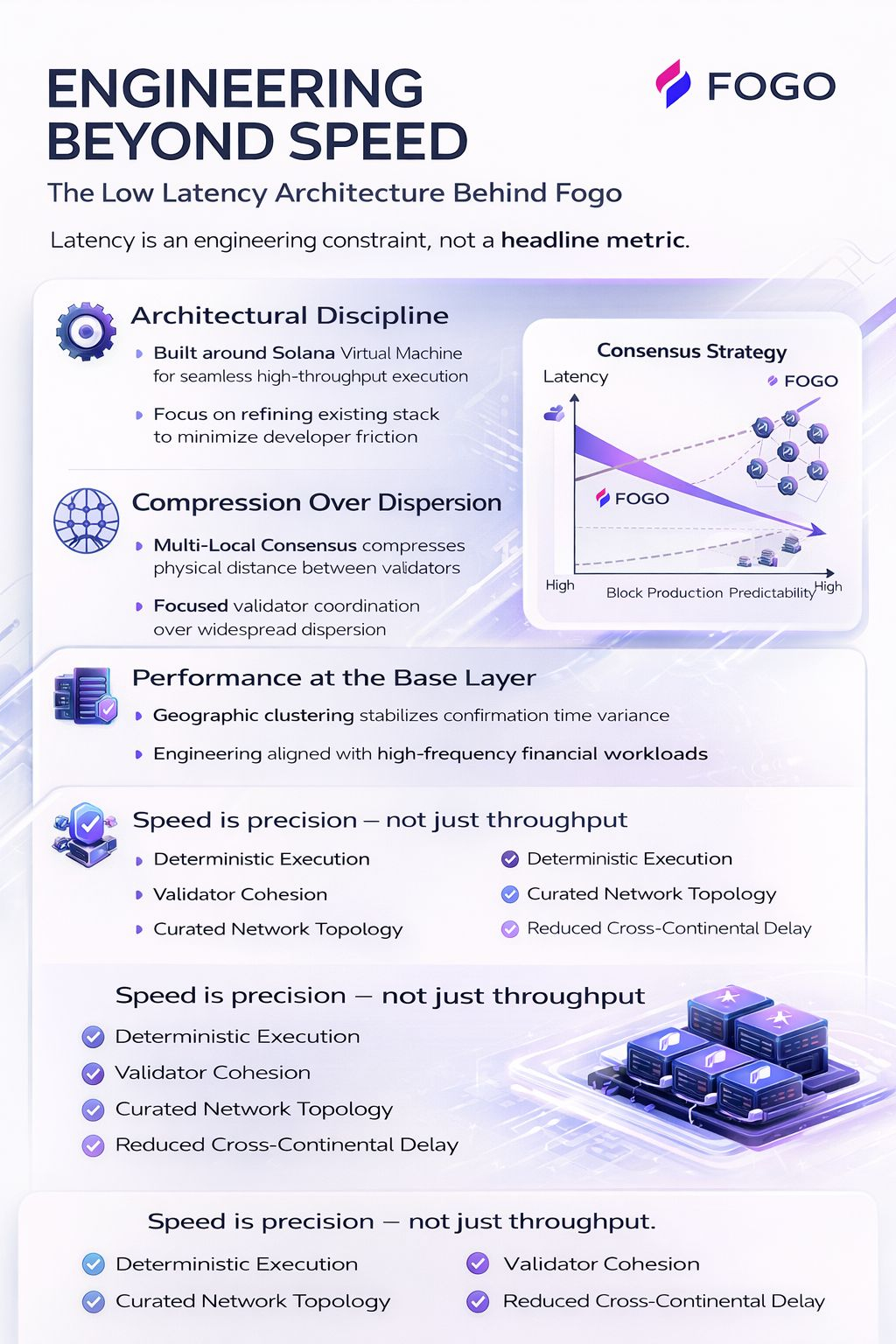
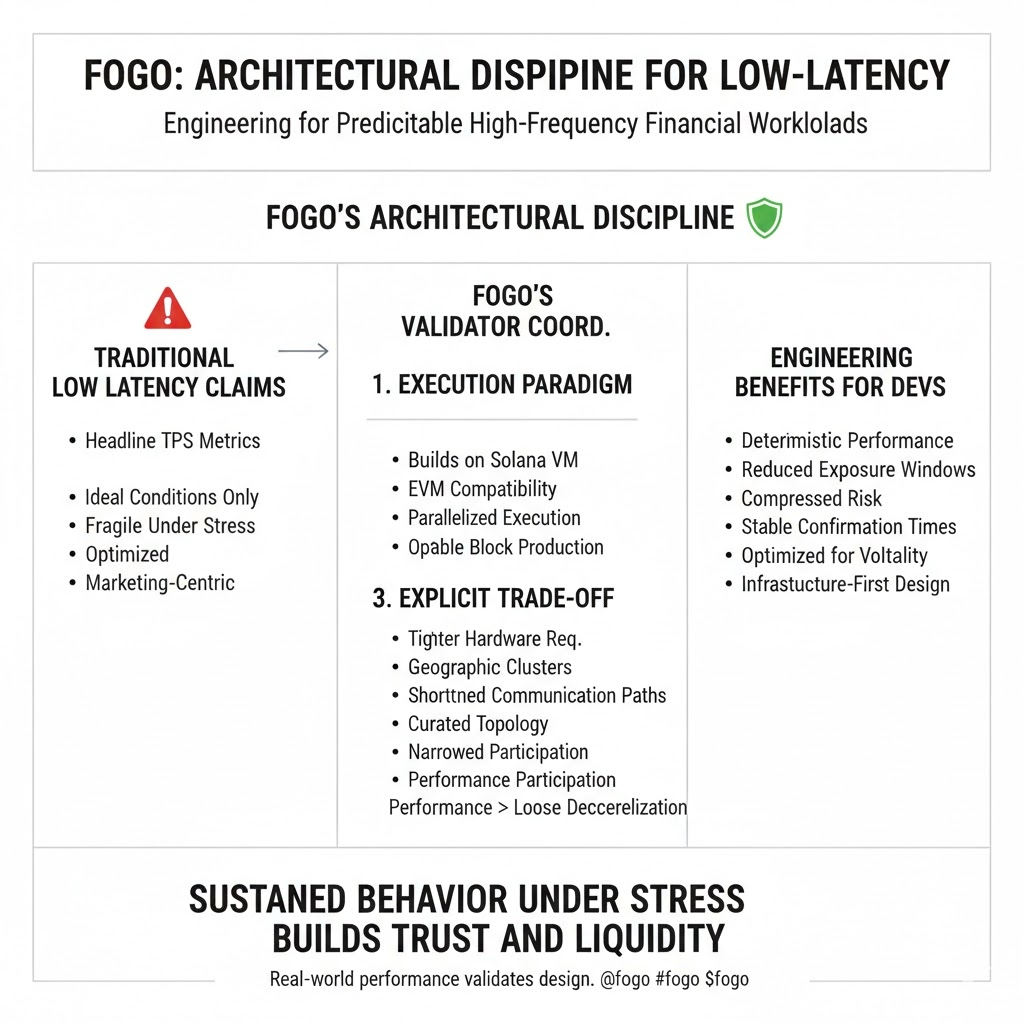
That is not a cosmetic improvement. It is a structural rebalancing of the classic blockchain triangle. Latency decreases because communication paths shorten. Determinism increases because fewer milliseconds are lost in cross-continental relay. But this also concentrates certain operational assumptions. Hardware requirements rise. Network topology becomes more curated. Participation may narrow to operators capable of meeting performance thresholds. The trade-off is explicit: performance predictability in exchange for looser decentralization margins.
From an engineering perspective, this is coherent. High frequency financial workloads do not tolerate variance well. A trading engine cares less about theoretical decentralization metrics and more about whether confirmation times remain stable when order flow spikes. In volatile environments, milliseconds matter not because they are impressive, but because they reduce exposure windows. A shorter interval between submission and confirmation compresses risk.
However, architecture cannot be evaluated in isolation from behavior. Many chains demonstrate impressive throughput under controlled traffic. The true audit occurs when demand is adversarial. Arbitrage bots probe latency edges. Liquidations cascade. Users flood RPC endpoints simultaneously. In these moments, micro inefficiencies amplify. The question for any low latency chain is not whether it can produce fast blocks in ideal conditions, but whether it can maintain deterministic performance under stress.
Fogo’s emphasis on validator performance and execution consistency suggests an awareness of this dynamic. Infrastructure first design implies that throughput is not an outcome of aggressive parameter tuning, but of careful coordination between client software, hardware baselines, and network topology. Yet that same tight coupling introduces systemic considerations. If the validator set becomes too homogeneous, correlated failures become more plausible. If a dominant client implementation underpins the majority of nodes, software risk concentrates.
There is also a liquidity dimension that pure engineering discussions often ignore. Low latency alone does not create deep markets. Liquidity emerges from trust, and trust accumulates through repeated demonstrations of resilience. If professional participants observe that block times remain stable during volatility, confidence builds gradually. If not, reputational damage compounds quickly. Financial infrastructure is judged not by its average case, but by its worst case behavior.
Compared with chains experimenting with modular rollups or parallel EVM variants, Fogo’s approach feels less exploratory and more surgical. It is not trying to generalize every possible use case. It appears to narrow its scope around performance sensitive environments. That specialization is strategically sound in a crowded landscape. Competing broadly against entrenched ecosystems is unrealistic. Competing on execution precision creates a differentiated battlefield.
Still, specialization raises the bar. When a network markets itself around low latency, every disruption becomes a narrative event. Market cycles are unforgiving in this regard. During expansion phases, performance claims attract attention and capital. During contraction phases, liquidity consolidates around systems perceived as durable. Infrastructure reveals its character when volatility intensifies.
I find myself less concerned with throughput ceilings and more focused on behavioral telemetry. Are developers building applications that genuinely leverage deterministic execution? Are validators operating across diverse environments while maintaining performance? Does network behavior remain stable as transaction density increases? These signals matter more than promotional dashboards.
Low latency architecture is ultimately about compression: compressing time, compressing uncertainty, compressing the gap between action and settlement. Fogo’s engineering choices suggest a deliberate attempt to control those variables at the base layer rather than layering optimizations on top of slower foundations. That coherence is notable.
Whether it translates into lasting ecosystem gravity remains uncertain. Architecture can enable speed, but it cannot guarantee adoption. The durability of any low latency blockchain will depend not only on its engineering, but on how it behaves when the market ceases to be forgiving. In that sense, the real measure of Fogo’s design will not be its block time in isolation, but its composure when real liquidity tests the limits of its infrastructure.