


Fogo is not trying to “replace Solana”; it’s trying to solve a narrower, more extreme version of the speed and fairness problem that still exists for serious trading firms even on Solana.
1. Latency ceiling for HFT‑grade trading
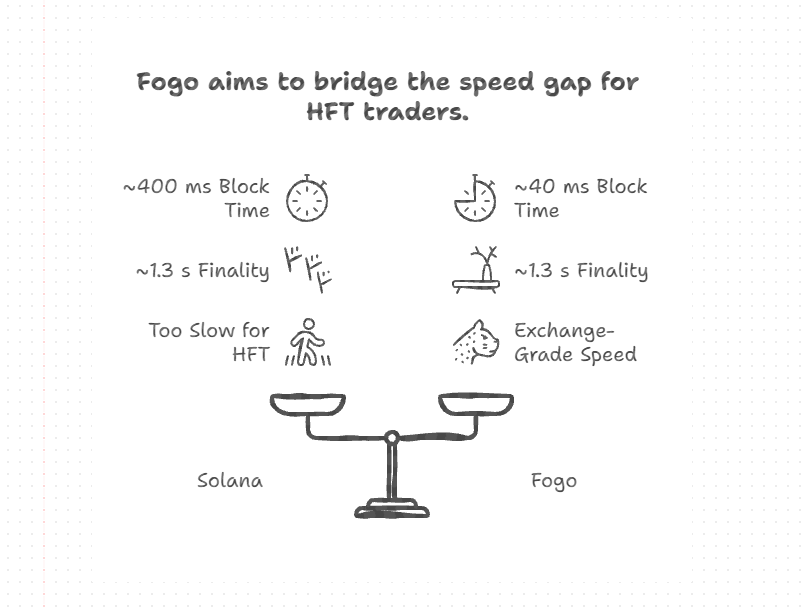
Solana is fast, but for high‑frequency traders, a few hundred milliseconds is still a long time.
Solana’s typical block times are around ~400 ms; Fogo designs for ~40 ms blocks and ~1.3 s finality by running a pure Firedancer client and tuning the whole network around it.
Fogo’s own positioning: “96% of high‑frequency traders say Solana is too slow to meet their needs… allow us to introduce Fogo.”
So the exact problem: for true HFT and institutional desks, Solana is still not “exchange‑grade” fast; Fogo is built to push that limit down another order of magnitude.
2. Consistency and locality, not just raw TPS
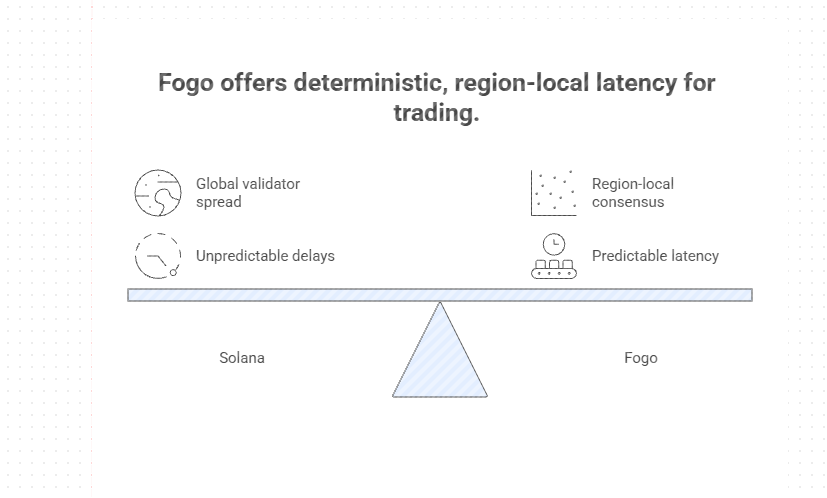
Even when Solana is fast on average, it’s global and noisy: validators are all over the world, apps are heterogeneous, and congestion events still create unpredictable delays.
Fogo tries to fix that for trading:
Multi‑local consensus / validator zones: Validators are curated into zones near major liquidity centers (e.g., Tokyo), so order flow and block production happen in the same data centers, not across the entire globe.
This makes latency not only lower but more predictable, which is what market makers and HFTs care about; variable 200–800 ms on a global network is materially worse than a tightly ranged 20–40 ms in one region.
Problem statement: Solana’s global validator spread and general‑purpose workload mean you still see jitter and congestion; Fogo is solving for deterministic, region‑local latency for trading.
3. Fairness around stale quotes and priority fees
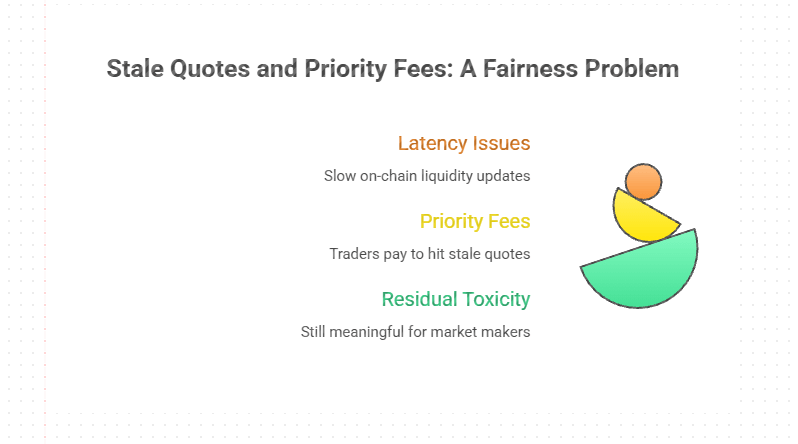
In volatile markets, a CEX like Binance moves first; on‑chain liquidity updates later. On a slower or more jittery chain, opportunistic traders can pay priority fees to hit stale LP quotes before market makers can update, which is effectively a fairness and toxicity problem.
Interviews with Fogo contributors explicitly call out this issue: if the chain isn’t aware of price changes in near real time, “people can pay a higher priority fee… to hit that stale liquidity,” hurting market makers and making LP returns worse.
Fogo’s solution is to cut latency so much (and coordinate validators so tightly) that the window in which stale quotes can be abused gets dramatically smaller, improving execution quality and LP PnL for on‑chain order books.
Problem: Solana reduced this issue vs older chains but didn’t eliminate it; for serious market makers, that residual toxicity is still meaningful. Fogo is designed to compress that arbitrage window further.
4. End‑to‑end stack for trading, not a general L1
Solana is a general‑purpose high‑throughput L1; Fogo is explicitly “a trading chain.”
Fogo bakes trading assumptions into its design:
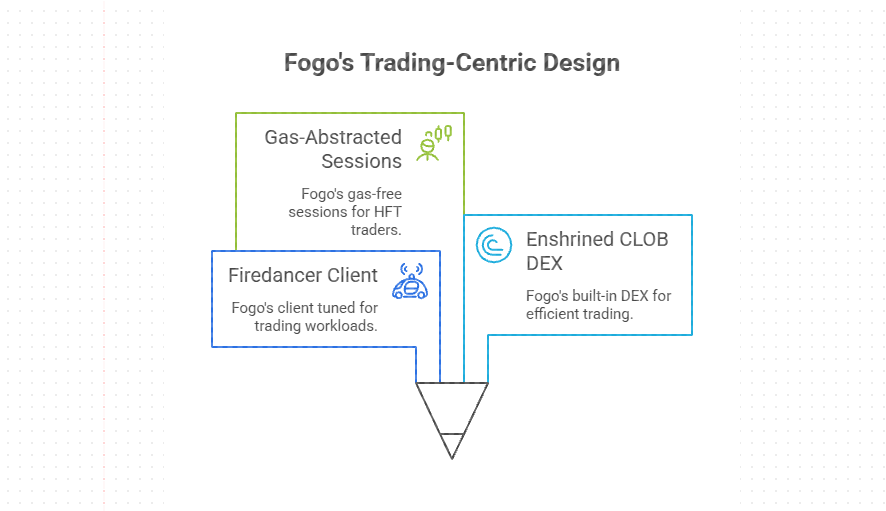
Pure Firedancer client from day one, tuned purely for trading workloads.
Enshrined CLOB DEX (Valiant) and batch‑auction primitives at the protocol/official‑stack level, rather than leaving execution architecture entirely to third‑party apps.
Gas‑abstracted sessions and SVM‑native UX so traders don’t manage gas or signer prompts at HFT speeds.
So the precise problem: on Solana, you can build great trading apps, but the protocol is still neutral and general‑purpose; Fogo is solving for a chain where every layer, from client to consensus to DEX, is optimized for trading specifically.
5. TL;DR in one sentence
Solana proved you can have fast, general‑purpose smart contracts; Fogo exists because for HFT‑style, institutional‑grade, fairness‑sensitive trading, “Solana‑fast” is still not enough, so they built an SVM chain that trades off some decentralization and generality to chase CEX‑level latency and determinism.
