
We’ve all been there: You open your charts, see massive red or green candles swinging wildly, and feel that surge of FOMO (Fear Of Missing Out) or pure panic.
Volatility is simply the market’s way of saying it’s searching for a new price. For the unprepared, it’s a trap. For the educated trader, it’s a discount or a breakout. Here is the exact blueprint I’m using to navigate the current market turbulence without losing my cool or my capital.
The Strategy (The "Wait for the Dust to Settle")
In a volatile week, the most dangerous move is "chasing." If you buy because a price is pumping, you are usually the "exit liquidity" for pro traders.
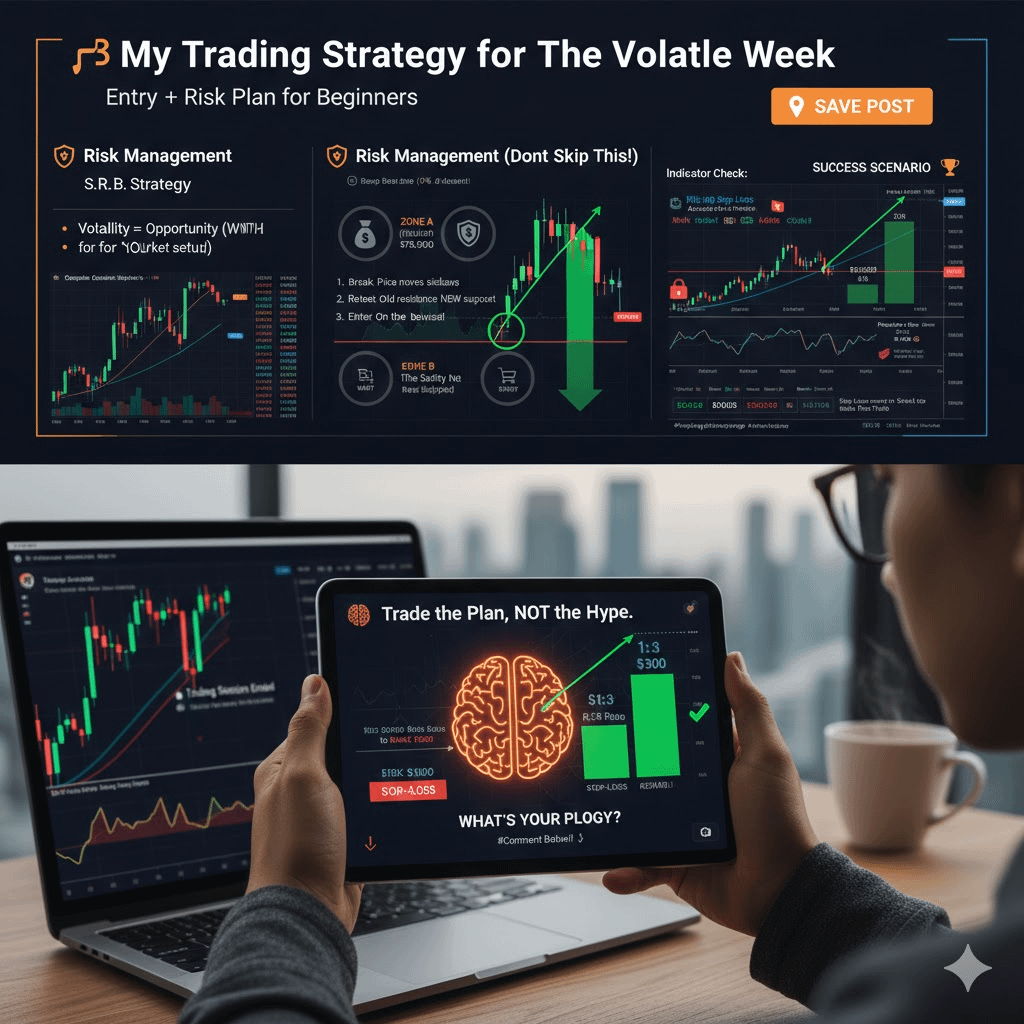
I use the S.R.B. Strategy (Support, Resistance, Breakout).
The Logic: Instead of guessing where the top or bottom is, I let the market prove its intent. I look for "Consolidation Zones"—areas where the price moves sideways, building up energy like a coiled spring.
The Trigger: I look for a candle to close decisively outside that zone. If we are in a volatile downtrend, I’m looking for a "Trend Shift" where we stop making lower lows and start carving out a base.
Identifying Entry Zones (The "Sniper" Approach)
I never use "Market Orders" during high volatility because "Slippage" (the difference between the price you want and the price you get) can eat your profits instantly. Instead, I set Limit Orders in two specific zones:
1. The Retest Zone (The Conservative Entry)
When price breaks a major resistance level, it often returns to "kiss" that level before moving higher.
Entry: Place your buy order exactly at the old resistance line.
Why: This confirms that the "roof" has now become a "floor."
2. The Value Zone (The Contrarian Entry)
If the market is crashing due to news, I look at the 200-Day Moving Average or major historical support from 3–6 months ago.
Entry: I look for a "wick" (a long line at the bottom of a candle) that touches this zone and bounces quickly. This shows that big buyers (institutions) are stepping in.
Professional Risk Management
This is the only part of trading you can actually control. If you master this, you can be "wrong" 50% of the time and still make a fortune.
The "Anti-Liquidation" Position Size: In volatile weeks, I cut my usual position size in half. If I normally trade with $1,000, I trade with $500.
Pro Tip: Smaller size allows you to have a wider Stop-Loss. This prevents you from being kicked out of a good trade by a temporary "fake-out" spike.
The Hard Stop-Loss: Never trade without a programmed Stop-Loss. In a fast market, you cannot rely on "mental stops." If the price hits your invalidation point, you must exit. Period.
Risk-to-Reward Ratio ($R:R$): I aim for a $1:3$ ratio this week.
Risk: $100$ (Where my Stop-Loss is).
Reward: $300$ (Where my Take-Profit is).
The Math: This means I only need to be right 33% of the time to break even.
Expected Outcomes & Psychology
There are only four outcomes to any trade: a big win, a small win, a small loss, or a big loss. Our goal is to eliminate the "Big Loss."
The Success Scenario: Price hits my Entry Zone, bounces, and moves toward my target. Once I am up 1:1, I move my Stop-Loss to "Break Even" so the trade becomes "risk-free."
The Stop-Out Scenario: The market moves against me. My Stop-Loss triggers. I shut my laptop and walk away for two hours. Psychology is key: A loss is just the "cost of doing business," like a restaurant paying for electricity.

💡 Final Thought for Beginners
The market will always be there tomorrow. The only way you fail is if you run out of money today. Trade the plan, not the hype.
Which part of this strategy feels the most challenging for you finding the entry or sticking to the stop-loss? Let’s break it down in the comments! 👇