

When I look at ultra-fast block timing on Fogo, I notice that the most important change is not just raw speed, but how transaction timing becomes measurably more predictable in real trading conditions. Fogo’s sub-40ms block production creates a rhythm of execution that alters how transactions queue, compete, and settle. Instead of focusing on peak throughput numbers, the more interesting effect is how this rapid cadence stabilizes real-time trading behavior.
At a mechanical level, block production defines how often the network packages pending transactions into executable batches. When blocks are produced slowly, transactions accumulate in larger queues, and their inclusion becomes sensitive to bursts of activity. This leads to uneven confirmation timing, where users experience occasional spikes in delay. Fogo’s ultra-fast block cadence shortens this accumulation window. Transactions do not have to wait so long in queues, as the network processes them in a lot smaller, more frequent 'slices'.
The observable effect is a smoother timing profile. With sub-40ms blocks, the difference between sending a transaction slightly earlier or later becomes less dramatic. Each new block acts as a rapid checkpoint that absorbs pending activity before queues can grow unstable. In practice, this reduces timing variance. Traders and applications interacting with the network experience confirmations that cluster tightly around expected intervals rather than fluctuating widely during busy periods. This tighter timing distribution is observable as reduced latency spikes during burst activity.
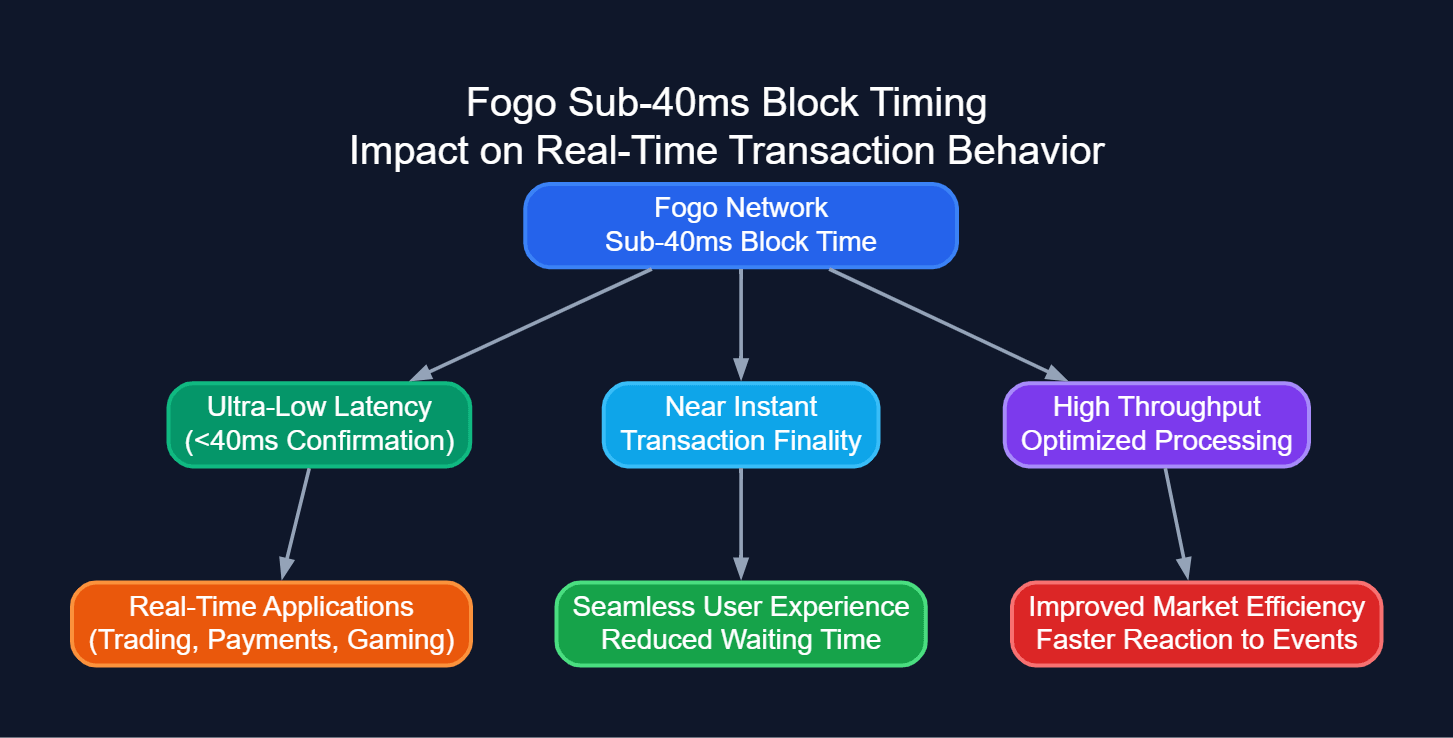
This behavior becomes especially important during bursts of trading activity. In many networks, sudden demand causes queues to expand faster than blocks can clear them. The result is a feedback loop where longer queues intensify competition for inclusion and destabilize confirmation timing. On Fogo, the fast block rhythm interrupts this loop. Because the system clears pending transactions more frequently, bursts are distributed across many small blocks instead of a few congested ones. On Fogo, this rapid block cadence keeps transaction backlogs shallow even during trading bursts. The effect is not the elimination of competition, but the moderation of its impact on timing.
Another consequence of ultra-fast blocks is how they influence transaction ordering perception. When blocks are infrequent, multiple transactions compete within a single large batch, and minor network delays can significantly affect their relative positions. With rapid block production, ordering decisions occur more often and in smaller groups. This reduces the window in which timing differences can accumulate. From a behavioral perspective, users observe more consistent execution sequences, which is particularly valuable for strategies that depend on tight timing assumptions.
There is also a subtle interaction between block cadence and confirmation confidence. Faster blocks do not automatically mean instant finality, but they provide a denser stream of intermediate confirmations. Each block adds incremental assurance that a transaction is progressing toward settlement. For users, this is experienced as a steady progression rather than extended periods of uncertainty that are suddenly confirmed. The network seems quicker because it shows progress at smaller time intervals.
From an application standpoint, ultra-fast block timing simplifies how developers model transaction behavior. When confirmation intervals are short and consistent, applications can rely on tighter assumptions about execution windows. This reduces the need for defensive timing buffers that compensate for unpredictable delays. In real usage, this translates into interfaces and trading systems that react more fluidly to on-chain events, because the underlying timing signal is stable.
An important insight here is that ultra-fast blocks primarily improve timing consistency, not just raw speed. Peak performance metrics often highlight how many transactions a network can process per second, but users interact with the distribution of delays, not the average. Fogo’s rapid cadence compresses that distribution. Transactions are less likely to experience extreme outliers in waiting time, which is a critical property for real-time financial activity where predictability matters as much as throughput.
Observing the network under load reinforces this point. When activity increases, the frequent block cycle continues to partition demand into manageable increments. Instead of allowing latency to escalate in large steps, the system adjusts in finer gradients. Users perceive this as graceful degradation rather than abrupt congestion. Execution slows, if at all, in a controlled and measurable way.
In practical terms, sub-40ms block production changes how participants reason about time on the network. Transactions move through a tightly spaced sequence of execution opportunities, queues remain shallow, and confirmation timing clusters around stable expectations. The result is an environment where real-time interactions feel continuous rather than episodic. For latency-sensitive trading workflows, this consistency transforms block speed into a predictable execution environment rather than just a theoretical performance metric.
