


I frequently contemplate the nature of adoption and the ways it can occur organically, without any deliberate intervention. A person appears to be overlooking block times or throughput information. Individuals seek to engage in typical activities such as entering a gaming environment, creating a profile, claiming items, purchasing skins, or participating in brand experiences that are already being discussed among their peers. The individual is not interested in acquiring knowledge about Web3. Users anticipate that the product will function similarly to their preferred applications, featuring a straightforward sign-up process, a reliable recovery method, and a payment system that aligns with common online purchasing practices. Viewing Vanar in this manner transforms its perception from merely a chain participating in a benchmark race to a project that is dedicated to addressing the genuine adoption challenges that many prefer to overlook: prioritising confidence, simplicity, and consistent usage over speed.
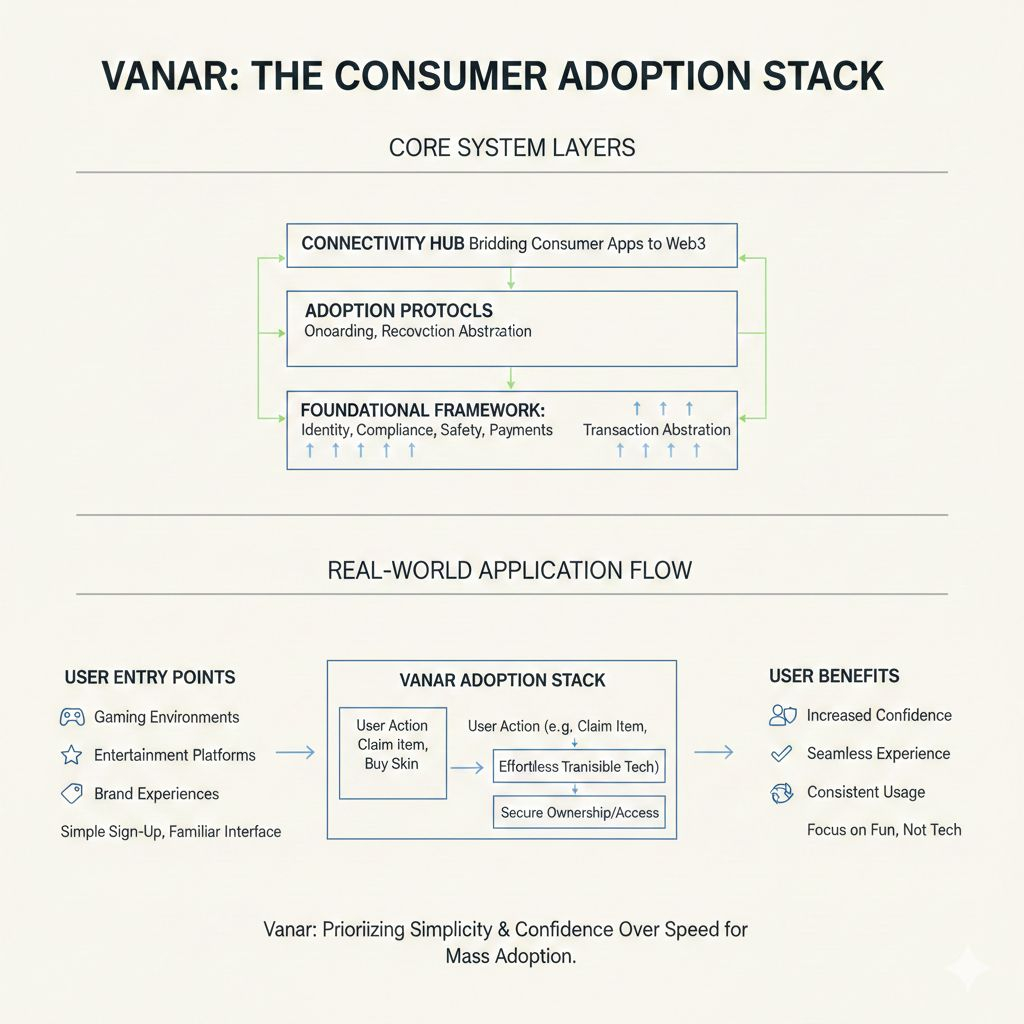
Vanar's primary advantage lies in its perception as a comprehensive adoption stack rather than merely a singular technical layer. The project consistently revisits areas where consumers engage, such as gaming, entertainment, and brand experiences. In these environments, any form of friction is immediately detrimental, leading individuals to depart at the first sign of confusion. In that context, it is not advisable to instruct individuals to remain; rather, the focus should be on enhancing the experience to such an extent that the underlying technology goes unnoticed. Vanar's plan is logical as it aims to prevent the perception of merely functioning as a series of transactions. Rather, it aims to establish itself as a fundamental framework for consumer-grade products that require systems for onboarding, safety, payments, identity, and compliance to operate efficiently on a large scale.
The onboarding process represents the initial phase in the decision-making journey. I am referring to "onboarding" not in the context of cryptocurrency, where individuals may celebrate acquiring a wallet; rather, I mean it in the traditional consumer sense, where the initial experience can either engage someone with the product or deter them permanently. Vanar's adoption thesis is logical when considering a new user transitioning from a familiar environment, where they anticipate an app-like login, a seamless entry process, and a guided experience that allows them to engage without needing to take control until they have sufficient knowledge. For Vanar to engage the next generation of gamers and the general public in gaming environments, the onboarding process should resemble the user-friendly entry point of a contemporary application rather than a formal procedure that requires users to adopt banking-like behaviours immediately. The mental burden hinders curiosity from developing into a consistent practice.
Following the onboarding process, the primary focus is on recovery and safety. This is a crucial aspect that subtly influences whether a user will regard it with seriousness. Individuals are concerned about the potential loss of financial resources and the possibility of losing access. The primary factor that contributes to regular users feeling as though they are engaged in a high-stakes environment is the apprehension of losing access. Individuals frequently misplace their phones, reset their devices, forget their passwords, and encounter errors. If the recovery narrative lacks strength, the user may perceive the entire system as a delicate experiment rather than a reliable environment for enduring comfort. Vanar's approach appears to emphasise alleviating the anxiety associated with seed phrases by designing experiences that inherently incorporate safety rather than depending on cautionary measures. This holds significant relevance for consumer-grade products, as users are unlikely to maintain loyalty to an ecosystem that may lead to permanent access issues following a single negative experience.
Payments represent the transition of adoption from a theoretical concept to a tangible reality. A transaction differs from a purchase, and the majority of individuals do not prefer "onchain." They seek to purchase, utilise, and progress without the perception of engaging in a risky endeavour. Payment-ready design encompasses more than merely the associated fees. The objective is to ensure that the entire checkout process is seamless and reliable, providing clear information regarding the actions taken upon clicking "confirm," minimising friction, and delivering an experience that aligns more closely with contemporary digital commerce rather than a technical procedure. Vanar's adoption stack framing is significant as it illustrates that consumer ecosystems inevitably evolve into commerce. This encompasses digital goods, memberships, access to events, in-game economies, and branded experiences, all of which require straightforward purchasing methods. Long-term users will not be retained if the processes are not clear or consistent; rather, only short-term visitors will be attracted.
Identity and reputation may initially appear abstract; however, they serve as the foundational elements of every successful consumer platform. The necessity arises from the requirement for gaming worlds, marketplaces, and brand ecosystems to consistently identify users, monitor their activities and achievements, and foster trust while ensuring that the user experience remains seamless and unobtrusive. A wallet address does not constitute a complete consumer identity. A comprehensive consumer identity encompasses elements such as continuity, progression, reputation, and regulations that safeguard the ecosystem from misuse, while simultaneously allowing ordinary users to engage freely and comfortably. Vanar's approach to adoption addresses this requirement, as consumer-grade products struggle in environments where individuals remain anonymous or where identity systems instill fear. The objective is to develop identity and reputation components that are user-friendly, function effectively, and integrate seamlessly with the overall product experience. This holds particular significance in gaming and entertainment environments, where trust and fairness are essential for maintaining the well-being of communities.
Numerous narratives surrounding cryptocurrency often overlook the compliance-oriented aspect, yet this element is crucial for ensuring the stability of major brands and consumer goods over time. A brand must strategically plan and execute a campaign with precision rather than relying on mere optimism. It requires well-defined operations, uniform policies, effective risk management, and the capacity for growth without the concern that a minor issue may escalate into a significant public relations challenge. Incorporating compliance at a later stage can complicate matters and create a sense of discomfort among individuals involved. When compliance-ready frameworks are integrated into the stack effectively, they enhance product performance by reducing fraud, clarifying reporting, and instilling confidence in long-term partners, allowing them to concentrate on development rather than constantly scrutinising the foundational structure. In this context, Vanar's thesis holds significance as it aims to establish an infrastructure capable of withstanding real-world operational pressures without failure. A brief surge in popularity is distinctly different from a sustainable ecosystem that can facilitate long-term consumer engagement.
The culmination of these elements is found in the experience layer, where Vanar's emphasis on consumer verticals holds significant importance. The success of gaming and metaverse-style environments hinges on their ability to engage users while seamlessly integrating the underlying technology. They excel in allowing users to fully immerse themselves in the experience while simultaneously reaping the advantages of ownership, portability, and digital economies. A well-designed experience layer facilitates quick access to the platform, allows for natural interactions, instills confidence in purchasing, simplifies the return process, and enhances product enjoyment by minimising complications. Vanar's concept of an adoption stack is noteworthy as it illustrates that the chain transcends being merely a product requiring focus; it serves as an invisible engine that enhances the customer experience.
Mainstream technology operates on a fundamental principle: the most effective systems are those that users can navigate effortlessly, without the need for conscious thought. When I refer to Vanar as a "real-world adoption stack," I do not intend to imply that it is flawless. I am connecting the project to the factors contributing to the prolonged hesitance of consumers in adopting Web3. Individuals are increasingly disinterested in ownership and participation in digital economies. They aim to minimise friction, uncertainty, and the apprehension that a single misstep could compromise their experience.
Vanar presents a compelling vision of a future where onboarding is streamlined, recovery is attainable, payments are seamless, identity and reputation serve a meaningful role, compliance is systematic, and the product experience is sufficiently user-friendly for the average individual to appreciate without requiring specialised knowledge. This change distinguishes Vanar by transforming the narrative from "another L1" to "infrastructure for consumer-grade products." This presents a significant challenge; however, it holds the utmost importance. To encourage widespread adoption of a product, it is essential to ensure its functionality and to instill a sense of safety and confidence in users, promoting repeated usage. Genuine adoption is a practice, not merely a concept.

Vanar's thesis focuses on the minor details that often go overlooked by many chains. An optimal user experience is characterised by straightforward sign-up processes, smooth recovery options, transparent payment methods, gradual trust-building, and user retention driven by ease, safety, and value.
